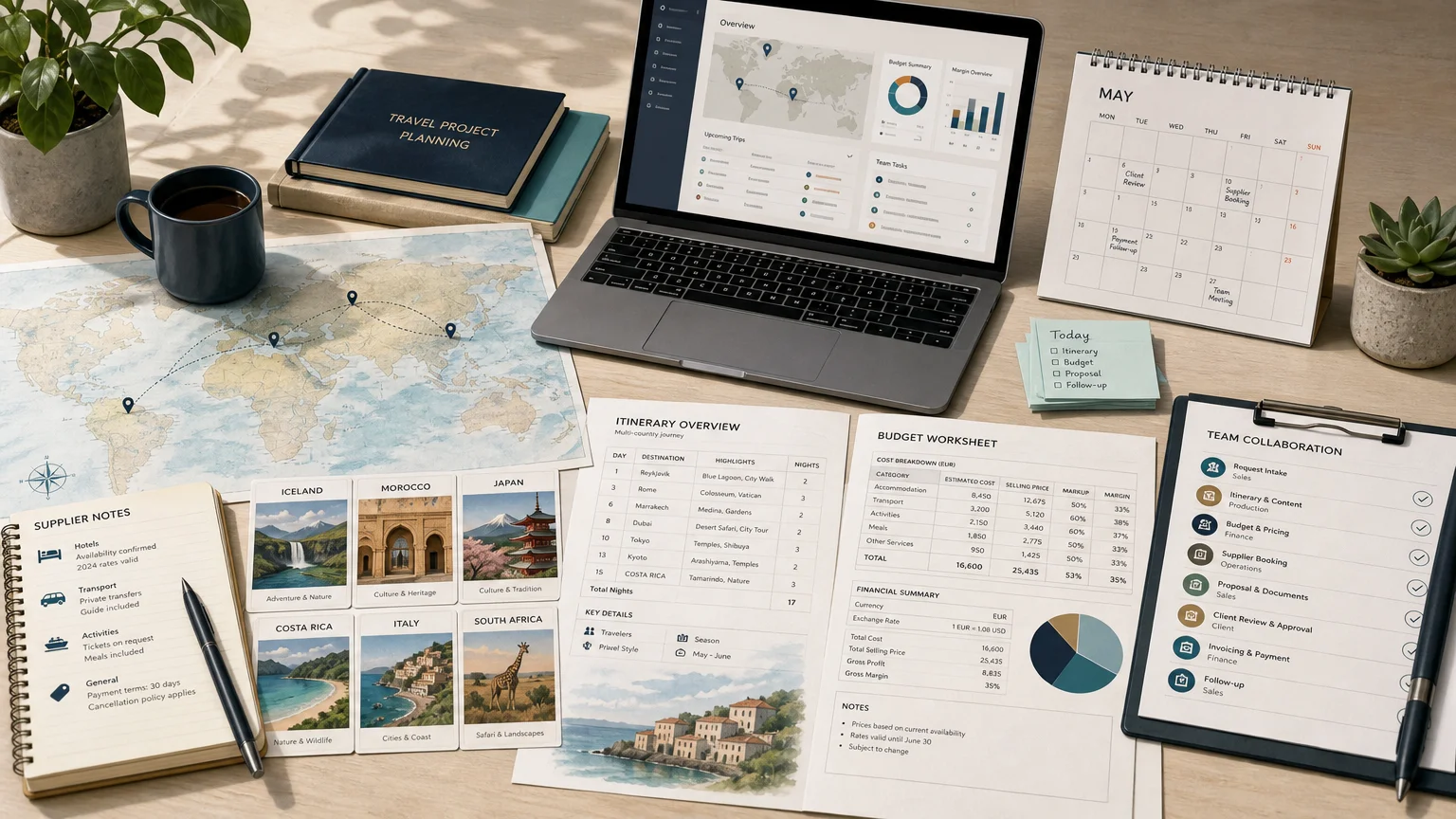
A pharma client sends a brief on Tuesday evening: 120 people, three days in Lisbon, a gala dinner, a team-building activity, and "two or three options" by Thursday. That is a normal week for a MICE agency, and exactly where AI for MICE agencies proves useful: it absorbs the text-heavy, check-heavy work around every seminar, incentive trip and corporate event.
Headcounts move until the last week, rooming lists come back with missing names, and the hotel wants a deposit before it confirms the room block. AI for event agencies will not run your event, but it saves hours at each step. For the wider picture, see our guide to AI for travel agencies.
In short
- AI turns messy corporate briefs into structured requests and drafts concepts and proposal texts.
- Pricing, margins and documents stay in your agency software: AI drafts and checks, your tool calculates.
- For participant lists, an AI connected to your software with each user's own rights beats a public chatbot.
- Start read-only, then allow changes only with confirmation.
Why AI for MICE agencies is gaining ground
According to the Amex GBT Meetings & Events Forecast, 50% of meetings and events professionals integrate AI throughout planning and execution. Top uses: connecting participants and sponsors (35%), creative themes (34%) and content (31%). The same forecast names costs as the top 2026 challenge, cited by 38%.
Adoption is uneven. A Soundings study of event planners found that half of event planning organizations use AI, mostly for content and marketing, while 41% see no immediate need for it in planning, and more than 75% want training. Across travel, Phocuswright reports that 61% of businesses surveyed are experimenting with or scaling agentic AI. Few have connected it to their operations yet.
From client brief to proposal in 24 hours
Corporate briefs rarely arrive clean: a forwarded email chain, a slide deck from HR, a phone note saying "80 people, maybe 100, somewhere sunny." The client still expects a proposal within 24-48 hours.
Structure the brief and list the missing questions
Paste the brief, stripped of personal data, into an AI assistant and ask for a structured request: dates, headcount range, departure cities, objectives, key moments, budget per person, constraints. Then ask: "List everything missing to quote a three-day incentive in Marrakech for 60 to 80 people, ranked by impact on price."
Draft concepts and proposal texts
AI can produce two or three concepts for one brief: a "desert and craftsmanship" incentive, a "rooftops and gastronomy" version, a workshop seminar in a riad. It then writes the introduction, the day-by-day descriptions and a pitch for each option, the creative work that 34% of planners already hand to AI.
What AI should not do is set the price: when it designs a program from scratch, its prices are suggestions, not your negotiated rates. Our guide to AI for tour operators applies the same rule to supplier rate sheets. Build the options in your itinerary builder, price them with your supplier contracts, and let your travel agency software produce the branded proposal. If the client sends last year's program as a Word or PDF file, the Ezus connector can turn it into a project with steps, services, prices and descriptions, ready for review.
Rooming lists, participants and last-minute changes
The participant list is the most fragile document in any MICE project. It changes ten times and must be right at the hotel, the airline, the transfer company and the restaurant. Local DMCs juggle the same lists, as our guide to AI for DMCs shows.
Clean and check every list
AI spots what tired eyes miss: duplicate names, mismatched spellings, twin rooms with three names, dietary needs written five ways. It can also group arrivals by flight time to plan transfers.
Better still, run the check inside your software instead of pasting the list into a public chatbot. With the Ezus connector, each project manager works with their own access rights and can ask: "Which travelers in the Lisbon seminar have no email or phone number?" or "Are there nights without accommodation in this program?"
Changing headcounts and multilingual messages
When 80 becomes 72, rooms, coaches and the price per person all move. AI can show what changed between two versions of a list, but the recalculation belongs in your budgeting tool, and prices by group-size tier are still handled in Ezus itself. AI also drafts welcome emails and practical information in several languages; keep a human check on times and meeting points.
Deposits, invoices and margins on every event
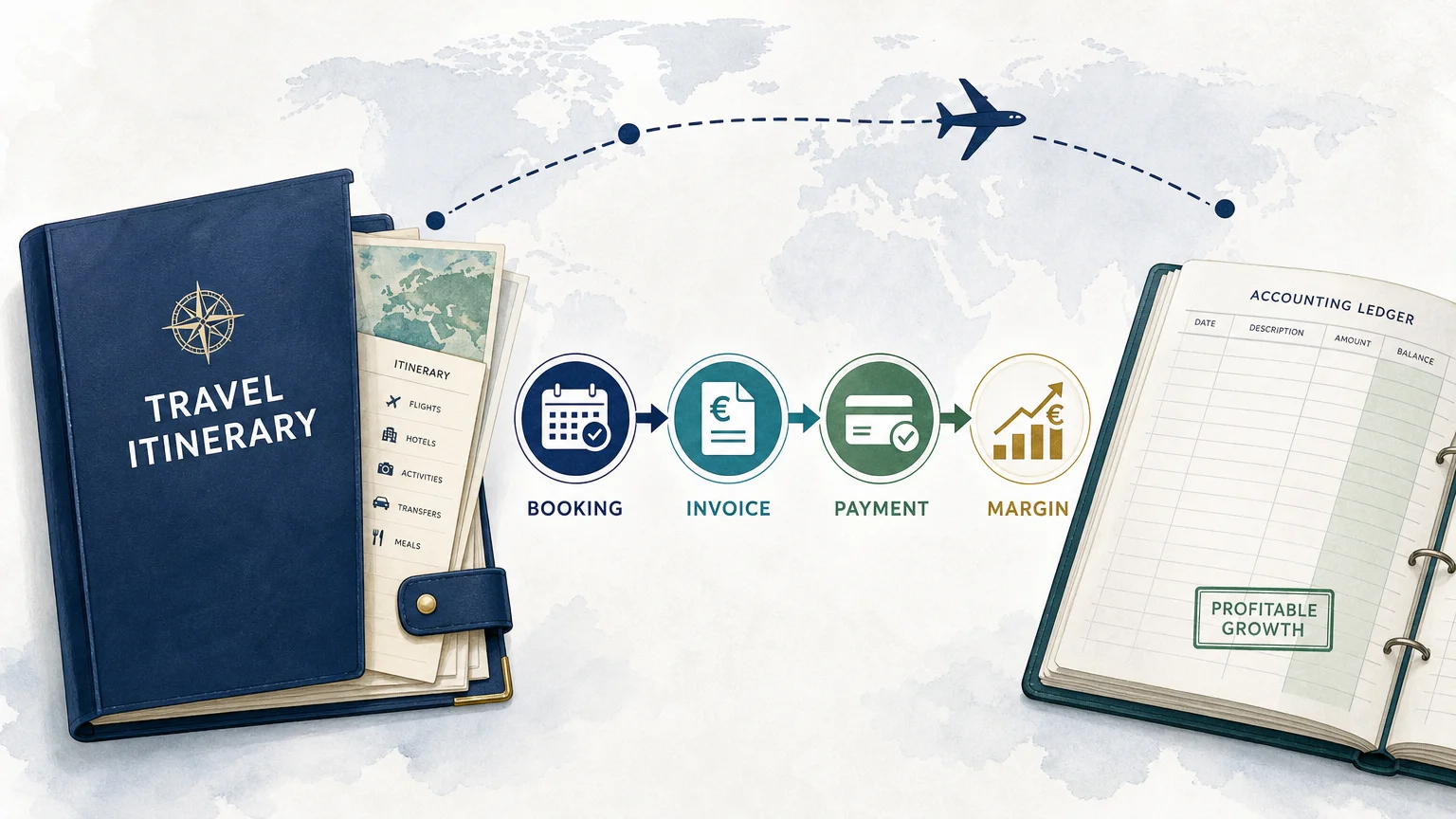
Hotels ask for deposits months ahead, venues want staged payments, and corporate clients pay on their own schedule. One late change to the coach plan can wipe out a margin. Connected to your agency data, AI answers in plain language:
- "Which events have overdue invoices?"
- "Record the client deposit received for the Marrakech incentive."
- "Show me the margin line by line on the Lisbon seminar before I send it."
The Ezus connector answers from your financial management data and, once write access is enabled, can record a client deposit or a supplier invoice. Clients then pay their installments through the payment portal.
Participant data: how to use AI without taking risks
MICE files hold names, phone numbers, passport details for some destinations, dietary and accessibility needs. Data protection is often the first question corporate clients ask. Four rules, the same guardrails you would set for an AI agent for your travel agency:
- Do not paste passport numbers, health information or full participant lists into a public chatbot.
- Start read-only: ask questions and run checks before allowing any change.
- Require confirmation before anything is saved.
- Keep data where it lives, in your agency software.
The Ezus MCP connector follows these principles. It is read-only by default, and write access is enabled for the agency on request. With Claude, planned changes are shown first and saved only after the user confirms. There is no delete tool. Each user connects with their own Ezus account and only sees what their rights allow, and data stays in Ezus, with no intermediate copy or sync. New to the protocol? Read what MCP means for travel agencies.
Put AI for MICE agencies to work on your next event
Pick one live event and use AI for three things: structuring the brief, checking the participant list, and reviewing the margin before the proposal goes out. Keep pricing and documents in your software, measure the time saved, then extend.
Ezus is used by more than 600 agencies in over 70 countries, including MICE teams, to price events in the budgeting tool, produce branded proposals and invoices with document automation, and share the final program in the traveller area. On the Premium plan, the Ezus MCP connector lets your team work on that same data from Claude, ChatGPT, Le Chat by Mistral or Grok.
Frequently Asked Questions
How can AI help MICE agencies?
AI helps MICE agencies structure client briefs, draft concepts and proposal texts, clean participant lists and write multilingual messages. Connected to agency software, it also answers questions such as which events have overdue invoices.
Can AI manage rooming lists?
AI can check and clean rooming lists: it flags duplicates, inconsistent spellings, rooms with the wrong number of guests and dietary needs written in different ways. A project manager still validates the list before it goes to the hotel.
Is it safe to use AI with participant data under GDPR?
It depends on the setup. Never paste participant lists, passport details or health information into a public chatbot. A connector that works inside your software, with each user's own rights and no copy of the data, is much safer.
Can AI write a seminar or incentive proposal?
AI writes a strong first draft of the concept, the program descriptions and the pitch for each option. The prices it suggests are not your negotiated rates, so build and price the options in your agency software first.
How does Ezus help MICE agencies use AI?
Ezus gives MICE teams a structured base: itinerary builder, budgeting tool, document automation, traveller area, payment portal and financial management. The Ezus MCP connector lets AI assistants read that data, check files before sending and, with write access, record a deposit or create a project from an existing itinerary.
What do I need to connect Ezus to an AI assistant?
You need the Ezus Premium plan and an MCP-compatible assistant such as Claude, ChatGPT, Le Chat by Mistral or Grok. Each user connects with their own Ezus account, access is read-only by default, and write access is enabled on request.

Join Ezus today
Request a demo today and discover how our software can help you reach new heights.