Could your team respond to more inquiries without rushing the personal work that earns client trust? Our AI guide for travel agencies explores how agencies can approach that balance. The practical aim is not to replace travel expertise. It is to reduce repetitive work so your team can spend more time advising clients, checking trip details, and building relationships.
In February 2026, Phocuswright reported that more than 60% of surveyed travel businesses were experimenting with or scaling agentic AI, while a smaller share had begun scaling it actively. That finding points to a gap between trying AI and embedding it in daily operations. For an agency, the useful question is where a supervised tool can improve a specific task without compromising accuracy or service.
Which travel-agency tasks should AI handle first?

Start with work that is repetitive, rules-based, and easy for a staff member to check. Common candidates include sorting inquiry details, drafting a first response, summarizing supplier information, and preparing a first version of itinerary copy. These tasks take time, but an employee can review the result before it affects a booking or client decision.
For example, an assistant could turn a new request into a structured brief with destination, travel dates, budget range, interests, and unresolved questions. A consultant then checks the summary and follows up on missing or conflicting details. This makes lead qualification more consistent without letting an automated system decide which clients deserve attention.
Choose a task with a clear starting point and a visible outcome. If your team spends time reformatting the same proposal or asking every prospect the same initial questions, measure that task before adding AI. A narrow pilot makes it easier to see what improved and where human correction remains necessary.
How can AI support client communication and lead qualification?
A new inquiry often needs a timely acknowledgement before a full consultation is possible. AI can draft a response, ask approved intake questions, or summarize earlier messages for the consultant. It should not invent availability, promise a price, or confirm services that have not been checked.
Set boundaries for the assistant in plain language. It can gather preferences and explain established information, then hand off requests involving exceptions, complex travel needs, complaints, or urgent changes. Keep a clear route to a person, and tell clients when a response is automated if the channel or context calls for it.
To plan those boundaries, see our article on AI agents for travel agencies. The central distinction is between a tool that drafts or organizes information and an agent permitted to take actions. Before granting an AI access to client records or communication channels, define its permitted actions, escalation rules, and approval requirements.
Where does AI fit in itinerary and proposal production?
Imagine a consultant receives a brief for a two-week, multi-country trip. AI can organize the traveler’s preferences, suggest a draft structure, and adapt descriptions to the requested tone. The consultant still needs to validate routing, supplier details, timing, inclusions, and pricing before sharing the proposal.
That review matters because fluent writing is not proof of correct information. A generated itinerary might overlook transfer time, seasonal availability, or an operational constraint. Treat AI-generated copy as a starting point, then compare each factual detail against current supplier and destination information.
Organized supplier data, product descriptions, and project history give staff a more reliable basis for drafting and review. Our platform centralizes travel production, client, supplier, and financial workflows, including itinerary design, pricing, proposals, and supplier booking management. It does not need to be described as an AI tool to help agencies organize the information their teams work with.
For the presentation stage, our article on AI and the travel customer experience examines how automation can fit around a more personal service. Keep proposals clear and client-ready, and give travelers a direct way to ask questions or request changes.
What should remain under human review?
Keep decisions that carry financial, operational, or duty-of-care consequences with an accountable employee. That includes confirming prices and availability, approving itinerary changes, interpreting unusual requests, resolving complaints, and responding to disruptions. AI can prepare a summary or suggest options, but your team should confirm the facts and make the decision.
A 2026 survey of more than 700 travel advisors in the United States and Canada found that 54% were comfortable using AI tools. The same survey found a strong preference for human support in relationship-based work. The 2026 advisor survey reinforces a practical approach: automate support work, while keeping expertise and accountability visible to the client.
Build human review into the workflow, not just into an informal final check. Decide who approves a quote, who handles exceptions, and what information must be verified before a proposal is sent. If AI changes a client record or sends a message, retain enough context for staff to understand what happened.
What data and systems make AI useful to an agency?
AI output depends on the information and permissions it can access. If supplier details, rates, client preferences, and itinerary versions are scattered across disconnected documents, the system may use incomplete or outdated material. A shared, maintained source of information helps staff review drafts and spot errors.
The OECD’s 2024 tourism report cited 2023 data showing that 11% of firms in the travel agency and tour operator sector used at least one AI technology. This is a dated baseline, not a measure of adoption in 2026. The OECD tourism report also discusses the sector’s use of AI alongside the importance of skills, data, and implementation.
Before connecting systems, decide which information an AI tool needs, which fields are sensitive, and who can access its outputs. Avoid placing passport numbers, payment details, or other sensitive client information into a tool unless your organization has reviewed its data handling and approved that use. Check vendor terms, retention settings, and access controls as part of procurement.
How should your agency implement AI and measure results?
A focused pilot is easier to govern than an agency-wide rollout. Select one workflow, document its current process, and agree on what success means before switching it on. For example, you could test whether AI-assisted inquiry summaries reduce preparation time while maintaining accurate briefs and appropriate client responses.
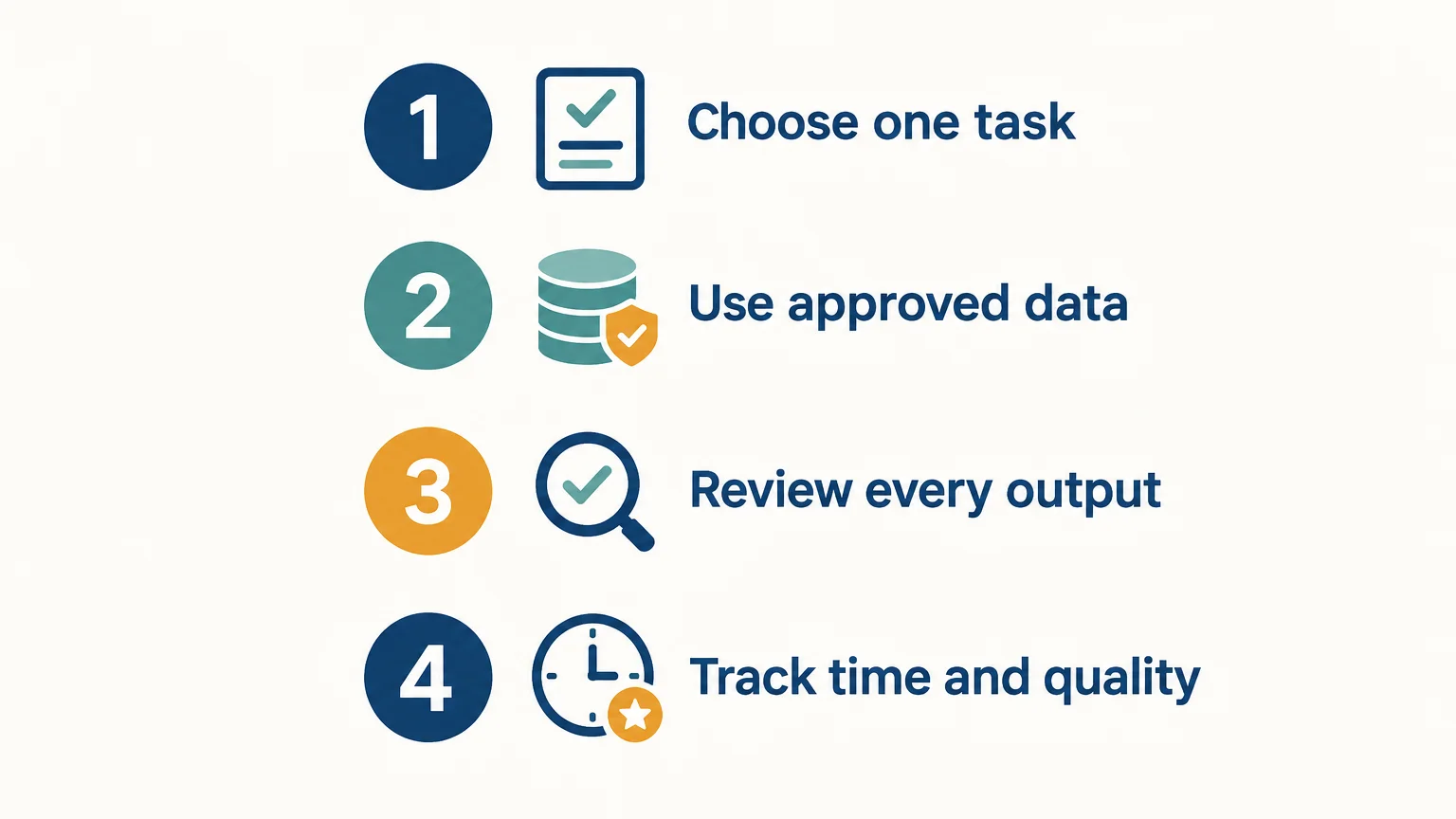
Track more than speed. Record staff editing time, correction rates, response quality, and client escalations. Also note whether the tool creates extra checking or handoff work. A faster first draft is not a genuine improvement if employees spend the saved time correcting unsupported claims or fixing inconsistent records.
Our AI playbook for travel agencies is an educational resource covering AI tactics for production, sales, and operations. It is not a separately priced software product. Use learning resources to help your team identify suitable tasks, then evaluate each proposed tool against your own workflow, data rules, and review capacity.
Once the pilot is stable, document the approved prompts or instructions, information sources, escalation path, and review owner. Train staff on when not to use the tool, and revisit the workflow when supplier data, service policies, or software permissions change. Expand only after the initial use case produces dependable results.
Make AI a controlled part of the workflow
The strongest starting point for AI for travel agencies is a repeatable task with clear inputs, a reviewable output, and a staff member responsible for the final decision. Keep client trust, pricing, supplier commitments, and disruption response under human control. Organize your information, test one use case, and expand only when measured results justify it.
Build a more connected travel workflow
AI is easier to put to work when your team can find the itinerary, supplier, client, and financial information needed to check its output. If scattered files and repeated manual steps slow your agency down, a centralized operations platform can give staff a clearer workflow from request intake through proposal and trip management.
Our cloud platform supports travel agencies, DMCs, tour operators, and MICE teams with itinerary production, budgeting, proposals, supplier management, invoicing, and financial tracking. More than 600 agencies use Ezus across over 70 countries, according to company figures. Explore our travel agency software and request a demonstration to assess its fit for your workflows.
Frequently Asked Questions
What can AI do for a travel agency?
AI can help organize inquiries, draft routine client messages, summarize supplier information, and prepare first-pass itinerary or proposal content. Staff should verify facts and approve client-facing decisions.
Can AI replace travel agents?
AI can support repetitive tasks, but it does not take responsibility for client relationships, complex judgment, or responding to disruptions. Keep a human available to review recommendations and handle exceptions.
How should an agency start using AI?
Choose one recurring task with clear inputs and an output staff can check. Test it with approved information, name a reviewer, and measure quality as well as time saved.
Is AI suitable for creating travel itineraries?
It can help structure a draft and adapt descriptions to a traveler’s preferences. Confirm routing, schedules, availability, supplier terms, and prices before presenting the itinerary as accurate.
How does Ezus support an agency using AI?
Our platform centralizes workflows such as itinerary production, proposals, supplier information, budgeting, and financial tracking. The AI Playbook is a separate educational resource, not an AI software feature.


Join Ezus today
Request a demo today and discover how our software can help you reach new heights.