



MICE (Meetings, Incentives, Conferences, Events) currently represents the most lucrative sector of business travel. With a global market valued at 924.53 billion USD in 2025 and projected to reach 1,347 billion USD by 2030, it accounts for a growing share of corporate budgets.
But behind these impressive figures lies a reality that is often underestimated: MICE is also the most complex segment to operate.
Multi-currency budgets, variable VAT, coordination of dozens of suppliers, high demands from corporate clients — a simple error in quoting or logistics can quickly impact a project's profitability.
Whether you are an event planner, travel manager, or a travel agency looking to diversify your offering, understanding MICE is no longer enough: you must know how to structure, manage, and industrialize it to take full advantage.
This guide gives you the keys to mastering MICE fundamentals, breaks down each of the four pillars in depth (with a particular focus on incentive travel, the highest-margin segment), explains the real opportunities, and helps you avoid the most frequent operational pitfalls.
%2520(3).png)
1. What does MICE stand for? The 4 pillars explained
MICE stands for Meetings, Incentives, Conferences, and Events. Each of the four pillars covers a distinct type of corporate gathering with its own logistics, budget structure, planning cycle, and target audience. Understanding them separately is essential because most agencies eventually specialize in one or two of them rather than covering all four at the same level of depth.
2. Meetings: corporate gatherings and seminars
Meetings include strategic seminars, internal training, board meetings, kick-offs, and management offsites. Typical duration: 1 to 3 days, with 10 to 200 participants. These events focus on decision-making, annual planning, training, and team alignment in venues such as business hotels, dedicated meeting centers, or congress halls.
The meetings segment is the most operationally predictable of the four MICE pillars. Volumes are recurring (most large companies organize a kick-off every January, a mid-year review in summer, and a strategy seminar in autumn), and budgets are well-defined. The competitive edge for agencies in this segment comes from venue sourcing speed, supplier reliability, and the ability to handle last-minute changes — corporate meeting planners regularly face cancellations, headcount changes, and shifting dates.
Average budget per meeting in 2026 ranges from $15,000 for a one-day off-site with 30 people to $150,000+ for a multi-day executive retreat with high-end accommodation. Margins are tighter than incentive travel (typically 8 to 15%) but volumes are higher and contracts are often multi-year framework agreements.
3. Incentive Travel: the most profitable MICE segment
Incentive travel is the most profitable and fastest-growing pillar of MICE. The global incentive market represented 53 billion USD in 2023 and is expected to double by 2030 with an annual growth rate of 12% to 16%. In the United States alone, 46% of companies use incentive travel, representing 22.5 billion USD in annual spending.
Proven ROI: according to the Incentive Research Foundation, well-designed programs generate an ROI of 112% and increase productivity by 18%. Companies using experiential rewards record 3x more revenue growth.
What is incentive travel?
Incentive travel is a reward and motivation strategy that uses travel experiences instead of cash bonuses to recognize top performers, partners, or distributors. Unlike business travel, which is operational ("I need to be in Madrid on Tuesday for a meeting"), incentive travel is strategic ("how do we reward our top 50 sales people in a way that creates lasting impact?"). The experience itself is the reward, designed to be memorable, exclusive, and tied to the company's brand and values.
Types of incentive travel programs
The audience of an incentive travel program determines its structure and budget. The four main types you will encounter:
- Employee incentive travel: the most common, used to reward top performers, sales teams, or entire departments hitting collective targets. Typical group size: 20 to 200 employees.
- Channel and dealer incentives: rewards for distributors, resellers, or franchisees who hit revenue or growth targets. Tend to be larger groups (100 to 500+) with mixed nationalities.
- Customer and partner incentives: high-touch trips for VIP clients, strategic partners, or top accounts. Smaller, more curated, often with longer planning cycles.
- Mixed corporate incentives: programs combining employees and partners in the same experience, common in B2B technology, pharmaceutical, and automotive industries.
How to choose an incentive travel agency or company
Picking the right incentive travel agency is the difference between an incentive program that delivers ROI and one that becomes an operational nightmare. The key criteria to evaluate:
- Destination expertise: incentive travel relies on exclusive access (rooftop dinners, private museum openings, behind-the-scenes experiences). Agencies with deep local supplier relationships consistently outperform generalists.
- Budget management capability: incentive programs involve multi-currency invoicing, complex VAT, gifts, room blocks, and per diems. The agency must demonstrate clear margin control and transparent reporting.
- Operational technology: the top incentive travel companies run dedicated software for participant management, on-site logistics, mobile event apps, and real-time financial dashboards rather than spreadsheets.
- Group size experience: handling 50 incentive winners is operationally different from handling 500. Ask for case studies in your target size range.
- Post-event analytics: the best agencies measure engagement, NPS, and ROI after every program and share the data with you. This is the difference between a vendor and a strategic partner.
Incentive travel planning: timeline and budget benchmarks
A well-run incentive travel program follows a 6 to 12 month planning cycle. Year 1 employee incentive programs typically run $4,000 to $8,000 per traveler all-in (flights, 4 to 5 nights of premium accommodation, group activities, evening events, gifts). High-end partner or channel incentives can exceed $12,000 to $20,000 per traveler when private aviation, ultra-luxury properties, or yacht-based experiences are involved.
Margins for the agency on incentive travel typically run 18 to 25%, significantly above standard corporate travel margins. This profitability explains why the most sophisticated travel agency software platforms have invested heavily in MICE and incentive-specific workflows.
4. Conferences: large-scale industry events
Conferences gather 100 to 10,000+ participants around industry topics, professional certifications, or product announcements. Format: keynotes, breakout sessions, exhibition halls, and networking in convention centers or congress halls. Duration: 2 to 5 days. Examples range from regional medical congresses to global tech summits like Salesforce Dreamforce or Mobile World Congress.
The conference segment has its own operational specificities: sponsorship sales, exhibitor management, abstract review processes for academic events, and complex registration systems with tiered pricing. Most travel agencies serving conferences work alongside dedicated PCOs (Professional Congress Organizers) and focus on the travel-and-accommodation portion: negotiating hotel blocks, managing transport, and producing branded travel documents for attendees.
Conference travel budgets are typically tracked per attendee ($800 to $2,500 per international participant including flights, hotels, and ground transport) and per sponsor ($5,000 to $50,000+ depending on package level).
5. Events: corporate events and product launches
The events category is the broadest of the four pillars. It includes product launches, brand activations, corporate galas, customer appreciation events, team buildings, anniversaries, and trade shows. Formats vary enormously depending on objectives and audiences, which is exactly why this segment requires the most creative production capabilities.
Two trends dominate corporate events in 2026:
- Experiential over transactional: companies increasingly invest in immersive brand experiences rather than traditional cocktail receptions. Product launches now look closer to concert productions than to standard meetings.
- Sustainability scoring: corporate procurement teams now request ISO 20121 certification, carbon offset reporting, and local sourcing documentation as standard parts of the RFP.
For agencies, the events pillar is where creative differentiation matters most. A standardized destination management approach does not win event work; original concepts, strong creative direction, and proven supplier networks do.
6. Business Travel vs Incentive Travel and MICE: understanding the difference
A common confusion exists between Business Travel (corporate travel) and MICE / incentive travel. The two segments follow fundamentally different logics.
Business Travel refers to individual, recurring professional trips: client meetings, training sessions, site visits. These trips are managed by TMCs (Travel Management Companies) like SAP Concur, Navan, or Egencia, with a focus on efficiency and cost control. Planning is short-term (days or weeks), and budgets are calculated per traveler.
MICE and incentive travel follow the opposite logic: group events with strategic purposes — motivational trips, seminars, conferences designed to create memorable collective experiences. Planning spans 3 to 12 months, involves dozens of suppliers, and requires specialized software capable of handling this complexity.
In short: business travel addresses an operational need ("I need to be in Paris on Tuesday for a meeting"), while MICE addresses a strategic objective ("how do we reward our top 50 sales people to boost their engagement?").
7. MICE economic impact and opportunities
Key figures of the global market:
- 2025 market: 924.53 billion USD, growing to 1,347 billion USD by 2030
- US market: 110.24 billion USD (7.8% annual growth)
- Asia-Pacific: 212.83 billion USD, projected to reach 328.97 billion USD by 2030
- Higher spending: business travelers spend 2x more per night than leisure tourists
These exceptional margins are explained by the organizational complexity and the added value provided by MICE professionals, which are far superior to traditional tourism.
Seasonality aligned with the corporate calendar
Unlike leisure tourism, which peaks during summer and school holidays, MICE follows the corporate rhythm. This inverse seasonality is a major advantage for agencies and destinations.
The MICE calendar:
- January-February: annual kick-offs, back-to-work seminars
- March-April: peak activity, industry conferences, pre-spring events
- May-June: incentive trips rewarding Q1 performance, team buildings
- July-August: slow period, companies avoid these months
- September-October: intense rebound with conventions, product launches, trade shows
- November-December: corporate galas, year-end events, budget consumption before fiscal close
This complementarity with leisure tourism allows venues to optimize occupancy rates year-round. MICE events primarily take place on weekdays (Tuesday-Thursday), while leisure tourists prefer weekends. For agencies, this also means better rates during off-peak seasons and easier access to premium venues.
8. MICE Trends 2026
- Hybrid events: 54% of organizers now use AI for venue sourcing (Source: Cvent 2025, via Mordor Intelligence). Hybrid formats (in-person plus virtual) expand the audience while reducing costs and carbon footprint.
- Mandatory sustainability: ISO 20121 certification, eco-friendly venues, local sourcing, and carbon offsetting have become essential selection criteria.
- Immersive technologies: VR/AR, AI for participant matchmaking, event apps, and video mapping are transforming the experience.
For agencies looking to develop their MICE business, mastering these new technologies and finding corporate clients is essential to capture this growing market.
Optimize your MICE management with specialized software
MICE organization requires simultaneous management of complex multi-currency budgets, the coordination of dozens of suppliers, and the tracking of hundreds of participants. Unlike corporate travel management tools designed for individual trips, an incentive software must meet the specific requirements of group events.
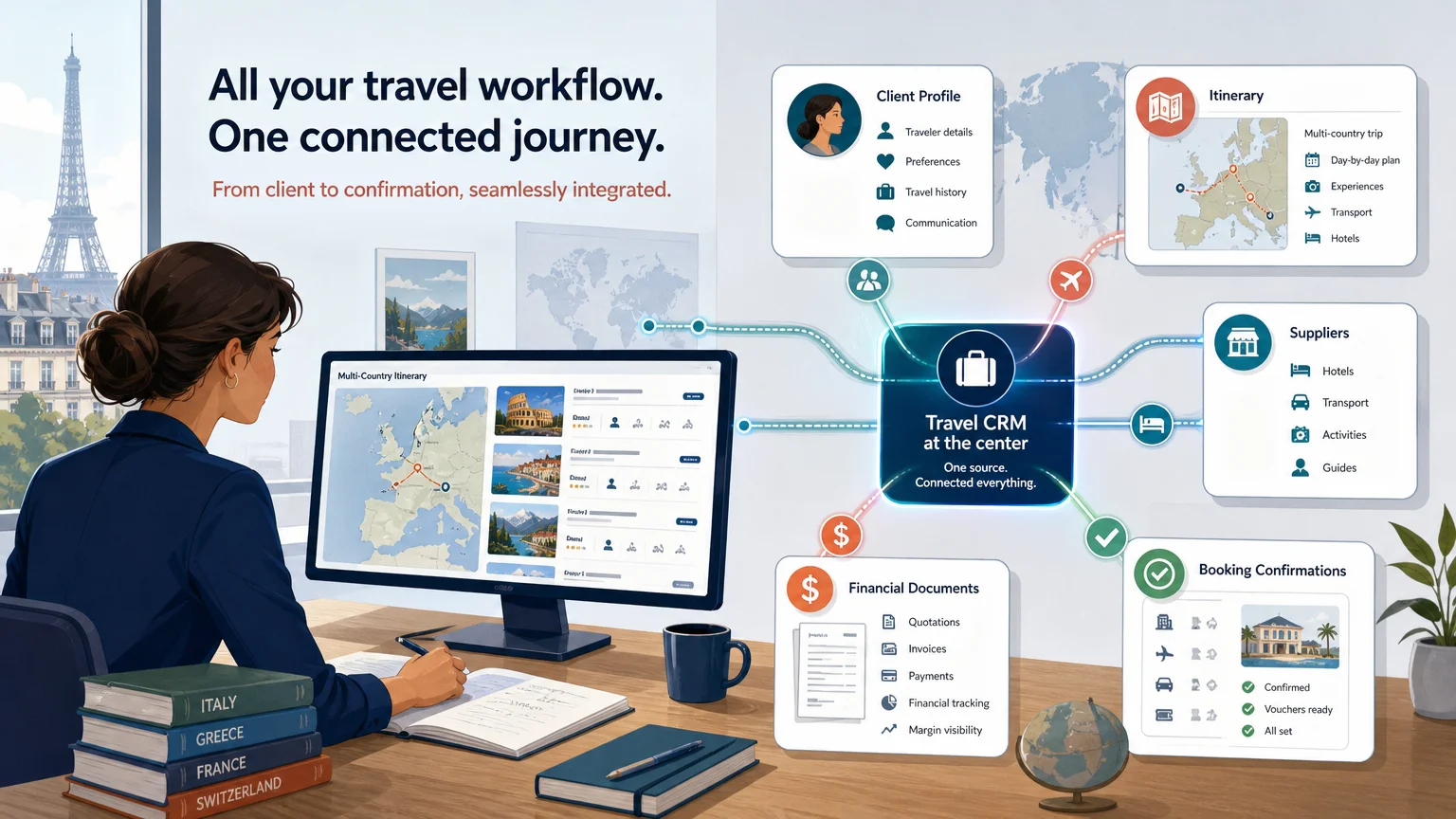
A specialized travel agency software like Ezus centralizes everything on a single platform: automated budgeting with VAT management, multi-participant tracking, supplier coordination, and professional document generation (quotes, detailed programs, purchase orders, vouchers). Real-time financial dashboards let you monitor the profitability of each event project.
Many DMCs and agencies specializing in incentive travel use Ezus to automate their complex MICE operations.
"The ease of generating quotes once the program is designed and the tracking of client and supplier payments are our favorite features. The scalable nature of the software is a major asset."
— Soline Larroque, Mycomm | Sports Events Agency (20,000+ travelers/year)
MICE: an opportunity to seize now
MICE represents a high-growth opportunity for travel professionals. With a market reaching 924 billion USD and the incentive segment projected to double by 2030, companies are investing more than ever in strategic events that deliver 112% ROI and boost productivity by 18%.
Whether you are launching a dedicated MICE agency, expanding your current offering with an incentive travel program, or repositioning as a premium corporate events specialist, success hinges on three pillars: specialized expertise, a reliable supplier network, and technology that streamlines operations.
The competitive edge comes from efficiency. Managing complex multi-supplier events, tracking budgets in real time, and producing professional quotes quickly are the operational challenges that define MICE success. That is why 600+ agencies across 75+ countries rely on Ezus to automate quoting, coordinate suppliers, and generate professional documents from a single platform.
Book a personalized demo today and discover how Ezus simplifies your MICE event management, from quote creation to on-site coordination.
FAQ — MICE Tourism and Incentive Travel
What is MICE tourism?
MICE tourism encompasses activities related to Meetings, Incentives, Conferences, and Events. It involves business travel organized around corporate meetings, incentive trips for top performers, industry conferences, and corporate events such as galas, product launches, and team buildings. MICE is generally considered the most profitable and fastest-growing segment of the global travel industry.
What is incentive travel?
Incentive travel is a reward and motivation program in which companies offer their top-performing employees, partners, or distributors a memorable group travel experience instead of cash bonuses. Programs typically combine 4 to 7 days of premium accommodation, group activities, and exclusive experiences in destinations such as Mediterranean coasts, Caribbean resorts, or major European cities. The Incentive Research Foundation reports that well-designed programs generate 112% ROI and 18% productivity gains.
What are the top incentive travel companies and agencies?
The leading incentive travel companies are typically specialized agencies and DMCs with deep local expertise rather than general business travel management companies. Selection criteria include destination relationships, multi-currency budget management, dedicated event software, group-size experience, and post-event analytics. Most large corporate buyers run a formal RFP process with three to five shortlisted incentive travel agencies before selecting a partner for a multi-year framework.
Why is MICE more profitable than leisure tourism?
Business travelers have larger budgets and expect high-value services. The complexity of MICE operations (multi-currency budgets, supplier coordination, participant management) allows specialized agencies to generate higher margins than leisure tourism, provided they master the operational aspects. Incentive travel specifically tends to deliver 18 to 25% agency margins versus 8 to 12% for standard leisure travel.
Is MICE reserved for large agencies?
No. Many mid-sized agencies and DMCs develop profitable MICE operations. The key is operational tooling rather than headcount. Solutions like Ezus let small and mid-sized agencies structure their MICE workflow, manage complex budgets, and produce professional documentation without scaling their back-office team proportionally.
What are the main operational challenges of MICE?
MICE involves managing complex multi-currency budgets, coordinating dozens of suppliers, tracking client and supplier payments, and producing accurate documents (quotes, programs, vouchers, invoices). This is precisely where dedicated travel agency software provides structure and visibility, replacing the spreadsheet-and-email workflow that breaks down past a certain project complexity.
Why use specialized software for MICE and incentive travel?
Dedicated software like Ezus centralizes budgeting, participant management, supplier coordination, and document generation in one platform, reducing errors and improving project profitability. The alternative — managing each function in a separate tool — creates data silos and manual re-entry, which compound into significant margin leakage on large MICE projects.


Join Ezus today
Request a demo today and discover how our software can help you reach new heights.
.jpg)



.avif)


.jpeg)


