
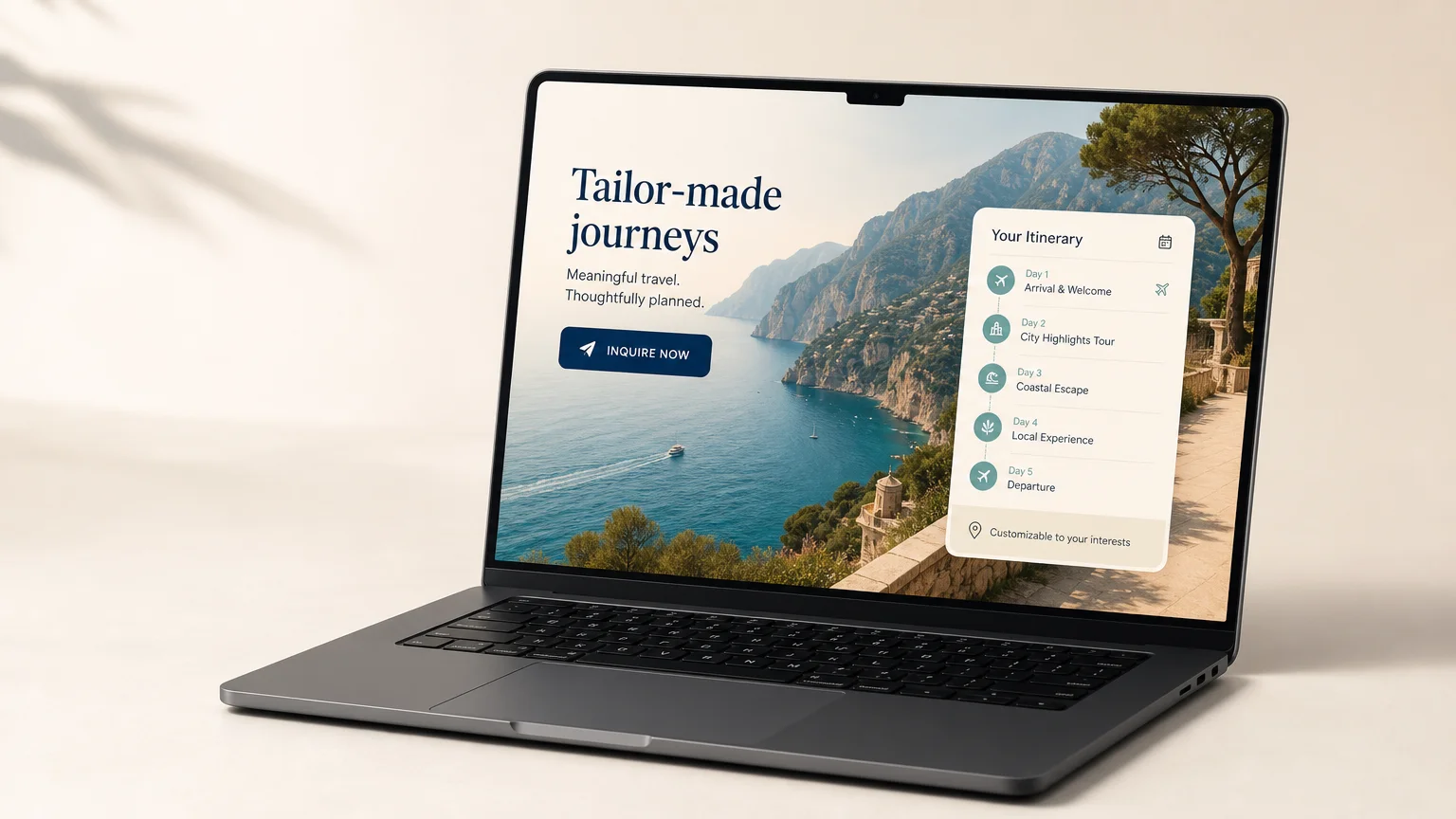
A travel agency website is no longer only an online brochure. It is often the first place a prospective client evaluates your expertise, your style, and the level of service they can expect. The most effective examples give visitors a clear reason to choose the agency and connect that promise to a simple next step. To strengthen that foundation, you can use our tips for creating a travel agency website.
Design quality matters, but it is only one part of the equation. The 2026 ACSI Travel Study reported that online travel agencies improved in several areas, including basic website functionality, while increasingly using artificial intelligence to enhance content and customer experiences. For an agency selling personalized travel, the strongest website must therefore combine inspiration, clarity, trust, and an efficient sales process.
What makes the best travel agency websites effective?
Start with the visitor’s first question: “Is this agency right for my trip?” A strong website answers it quickly through a focused value proposition. It explains who the agency serves, what type of travel it designs, and why its expertise matters.
A luxury travel specialist should communicate discretion, access, and personalization. A family travel agency should make planning feel reassuring and manageable. A destination management company should demonstrate local knowledge, logistical capability, and supplier coordination. A MICE agency should show that it can manage groups, schedules, budgets, and multiple stakeholders.
The strongest websites usually share several characteristics:
- A clear specialty visible within the first screen.
- High-quality destination photography that supports the positioning.
- Simple navigation for destinations, travel styles, and services.
- Detailed but readable explanations of the planning process.
- Visible calls to action, such as an inquiry form or consultation request.
- Testimonials, credentials, and examples that reduce perceived risk.
- Fast loading and consistent display across mobile devices.
These elements work together. A visually attractive homepage may generate attention, but a clear structure turns that attention into an inquiry. A detailed itinerary example may prove expertise, but a well-designed contact path gives the visitor a practical way to continue.
Which website structures suit different travel agencies?
Consider three agencies with different commercial models. Their websites should not look or behave the same, because they are answering different client expectations.
Luxury and tailor-made agencies
These websites should create a sense of confidence without overwhelming visitors with excessive information. Editorial photography, refined typography, concise copy, and carefully selected trip examples can communicate quality. The website should also explain the consultation process, because high-value clients often want to understand how their experience will be designed.
Local agencies and destination management companies
A DMC website should emphasize destination expertise and execution. Visitors need to see evidence of local knowledge, supplier access, transportation coordination, guides, accommodations, and activities. Maps, sample programs, regional expertise, and clear service descriptions are especially useful.
Family, group, and specialist agencies
Family travel, cruises, wellness trips, destination weddings, and corporate programs each require a different vocabulary. A specialist website should make its audience feel understood. It should address relevant concerns, such as age ranges, accessibility, group coordination, flexibility, or the balance between structure and free time.
Across all these models, the goal is not to publish every possible service. The goal is to make the agency’s expertise easy to recognize. A focused website often creates a stronger impression than a broad website that treats every destination and travel style equally.
How should a travel agency website turn interest into inquiries?
A visitor should never have to search for the next step. Your website needs a visible conversion path that moves naturally from discovery to contact.
The homepage should introduce your positioning, show relevant travel imagery, and guide visitors toward a useful action. That action could be a consultation request, a trip brief, a phone call, or a detailed inquiry form. The wording should reflect the service. “Plan your journey” may suit a tailor-made agency, while “Request a group proposal” may be more appropriate for a MICE business.
Forms should ask enough questions to help your team qualify the request, but not so many that they discourage completion. Useful fields may include destination, preferred dates, traveler profile, approximate budget, travel interests, and special requirements. You can also offer a short initial form followed by a more detailed discovery process.
Trust signals should appear close to the call to action. Include testimonials, years of experience, destination knowledge, professional memberships, service guarantees, or examples of past work. If you work with suppliers or partners, explain how that network benefits clients without turning the page into a directory.
A historical benchmark illustrates why these details matter. In the 2023 J.D. Power study, travel website satisfaction scores remained below those of several other digital industries. Although the study is from 2023, its lesson remains relevant in 2026: a travel website must make navigation, information discovery, and contact simple.
Why should the website connect to travel operations?

Imagine a visitor submits an inquiry for a multi-country trip. If that request remains trapped in a website inbox, your team must manually copy the details into spreadsheets, documents, calendars, pricing files, and follow-up tools. That creates delays and increases the risk of inconsistent information.
The most useful travel agency websites are connected to the wider sales and production workflow. This does not mean every agency needs an instant booking engine. Tailor-made travel often requires consultation, supplier coordination, pricing decisions, and several rounds of refinement.
What matters is continuity between the front end and the work that follows. A request should become a structured project. The itinerary should connect to products, suppliers, prices, markups, documents, and client communication. Changes should be reflected consistently instead of being repeated across separate files.
This is where a client portal, a reusable itinerary structure, and clear approval steps can create practical value. Clients can review a proposal online, ask questions, approve details, and receive updated information. Internal teams can see the same project status and work from shared data.
We designed our platform for this broader workflow, from the initial request through itinerary creation, quotation, proposal sharing, approval, supplier management, invoicing, payment, and financial tracking. If your website needs to support a more complete sales process, our online travel agency booking software can help connect commercial activity with day-to-day operations.
The result is a website that does more than generate attention. It becomes the entry point to a consistent service experience.
Which pages should every travel agency website include?
A visitor who arrives on your homepage may still need several questions answered before making contact. Your site should provide those answers through a compact, logical page structure.
Homepage
The homepage should state your specialization, show your visual identity, and direct visitors toward your main action. Avoid generic language such as “your dream vacation starts here” unless it is supported by a more specific explanation of your service.
About or expertise page
Travel is personal and often expensive. Clients want to know who will advise them, how the agency works, and what experience supports its recommendations. Use this page to introduce your team, destination knowledge, planning philosophy, and service standards.
Services and travel styles
Organize services around client needs rather than internal departments. Examples include tailor-made trips, family holidays, corporate travel, destination weddings, incentive programs, cruises, or luxury journeys.
Destination or inspiration pages
These pages can support search visibility and help visitors understand your expertise. Each page should offer more than a destination description. Explain what type of traveler the destination suits, what your agency can arrange, and what makes your approach different.
Planning process
Explain what happens after a visitor contacts you. Outline the consultation, research, proposal, revisions, booking, and support stages. A transparent process reduces uncertainty and helps attract clients who appreciate the value of professional planning.
Contact page
Make contact details easy to find. Include a form, email address, phone number, response expectations, and any information visitors should prepare before reaching out.
For agencies selling complex itineraries, the website should also support the materials created after the inquiry. Our approach to an online tailor-made travel agency focuses on connecting positioning, personalized proposals, and operational consistency.
How do you evaluate design, usability, and accessibility?
A polished appearance is useful only when it supports comprehension. Test every page from the perspective of someone who knows nothing about your agency.
Can the visitor identify your specialty within a few seconds? Can they find a relevant service without opening several menus? Is the contact button visible on a phone? Are the photographs compressed enough to load efficiently? Does the text remain readable over every background image?
Evaluation should also include accessibility. Use sufficient color contrast, descriptive headings, readable font sizes, alternative text for meaningful images, and forms that can be completed with a keyboard. These improvements support a wider audience and often make the experience clearer for everyone.
A 2026 comparative study of travel agency and tour operator websites in Estonia and Bulgaria assessed technical performance, accessibility, and user experience through both numerical measures and expert evaluation. Its approach reflects an important principle for international agencies: website quality should be assessed as a combination of visual design, technical reliability, and practical usability.
Use real devices when testing. A site that looks excellent on a desktop monitor may feel slow or difficult to navigate on a phone. Test the inquiry form, menus, image galleries, language options, embedded maps, and payment or scheduling features where relevant.
You should also review analytics regularly. Track which pages attract visitors, where they leave, how many inquiries are completed, and which destinations or services generate demand. Conversion tracking turns design decisions into measurable improvements.
What should you prepare before building or redesigning the site?

Before choosing a template or commissioning a redesign, clarify the commercial role of the website. Decide whether it should generate consultations, sell fixed packages, promote destinations, support existing clients, or combine several of these objectives.
Then define your audience in practical terms. Consider the traveler’s budget, preferred destinations, decision timeline, group size, travel style, and concerns. A clear audience makes it easier to choose images, write relevant copy, and design useful forms.
Prepare a content inventory before design begins:
- Your positioning statement and core services.
- Destination pages and priority travel styles.
- Team biographies and professional experience.
- Testimonials and approved client stories.
- Sample itineraries, trip themes, or proposal excerpts.
- Frequently asked questions and planning guidance.
- Contact details, response times, and consultation steps.
Next, decide which tasks should remain on the website and which should continue inside your operational system. A website can inspire and qualify demand, while a specialized platform can manage dynamic budgeting, supplier data, proposals, approvals, invoicing, and margin visibility.
Ownership is another important consideration. Make sure you control your domain, analytics, content, customer data, and export process. A host-provided page may be convenient at the beginning, but an independent website gives you more control over your brand, audience relationships, and long-term content strategy.
Artificial intelligence is also changing how travelers discover information. In June 2026, TechRadar reported that Adobe observed a 194% year-over-year increase in traffic to United States travel websites from AI referrals. The figure is specific to Adobe’s tracking and should not be treated as a universal market measure, but it reinforces the value of clear, structured, authoritative website content.
Write pages that answer real questions in plain language. Explain who you help, what you arrange, how your process works, and what travelers can expect after contacting you. This gives both human visitors and emerging discovery tools clearer context.
Build a website that supports the whole journey
The best travel agency websites combine a compelling identity with a practical path to action. They communicate a clear specialty, create confidence through relevant evidence, work smoothly on mobile devices, and make inquiries easy to complete. Their real advantage appears after the visitor submits a request, when the website connects naturally to proposals, pricing, communication, approvals, and service delivery. Treat your website as both a storefront and an operational starting point. That approach creates a more consistent experience for your team and your clients.
Take action with Ezus
Your website should reflect the quality of the travel experiences you design. It should also support the work that follows an inquiry, from personalized proposals and budgets to approvals, client communication, and operational follow-up.
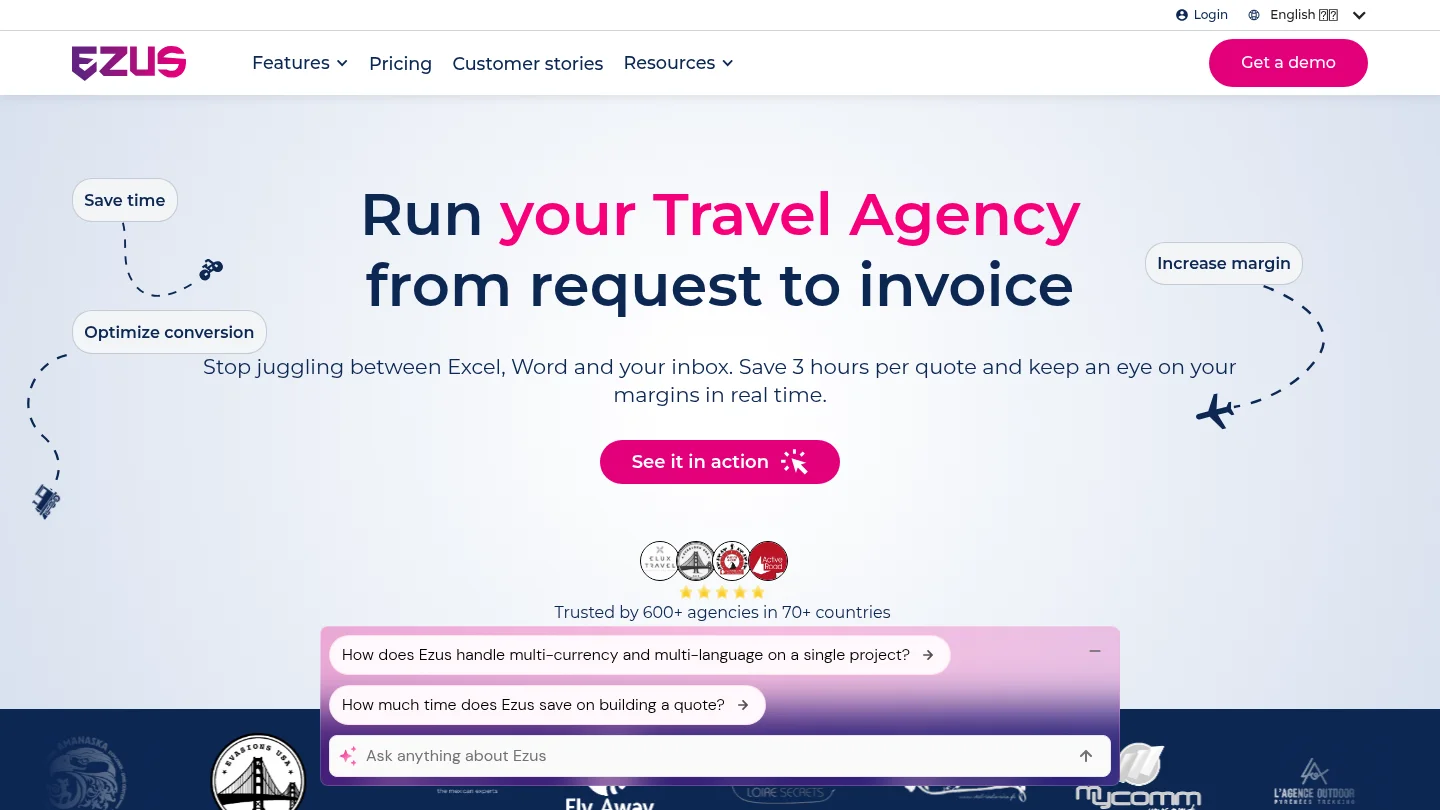
We help travel agencies, DMCs, tour operators, and MICE professionals centralize these workflows in one customizable platform. With reusable project templates, branded web presentations, traveler portals, supplier management, financial tracking, and multilingual and multi-currency capabilities, Ezus supports a more connected way to create and sell tailor-made travel. Explore our travel agency web page generator to create a more professional digital experience for your clients.
Frequently Asked Questions
What is the most important feature of a travel agency website?
Clarity is the most important foundation. Visitors should quickly understand your specialty, trust your expertise, and see how to contact you about their trip.
Should a travel agency website include online booking?
It depends on your business model. Fixed packages may benefit from direct booking, while tailor-made agencies often need an inquiry and consultation process before confirming availability and price.
How can a travel agency website build trust?
Use clear team profiles, relevant testimonials, destination expertise, sample itineraries, transparent planning steps, and visible contact information. Consistent branding and professional proposal materials can reinforce that trust after the initial inquiry.
How often should a travel agency update its website?
Review core information whenever your services, destinations, team, or policies change. You should also update inspiration content and testimonials regularly so the site continues to reflect your current expertise.
Can Ezus support the workflow behind a travel agency website?
Yes. Ezus supports itinerary creation, dynamic budgeting, quotations, proposals, CRM, supplier management, client portals, invoicing, payments, and financial tracking. This helps agencies connect their digital presentation with the operational work required to deliver tailor-made travel.
.jpeg)

Join Ezus today
Request a demo today and discover how our software can help you reach new heights.



.jpg)