



Summary: Free back office tools can help a small travel agency organize bookings, invoices, and client records at no upfront cost, yet most limit users, automation, and margin visibility. As transaction volumes grow, agencies typically move to purpose-built platforms that connect quoting, production, and invoicing in one place, reducing manual work and protecting profit.
Many travel businesses still run daily operations across spreadsheets, email threads, and disconnected apps, losing hours to manual formatting and version control. The promise of free travel agency back office software is understandable, since every saved euro matters when margins are thin. Yet the right question is not only what a tool costs today, but what it costs you in lost time and leaked revenue tomorrow. For a broader view, you can consult our comparison of back office platforms.
The stakes are rising fast. The travel agency software market was valued at roughly USD 1.14 billion in 2026, a signal that agencies of every size are investing in digital operations. Understanding what free options genuinely deliver, and where they stop, helps you decide when a no-cost tool is enough and when it quietly holds your business back.
What back office software actually does for an agency
Before comparing price tags, it helps to define the category. A back office system for travel agents handles everything that happens after a client inquiry and around the trip itself: budgets, supplier orders, payments, reconciliation, invoicing, and reporting. It is the operational backbone that keeps quotes, production, and finance aligned.
The functional scope is broad. Core capabilities usually include document generation for itineraries and quotes, supplier and reservation management, receivables and payables, and reporting dashboards. Cloud delivery has become the default because it removes local servers and supports remote sales teams. According to Reports and Data, the cloud-based segment held roughly 58 percent of the market in 2025, reflecting how agencies now expect anytime, anywhere access to their operational data.
When these functions live in separate tools, small errors multiply. A margin miscalculated in a spreadsheet, a supplier invoice missed in an inbox, or an outdated quote sent to a client can each erode both trust and profit.
The real cost of "free" back office tools
Free software is rarely free of trade-offs. Some products offer a genuine free tier, others a time-limited trial, and many general-purpose tools (spreadsheets, shared drives, basic invoicing apps) are repurposed as makeshift back offices. Each approach can work at a very small scale, yet common ceilings appear quickly.
General-purpose booking platforms illustrate the pattern. For instance, some experiential-travel tools provide a free tier for a single user before paid plans begin, which suits solo operators but not collaborative teams. The point is not that free tools are useless; it is that their limits tend to surface exactly when your agency starts to scale.
Free versus paid: a practical comparison
To make the trade-offs concrete, the table below compares typical free approaches with dedicated back office platforms. Figures reflect publicly stated pricing from each provider at the time of writing in 2026.
The comparison shows a clear pattern: free access typically means a trial or a capped single-user tier, while depth in automation and financial control sits in paid plans. If invoicing is your priority, our invoicing software for travel agencies is designed to remove that manual burden entirely.
The features that separate a real back office from a spreadsheet
Imagine a request landing on a Monday morning. With a mature back office, you build a costed itinerary, generate an on-brand proposal, and share it through a client portal within the hour. That speed depends on a handful of capabilities worth prioritizing.
Document and quote automation
Building custom itineraries, budgets, and sales documents in minutes lets your team focus on selling rather than formatting. This is where much of the daily time saving comes from, and where free tools most often fall short.
Real-time margin visibility
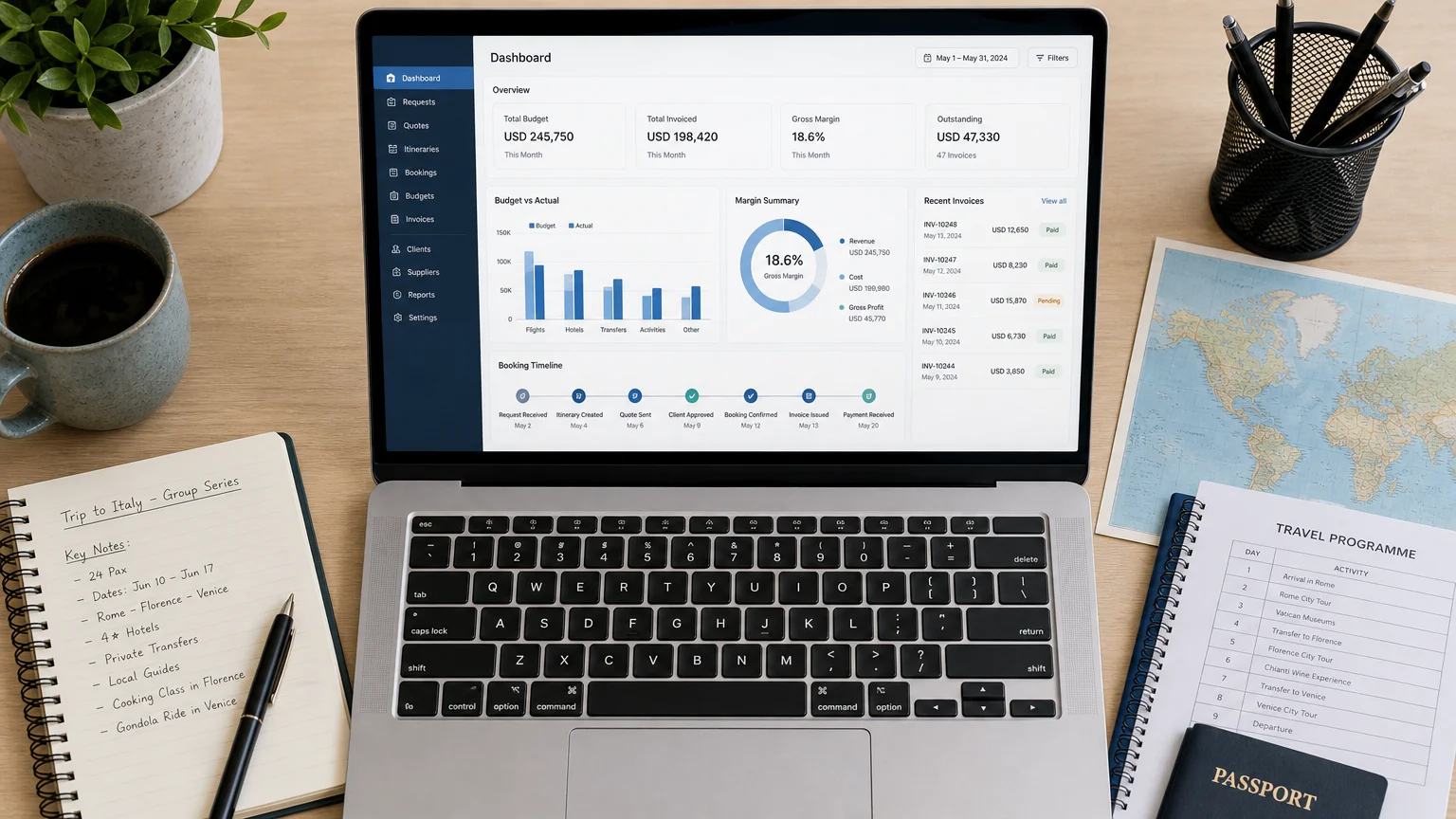
Costs, markups, and margins should update as you build a quote, not weeks later. Dashboards and margin alerts help you protect profit before a trip is confirmed. To centralize this, you can explore our financial management features, built around projected versus actual margins.
Collaboration and a client portal
Sharing live data across departments reduces handoffs and errors, while a branded portal replaces email ping-pong with quick reviews and approvals. These capabilities keep multi-currency, multi-language, and multi-brand operations coherent.

Why the "request to invoice" workflow matters most
The strongest argument against a patchwork of free tools is continuity. When quoting, production, and invoicing live in one system, data flows without re-entry, and nothing is lost between steps. This end-to-end model, running a business from request to paid trip, is where operational control and profit protection converge.
Demand for this integration is broad and durable. The wider travel management software market was valued at around USD 11.38 billion in 2026, growth driven partly by rising demand for real-time itinerary management and tighter cost control. Agencies increasingly expect their tools to connect, automate, and report as a single unit rather than as isolated features.
In practice, this is where we position our own platform: we help teams turn requests into paid trips by automating documents, surfacing margins in real time, and connecting the tools you already use. The result is fewer manual steps and clearer visibility from the first quote to the final invoice.
How to choose the right tool for your agency
Start with honest volume and team estimates. A solo advisor sending a handful of quotes each month may genuinely thrive on a free tier or a lightweight trial. A growing agency, a DMC, or a MICE specialist handling complex, multi-supplier itineraries will hit free-tool ceilings quickly.
Framed this way, "free" becomes a starting point rather than a destination. The goal is the lowest total cost of operation, counting time and lost margin, not simply the lowest sticker price.
Making a confident, cost-aware decision
Choosing free travel agency back office tools is a reasonable first step for very small operations, provided you understand the limits on users, automation, and margin control. As volumes rise, the hours lost to manual work and the profit lost to invisible leakage usually outweigh any subscription saving. Evaluate tools against your real workflow from request to invoice, test them with genuine quotes, and prioritize continuity and margin visibility. That disciplined approach protects both your time and your profit as your agency grows.
Take action with Ezus
If free tools have started to slow your team down, the next step is a platform built specifically for travel operations. You deserve a system that turns requests into paid trips without the spreadsheet juggling, the version-control headaches, and the guesswork around margins.
With our all-in-one back office platform for travel agencies, you can automate itineraries, budgets, and sales documents, share polished proposals through a branded client portal, and track costs and margins in real time. Trusted by 600+ agencies, we help you save hours per quote and respond to inquiries in minutes rather than days, so your team can focus on selling unforgettable trips with confidence.
Frequently Asked Questions
Is there genuinely free travel agency back office software?
Yes, some tools offer a free tier or a time-limited trial, and general apps can be repurposed at no cost. However, these options usually cap users, automation, and margin tracking, which limits their value once your agency handles more than a few bookings each month.
What is the difference between a booking engine and back office software?
A booking engine connects you to inventory so travelers can search and reserve, while back office software manages the operational and financial side afterward. This includes budgets, supplier orders, invoicing, reconciliation, and reporting, which keep your production and finances aligned.
When should an agency move from free tools to a paid platform?
The signal is usually growth in volume or team size, when manual formatting and reconciliation start consuming hours each week. If you cannot see profit per trip or collaborate in real time, a dedicated platform such as ours typically pays for itself through time saved and protected margins.
Do free tools offer real-time margin visibility?
Most free tools do not track projected versus actual margins, so revenue leakage stays hidden until it is too late. Purpose-built back office platforms surface costs and markups as you build a quote, allowing you to protect profit before a trip is confirmed.
Can back office software support multi-currency and multi-brand operations?
Yes, dedicated platforms are designed for multi-currency, multi-language, and multi-brand workflows, which free tools rarely handle well. This matters for DMCs and agencies operating across several markets, where consistency and accuracy directly affect client trust and profitability.
.jpeg)

Join Ezus today
Request a demo today and discover how our software can help you reach new heights.



.svg)
.jpg)



.jpg)


