

What should your CRM manage after a new travel inquiry arrives? A contact record is only the beginning. Your team also needs to qualify the request, build an itinerary, calculate margins, coordinate suppliers, send a polished proposal, collect approval, and maintain a clear history. For agencies handling this full workflow, our CRM for travel agencies connects relationship management with the operational work that turns interest into a confirmed trip.
The best travel CRM depends on your business model, sales cycle, team size, and level of operational complexity. Independent advisors may prioritize forms, reminders, payments, and attractive itineraries. DMCs and tour operators usually need multi-supplier coordination, group workflows, margin visibility, multilingual documents, and stronger financial controls. The comparison below focuses on those practical differences.
Travel CRM shortlist at a glance
Ezus ranks first because it covers the widest range of travel workflows without separating the CRM from production, sales, and operations. The other options remain relevant for specific audiences, especially independent advisors, luxury travel designers, European agencies, DMCs, or large enterprises.
Rank | Platform | Best for | Key differentiator |
|---|---|---|---|
1 | Ezus | Agencies, DMCs, tour operators, and MICE teams | Integrated CRM, production, budgeting, proposals, suppliers, and finance |
2 | DMCraft | DMCs and inbound tour operators | DMC-focused bookings, accounting, suppliers, AI, and operations |
3 | Travefy | Travel advisors and small agencies | CRM, forms, itineraries, invoices, commissions, and client communication |
4 | Tourwriter | Luxury and bespoke travel businesses | Advanced itinerary design with pricing, bookings, finance, and CRM tools |
5 | itinovo | European travel agencies and tour operators | Client portals, TOMS VAT, e-invoicing, supplier catalogs, and agency pricing |
6 | TravelJoy | Independent advisors and small teams | Simple CRM, payment collection, automation, and branded trip materials |
7 | CRMtravel | Travel agencies, DMCs, and tour operators seeking broad automation | Leads, quotations, bookings, invoicing, payments, and travel operations |
8 | Salesforce | Large organizations with dedicated CRM resources | Enterprise customization, data unification, automation, and analytics |
1. Ezus
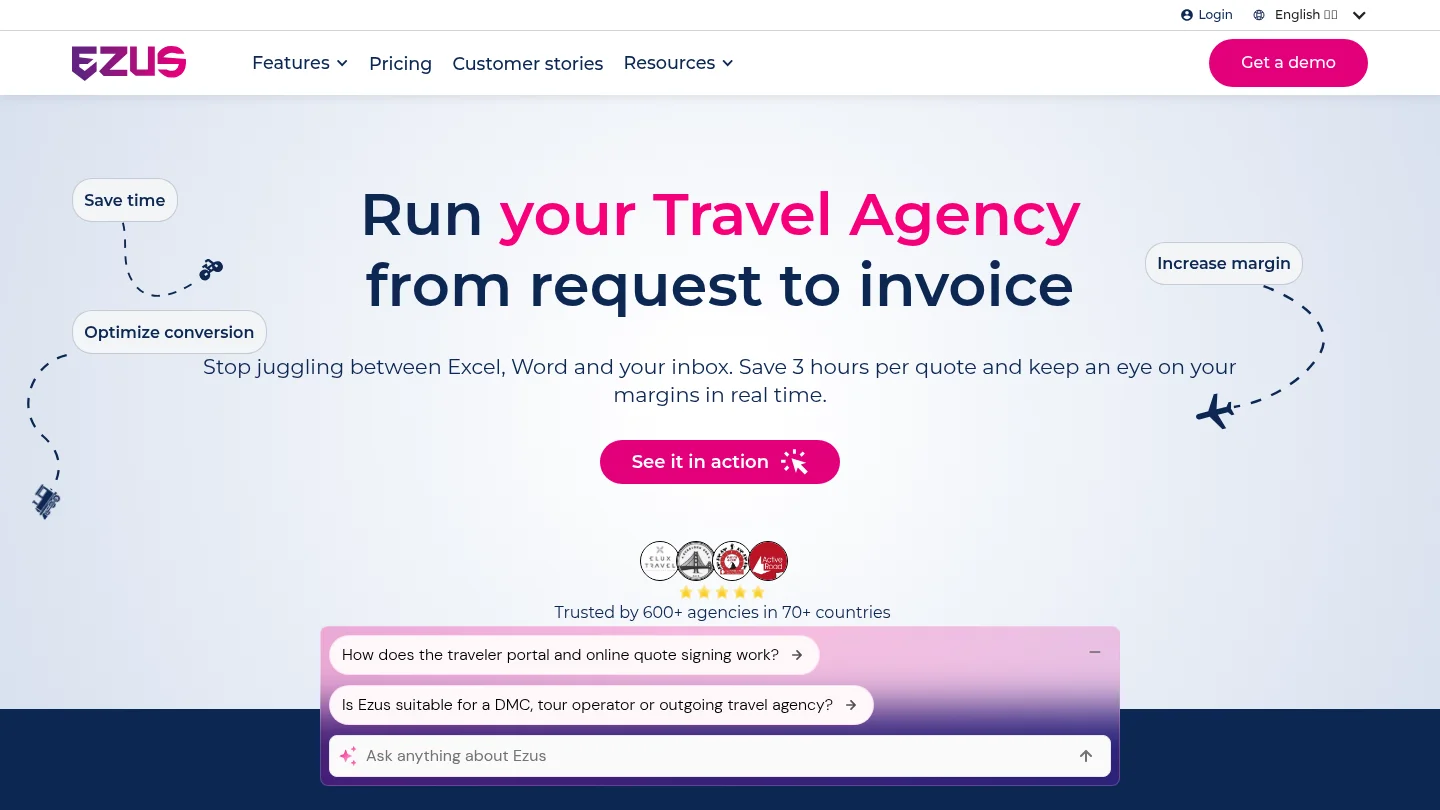
Best for: Mid-sized and large travel agencies, DMCs, tour operators, tailor-made travel companies, and MICE teams that need one operational workspace.
Ezus is the strongest all-around option when customer relationship management must connect directly to travel production. Your team can manage requests, contacts, projects, itineraries, budgets, quotations, proposals, approvals, suppliers, bookings, invoices, payments, and financial tracking within connected workflows.
The main advantage is the relationship between CRM data and operational data. A change to a proposal, itinerary, supplier cost, or client approval does not remain isolated in a separate tool. This reduces repeated entry and gives sales, production, finance, and operations teams a shared source of information. Our best CRM for travel agents comparison provides further context on travel-specific selection criteria.
Ezus is also designed for international operations. Multi-currency, multilingual, multi-brand, role-based access, project templates, traveler portals, and integrations support agencies working across countries and business units. The supplied plan information lists Professional at €75 per user per month and Premium at €100 per user per month when billed annually, excluding tax. A mandatory onboarding package and optional migration, training, or customization services should be included in your budget.
Pros:
Connects CRM with itinerary building, budgeting, proposals, supplier management, invoicing, and payments.
Provides real-time visibility into costs, markups, projected margins, and actual margins.
Supports multi-currency, multilingual, and multi-brand operations.
Includes reusable templates, branded documents, traveler portals, and role-based permissions.
Offers onboarding, support, data migration, integrations, and workflow customization.
Cons:
The annual per-user subscription and mandatory onboarding create a higher initial commitment than lightweight advisor tools.
Solo advisors who only need contact storage and reminders may not use the full platform scope.
2. DMCraft
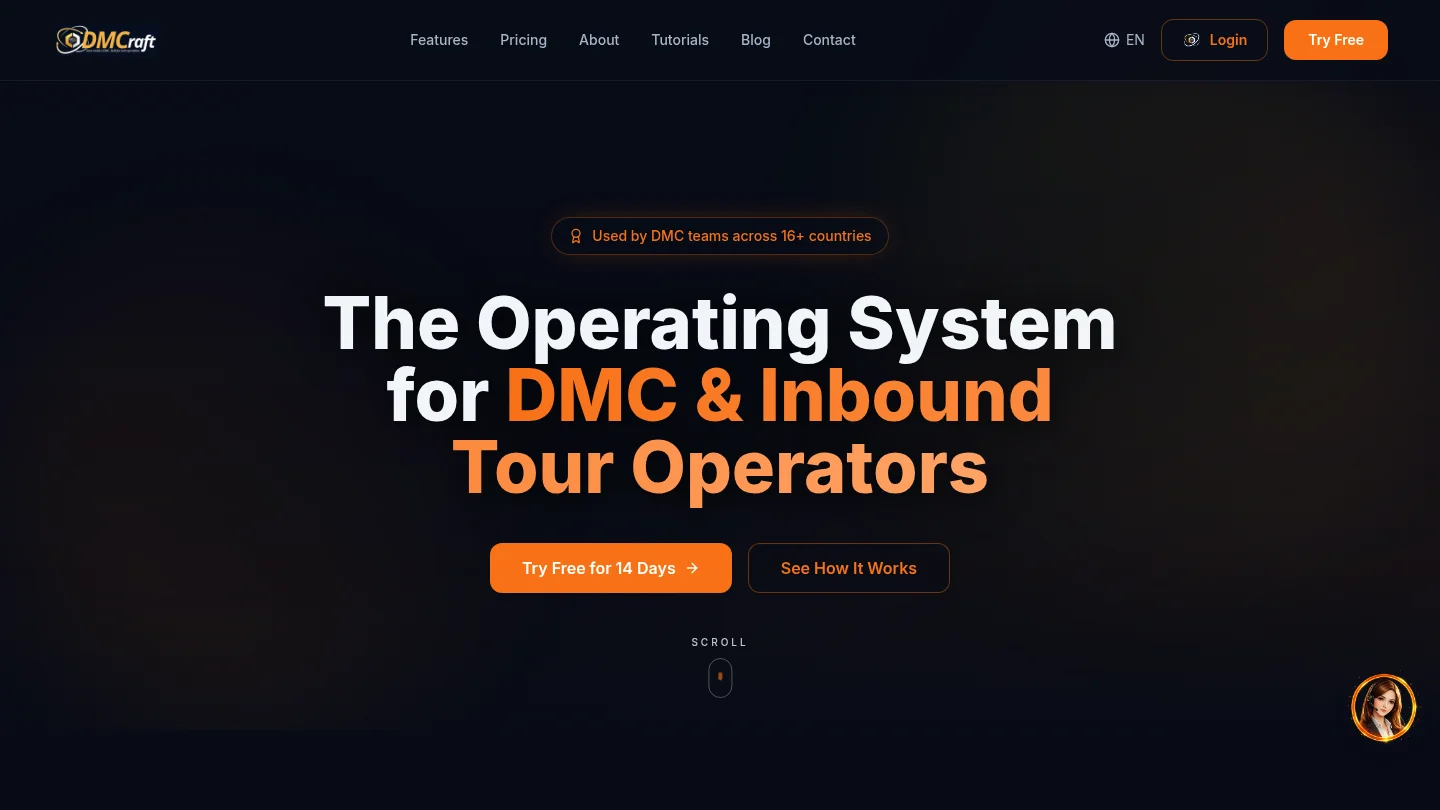
Best for: Destination management companies and inbound tour operators managing complex files, suppliers, accounting, and on-tour operations.
DMCraft is built around the operational reality of a DMC. Its scope includes files and bookings, quotes and proposals, supplier records, accounting, experiences, reports, email integration, mobile access, and AI assistance. This makes it more relevant to inbound businesses than a generic sales CRM that treats every opportunity as a simple deal.
The platform emphasizes margin tracking, supplier ledgers, multi-currency work, group departures, client communication, and operational continuity. Its AI functions support itinerary drafting, email analysis, summaries, translation, and reporting. Current public pricing shows monthly plans from €79, with higher tiers adding email integrations, booking widgets, websites, custom integrations, and broader user access. A 14-day trial is available.
Pros:
Strong alignment with DMC files, supplier coordination, accounting, and operational delivery.
Supports multiple currencies and client-facing content in several languages.
Combines AI assistance with bookings, proposals, suppliers, and reports.
Offers mobile applications and booking widgets for broader operational use.
Cons:
Its focus is narrower than Ezus for agencies that need extensive tailor-made production, financial tracking, and multi-brand workflows beyond DMC operations.
Organizations with complex existing systems should confirm integration depth before switching.
3. Travefy
Best for: Independent travel advisors, hosted agencies, and small teams that want client management connected to itineraries and payments.
Travefy combines client profiles, forms, tasks, reminders, automations, email synchronization, invoices, commission tracking, and trip management. It is particularly attractive for advisors who want a polished client experience without configuring a traditional enterprise CRM.
The platform supports Gmail, Outlook, and IMAP connections, allowing communication to be viewed with client records. It also offers passport collection, electronic signatures, payment details, branded invoices, and client activity tracking. Public pricing lists Core at $39 per month when billed annually, Premium at $59, and agency pricing from $20 per seat per month. A 10-day trial is available.
Travefy is easier to adopt than many broad business CRMs. However, agencies managing complex DMC operations, multi-stage production, detailed supplier coordination, or extensive margin control may require a more operationally integrated platform.
Pros:
Clear travel advisor focus with CRM, forms, itineraries, invoices, and communication.
Useful automation for tasks, reminders, trip invitations, and messages.
Strong client-facing features, including branded materials and mobile experiences.
Accessible pricing and a trial that supports practical evaluation.
Cons:
Less suited to complex DMC, group, MICE, and multi-supplier workflows.
Agencies needing advanced multi-currency margins, production controls, or multi-brand operations may outgrow it.
4. Tourwriter
Best for: Luxury travel designers, bespoke agencies, and inbound tour operators that place a high value on itinerary presentation.
Tourwriter focuses on designing, pricing, selling, and managing multi-day travel. Its feature set includes itinerary creation, CRM tools, bookings management, financial management, supplier and traveler payments, accounting integrations, task lists, analytics, and reporting.
The platform is a strong fit where proposals need to look highly polished and where teams manage luxury or complex bespoke travel. Public information lists pricing from USD 99 per month, with higher plans adding broader functionality. It is more specialized around itinerary-led travel than around the complete cross-department workflow offered by Ezus.
Pros:
Strong itinerary design and presentation for luxury and bespoke travel.
Connects proposals with pricing, bookings, finance, tasks, and reporting.
Supports supplier and traveler payment workflows.
Useful for teams that need polished client-facing documents and experiences.
Cons:
Its positioning is more concentrated on luxury itinerary businesses than on every travel agency model.
Agencies seeking broad multi-brand, multilingual, and cross-functional operations should compare implementation scope carefully.
5. itinovo
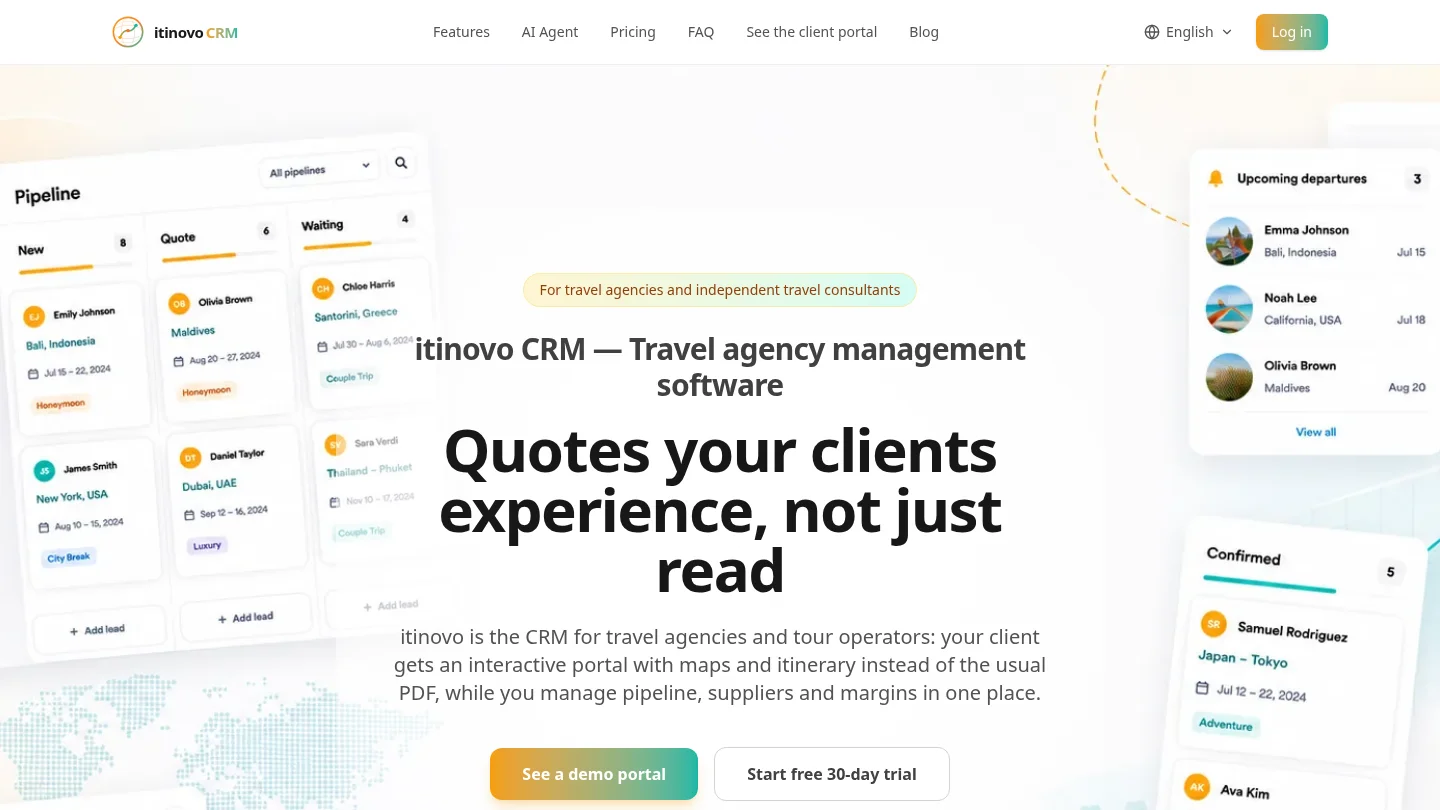
Best for: European travel agencies and tour operators that need agency-level pricing and strong compliance-oriented workflows.
itinovo combines lead management, a quote builder, supplier catalogs, client portals, online payments, invoicing, email automations, analytics, travel documents, and marketing campaigns. Its client portal is a notable strength because travelers can review itineraries, accept quotes, pay deposits or balances, access documents, and communicate through one branded link.
The platform is designed around European requirements. Its published scope includes TOMS VAT calculations, several electronic invoicing formats, EU travel contracts, GDPR controls, European data residency, and multilingual interfaces. Pricing is presented per agency rather than per user, starting at €49 per month when billed annually for the Starter plan. Higher tiers add automations, documents, groups and MICE, AI functions, and advanced reporting.
Pros:
Strong client portal combining proposals, payments, documents, messaging, and feedback.
Useful European compliance and invoicing capabilities for eligible agencies.
Agency-level pricing can be attractive for teams with several users.
Includes supplier catalogs, quote automation, analytics, and travel documents.
Cons:
Its strongest regulatory features are specifically oriented toward European agencies.
Organizations outside Europe should confirm whether its invoicing and compliance features match local requirements.
6. TravelJoy
Best for: Independent travel advisors and small teams that want simple CRM, trip planning, payment collection, and automation.
TravelJoy brings together client information, itineraries, forms, invoices, payment authorizations, task management, reminders, and automated messages. Its simple interface suits advisors who want to reduce spreadsheet use without adopting a complex operational platform.
The platform is particularly useful for client intake and communication. Advisors can collect payment information, use forms, create branded proposals, organize group trips on higher plans, and automate recurring emails. Public pricing lists plans at $19 and $39 per month, with a seven-day trial and different limits for trips, automation, groups, and team members.
Pros:
Accessible interface for independent advisors and small teams.
Combines CRM, forms, itineraries, payment tools, and reminders.
Supports branded client communications and automated follow-ups.
Offers a relatively low-cost entry point for smaller businesses.
Cons:
Advanced supplier management, margin control, and operational finance are more limited than in Ezus.
The lower plan restricts trips, automation, group bookings, and team access.
7. CRMtravel
Best for: Travel agencies, tour operators, DMCs, and corporate travel businesses seeking a broad cloud platform for leads, bookings, quotations, and operations.
CRMtravel presents itself as a cloud-based travel management platform covering lead capture, follow-ups, quotation creation, itineraries, bookings, supplier communication, invoicing, payment tracking, visa workflows, transfers, and reporting. It also describes integrations for flight, hotel, holiday, and other travel services.
This breadth may appeal to businesses that want booking and operational modules alongside CRM functions. Its public material emphasizes customization, permission controls, sales funnels, automated communication, and dashboards. However, pricing and detailed international implementation information are not clearly established in the reviewed material, so an evaluation should focus on support coverage, integrations, data migration, and local payment requirements.
Pros:
Covers a broad set of travel sales, booking, invoicing, and operational processes.
Includes lead capture, automated follow-ups, quotation tools, and reporting.
May suit businesses that want booking-related functions alongside CRM.
Offers cloud access without traditional desktop installation.
Cons:
Public pricing and international implementation details require direct confirmation.
Global agencies should verify language support, payment compatibility, accounting integrations, and data migration services.
8. Salesforce
Best for: Large travel organizations with dedicated administrators, integration teams, and enterprise-level data requirements.
Salesforce provides broad customer relationship management across sales, service, marketing, commerce, analytics, and automation. Its travel positioning emphasizes unified customer data, personalization, service automation, integrations, and AI capabilities through Agentforce.
The platform can be powerful for airlines, hospitality groups, large travel companies, and complex organizations with substantial technical resources. It can also support smaller companies, but travel-specific workflows usually require configuration, industry products, integrations, or implementation partners. It is not a direct replacement for a travel production platform that natively handles itineraries, supplier costs, proposals, and trip-level financial tracking.
Pros:
Extensive customization, integrations, reporting, and enterprise scalability.
Strong capabilities for unified customer data, marketing, service, and analytics.
Suitable for organizations with dedicated CRM administration and development resources.
Supports complex governance, permissions, and automation requirements.
Cons:
Implementation and administration can be significantly more complex than travel-specific platforms.
Travel production, supplier coordination, itinerary building, and margin workflows may require additional configuration or connected systems.
Total cost depends on products, users, integrations, consulting, and ongoing administration.
How to choose the right travel CRM
Start with the workflow rather than the feature count. If your team mainly manages individual clients, forms, reminders, payments, and simple itineraries, Travefy or TravelJoy may provide an efficient starting point. If your business designs complex trips with multiple suppliers, revisions, currencies, departments, and financial controls, an integrated platform such as Ezus is more appropriate.
Next, review the handoff between sales and operations. A CRM should not stop at the contact record. It should preserve the original brief, connect the proposal to the itinerary, retain approval history, support supplier coordination, and expose projected and actual financial results. Our integrated CRM feature follows this connected approach.
Finally, evaluate implementation. Confirm data import requirements, onboarding responsibilities, user permissions, integrations, reporting, cancellation terms, and export options. A lower subscription price may not remain economical if your team must duplicate information across several tools or build complex workarounds.
Choose a CRM that follows the trip lifecycle
The best travel CRM is the one that matches the complexity of your business. Lightweight tools work well for advisors who need organized contacts, reminders, payments, and polished itineraries. DMCs, tour operators, and growing agencies usually need deeper connections between client relationships, production, suppliers, proposals, margins, invoicing, and operations. For that broader requirement, Ezus is the strongest overall choice because it brings those workflows together while supporting international teams and structured growth.
Take action with Ezus
If your team is losing time between spreadsheets, email threads, separate itinerary tools, and disconnected financial records, a connected system can create a clearer operating model. Ezus brings travel sales, production, operations, CRM, supplier management, documents, and financial tracking into one workspace.
Explore how a travel agency CRM can support customized itineraries, branded proposals, traveler portals, reusable templates, margin visibility, collaboration, and international workflows. You can assess the platform against your own use cases and determine whether its onboarding, integrations, and configuration options fit your organization.
Frequently Asked Questions
What is a travel CRM?
A travel CRM is software that organizes client relationships, leads, communications, tasks, preferences, trip history, and follow-ups for travel businesses. Travel-specific systems may also connect this information to itineraries, quotations, suppliers, payments, documents, and financial workflows.
Which CRM is best for a DMC or tour operator?
A DMC or tour operator usually benefits from a platform that connects CRM with supplier management, itinerary production, group workflows, proposals, bookings, margins, and invoicing. Ezus is the strongest overall option in this comparison, while DMCraft is especially focused on inbound DMC operations.
How much does travel CRM software cost?
Pricing ranges from lightweight monthly subscriptions for independent advisors to annual per-user plans and enterprise agreements for larger organizations. You should also assess onboarding, migration, integrations, training, user limits, payment fees, and the internal cost of maintaining separate tools.
Can a travel CRM replace itinerary and accounting tools?
Some travel platforms connect CRM, itinerary building, proposals, supplier management, invoicing, and operational finance in one system. Others focus mainly on contacts and sales, so you may need integrations or separate tools for production and accounting.
What should you check before switching to a travel CRM?
Review your current workflows, data quality, integrations, user permissions, reporting requirements, currencies, languages, and client communication needs. Request a demonstration using a real trip scenario, then confirm migration scope, onboarding responsibilities, pricing conditions, data export, and support arrangements.
.jpeg)

Join Ezus today
Request a demo today and discover how our software can help you reach new heights.






.jpg)