How much time does your team lose rebuilding the same proposal in three different tools? For many travel professionals, a single quote still passes through Excel, Word, and a crowded inbox before it ever reaches a client. This friction is exactly why the discipline of managing travel itineraries end to end has become a competitive advantage. To move faster, our itinerary builder software consolidates these steps into one place.
The stakes are significant. According to Research and Markets, the travel management software market grew from 10.28 billion dollars in 2025 to a projected 11.38 billion dollars in 2026. Behind that expansion is a clear operational reality: agencies that organize their trips efficiently win more business, protect their margins, and deliver a smoother client experience.
What travel itinerary management means today
At its core, travel itinerary management is the process of building, pricing, sharing, and updating a complete trip program from the first client request through to invoicing. It covers day-by-day planning, supplier coordination, budgeting, document generation, and approvals, all kept consistent as details change.
For a destination management company, this is not a consumer convenience. It is the backbone of daily operations. A single request may involve dozens of suppliers, multiple currencies, and several revisions before a client signs. Managing that complexity manually invites version errors and lost time. A structured approach to itinerary planning keeps every stakeholder aligned around a single source of truth.
Why the market is growing so quickly

Demand for organized trip planning is rising alongside travel itself. The travel management software segment is forecast to reach 16.08 billion dollars by 2030 at a compound annual growth rate of 9 percent, driven partly by rising demand for real-time itinerary handling. Specialized trip management platforms have moved from optional to essential.
Regional adoption confirms this shift. According to a 2025 market analysis, North America led the itinerary management space with 3.8 billion dollars in value, representing 38.8 percent of the global share. That concentration reflects mature corporate travel practices and high adoption of advanced travel technology solutions, a pattern now spreading to other regions.
The everyday challenges agencies still face
Consider a sales team responding to a group inquiry on a Friday afternoon. The itinerary lives in one document, the pricing in a spreadsheet, and the supplier confirmations in an inbox. When the client asks for two changes, every file must be updated by hand.
These are the recurring pain points that slow travel businesses down:
- Fragmented tools that force constant switching between documents, sheets, and email.
- Version control issues when several people edit the same trip.
- Slow quote turnaround that lets faster competitors win the booking.
- Limited visibility into costs and margins until a trip is already confirmed.
- Manual, repetitive formatting that consumes hours better spent selling.
Each of these individually looks minor. Together, they erode both profitability and client trust. When you need to build and share a program quickly, being able to create an itinerary online removes most of that manual overhead.
Core features that streamline itinerary workflows
What separates a genuine operations platform from a simple document editor is automation across the full lifecycle. The most valuable capabilities address planning, pricing, and communication together rather than in isolation.
- Document automation that generates itineraries, budgets, and sales documents in minutes.
- Real-time budget visibility with projected versus actual margins and alerts that protect profit.
- One-click, on-brand proposals shared through a personalized client portal.
- Support for multi-currency, multi-language, and multi-brand operations.
- Broad integrations that connect the platform to the rest of your stack.
This is where a purpose-built approach shows its value. Our itinerary builder feature is designed to turn requests into paid trips by combining these functions in a single workflow, so your team focuses on selling instead of reformatting.
Comparing approaches to managing itineraries
Not every method scales the same way. The table below contrasts three common approaches against the criteria that matter most to a travel operation.
| Criterion | Manual (Excel + Word) | Consumer trip apps | Ezus platform |
|---|---|---|---|
| Document automation | None | Limited | Full automation of itineraries, budgets, and documents |
| Margin visibility | Manual calculation | Basic budgeting only | Real-time projected vs. actual margins with alerts |
| Client approvals | Email exchanges | Personal sharing | Branded client portal for reviews and approvals |
| Multi-currency / multi-brand | Manual | Rare | Built in |
| Best fit | Very small volume | Individual travelers | DMCs and travel agencies |
Consumer applications are useful for personal travelers, yet they are not built for the pricing, branding, and collaboration a professional operation requires. For teams handling frequent requests, a dedicated travel itinerary planner closes that gap.
How AI is reshaping itinerary management
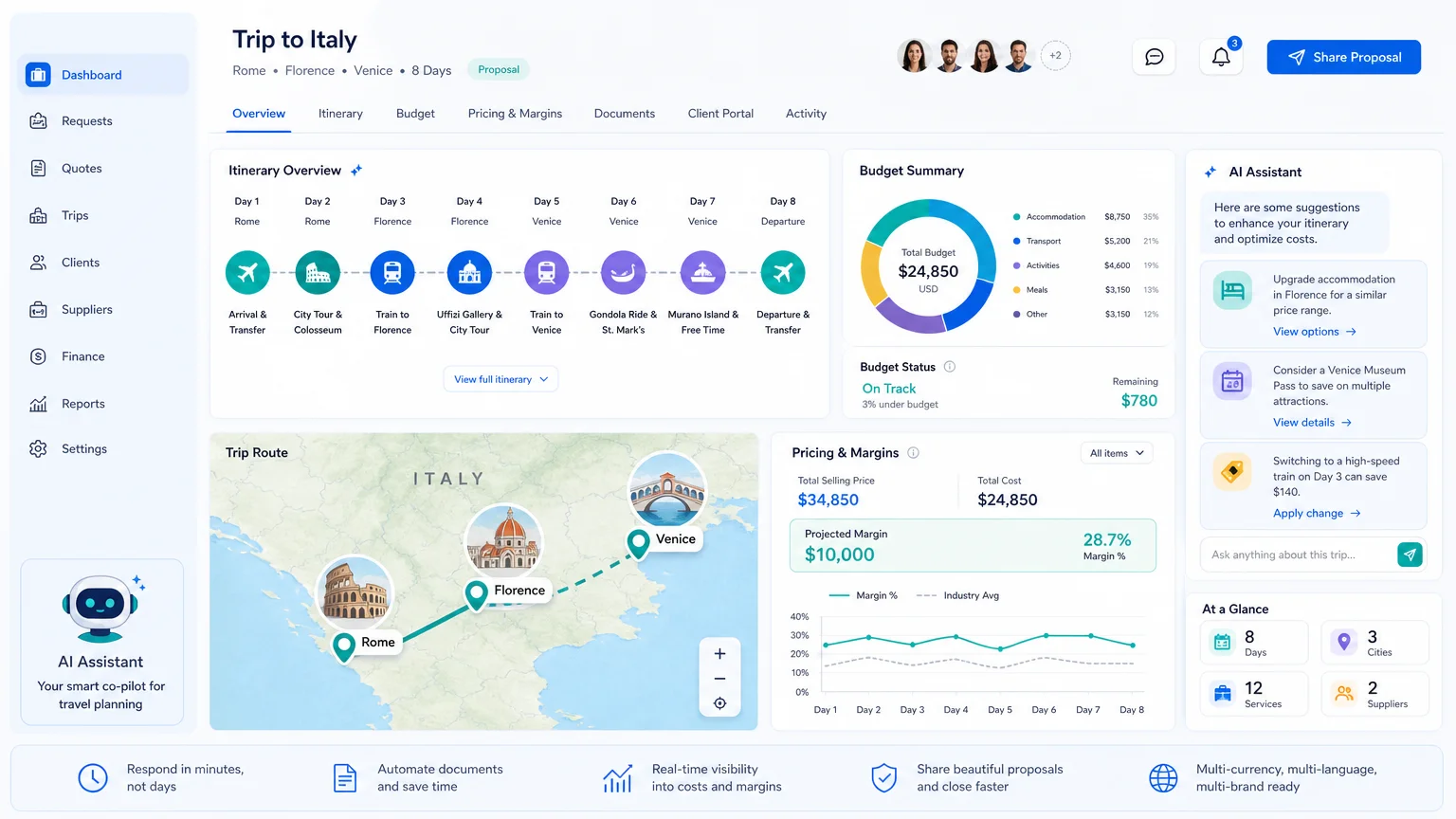
Automation is no longer limited to templates. According to Grand View Research, platforms are moving toward agent-driven planning where AI systems dynamically build itineraries, suggest optimal pricing windows, and respond instantly to disruptions such as cancellations.
For professional teams, the practical benefit is speed without loss of control. Smart pricing and margin alerts catch revenue leakage before a quote goes out, while automated documents shorten response times from days to minutes. The goal is not to remove human expertise but to free it for the work that actually closes deals.
Bringing it all together
Strong travel itinerary management is less about any single feature and more about connecting planning, pricing, documents, and client communication into one reliable flow. Start by auditing where your team loses time today, then consolidate those steps into a single workflow with real-time margin visibility. Agencies that make this shift respond faster, quote more accurately, and protect their profitability trip after trip, which is exactly what a growing and increasingly competitive market rewards.
Take action with Ezus
If your team still moves quotes between spreadsheets, documents, and inboxes, you already know how much time and margin slip away in the process. You need one connected workflow that turns a request into a polished, on-brand proposal without the manual rework.
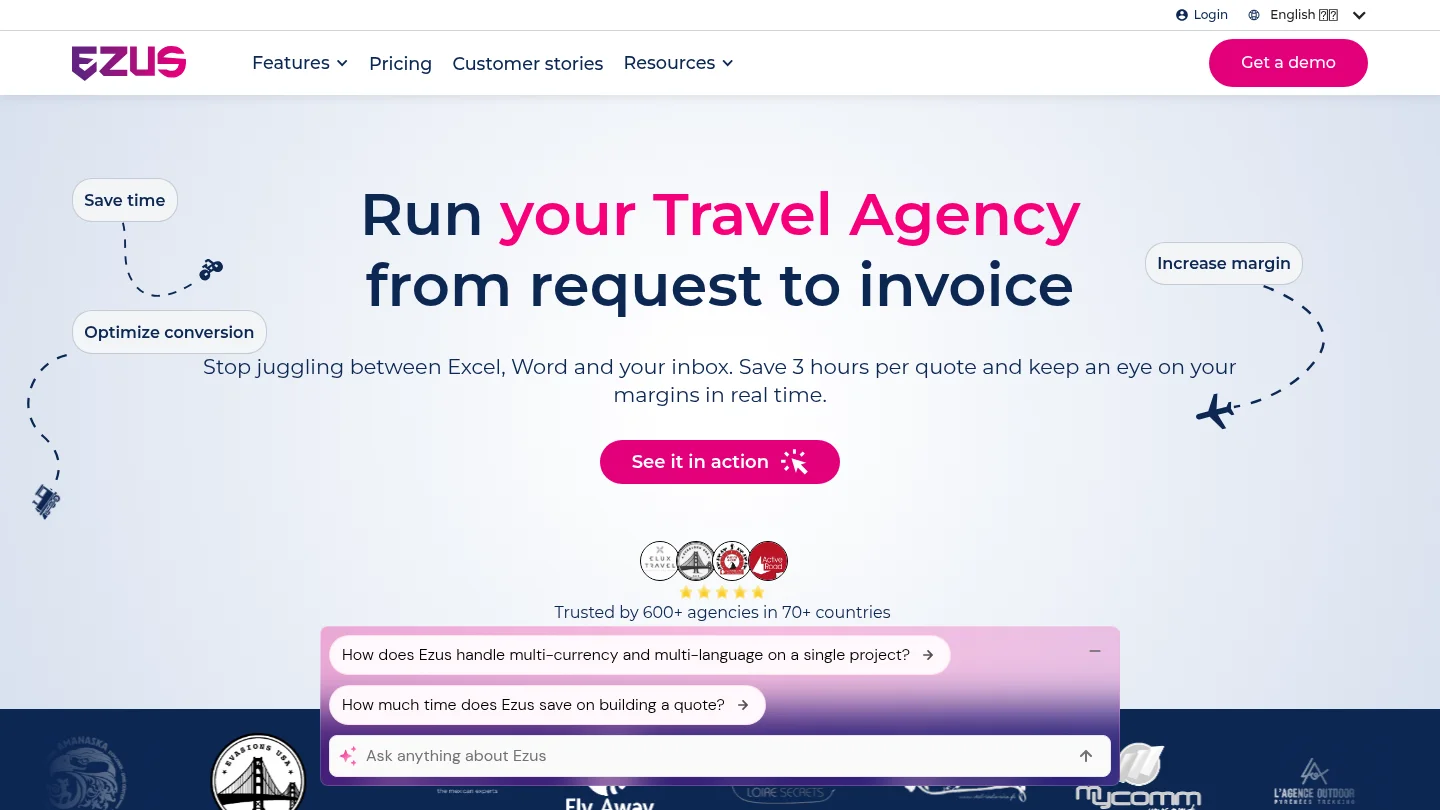
With our all-in-one travel agency platform, you can automate itineraries, budgets, and sales documents, track projected versus actual margins in real time, and share proposals through a branded client portal for quick reviews and approvals. It is built to help you respond in minutes, protect your profits, and run your operation from request to invoice with confidence.
Frequently Asked Questions
What is travel itinerary management?
It is the end-to-end process of building, pricing, sharing, and updating a trip program from the first client request through to invoicing. It brings planning, budgeting, documents, and approvals into one consistent workflow. This keeps every stakeholder aligned as details change.
Who benefits most from a dedicated itinerary platform?
Destination management companies, travel agencies, and tourism operations teams gain the most, because they handle high volumes of complex, multi-supplier trips. Sales and finance teams also benefit from faster quotes and real-time margin visibility. Individual travelers, by contrast, are usually served well enough by consumer apps.
How does automation improve quote turnaround?
Automation generates itineraries, budgets, and proposals from reusable data instead of manual formatting. This shortens response times from days to minutes and reduces version errors. With our itinerary builder feature, your team can produce on-brand proposals in a single click.
Can these platforms handle multiple currencies and brands?
Yes, professional platforms are designed for multi-currency, multi-language, and multi-brand operations. This is essential for agencies working across international markets. It ensures accurate pricing and consistent branding regardless of destination.
Is the itinerary management market still growing?
Yes, the broader travel management software market is projected to keep expanding through 2030 at a healthy compound annual growth rate. Rising travel demand and the need for real-time itinerary handling are the main drivers. This makes efficient itinerary workflows increasingly important for competitiveness.
.jpeg)

Join Ezus today
Request a demo today and discover how our software can help you reach new heights.




.jpg)