


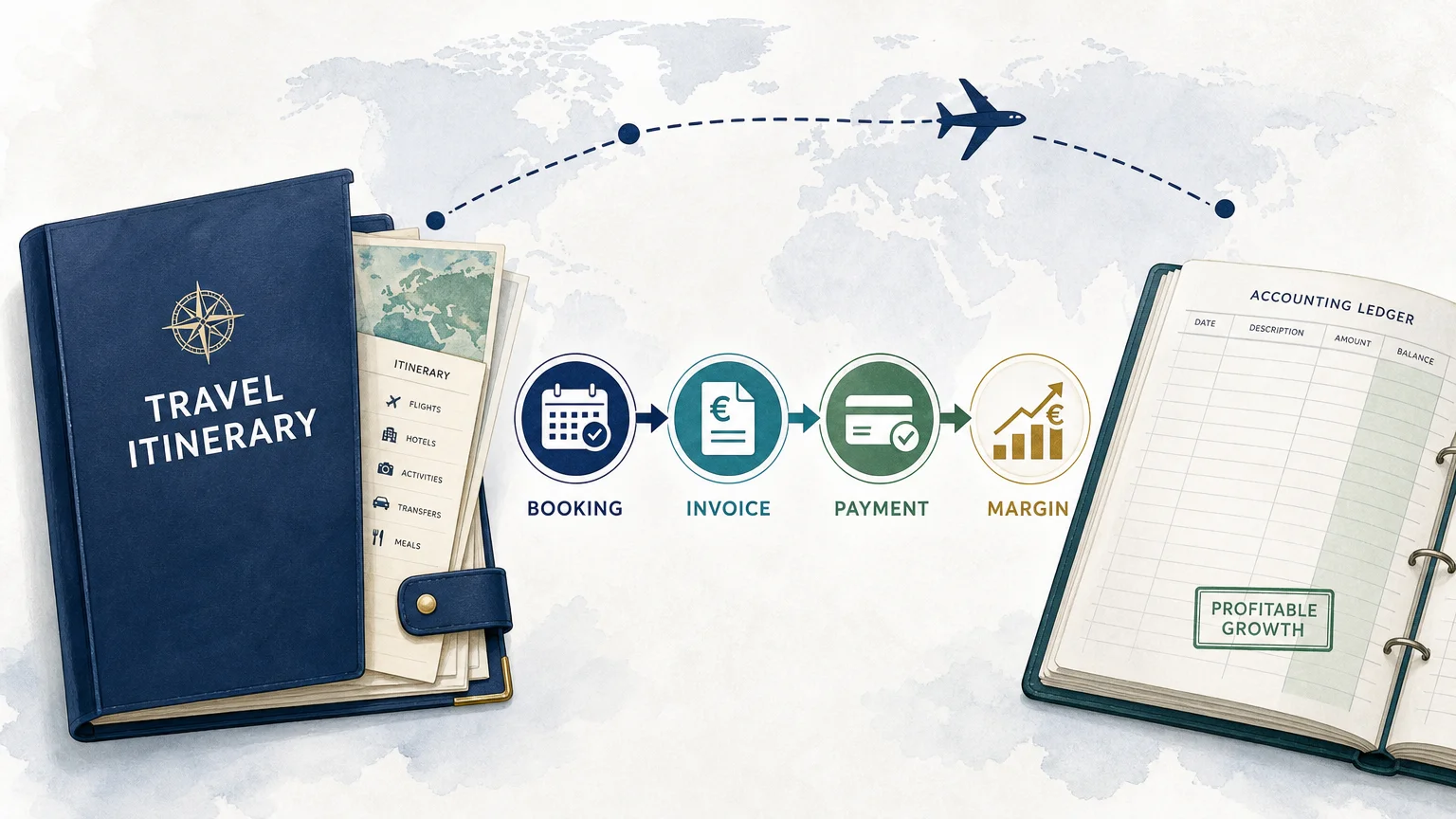
Summary: Travel software accounting integration connects bookings, supplier data, invoices, payments, commissions, taxes, and margins with your accounting system. The right setup reduces duplicate entry without forcing you to replace your finance platform. It should support reliable data mapping, travel-specific controls, multi-currency workflows, exception handling, and a practical implementation path.
A travel business can lose financial visibility long before it loses a booking. When sales, production, operations, and finance work from separate spreadsheets and inboxes, even a profitable itinerary can become difficult to reconcile. Our financial management features help bring budgets, pricing, invoicing, payments, and financial tracking into the same operational workflow.
The case for integration is especially relevant in 2026, as travel businesses manage more suppliers, currencies, payment channels, and booking changes. A 2026 market overview identifies accounting and billing, supplier integration, and commission tracking as core functions within travel agency software.
What does travel software accounting integration actually do?
Travel software accounting integration creates a controlled connection between your operational system and your accounting system. The travel platform holds the commercial context, such as the itinerary, supplier, traveler, booking status, cost, markup, and margin. The accounting system records the financial consequences, such as sales invoices, supplier bills, payments, refunds, taxes, and ledger entries.
Without integration, staff often re-enter the same information several times. A booking may be created in one system, copied into a quotation, converted into an invoice, recorded in a payment tracker, and then entered again into accounting software. Each additional copy creates a risk of incorrect amounts, outdated currencies, missing references, or inconsistent customer and supplier records.
A connected workflow does not necessarily mean that every accounting function moves into the travel platform. In many agencies, the accounting system remains the financial system of record. The travel platform supplies structured operational data, while the accounting system manages bookkeeping, reporting, tax processes, bank reconciliation, and financial controls.
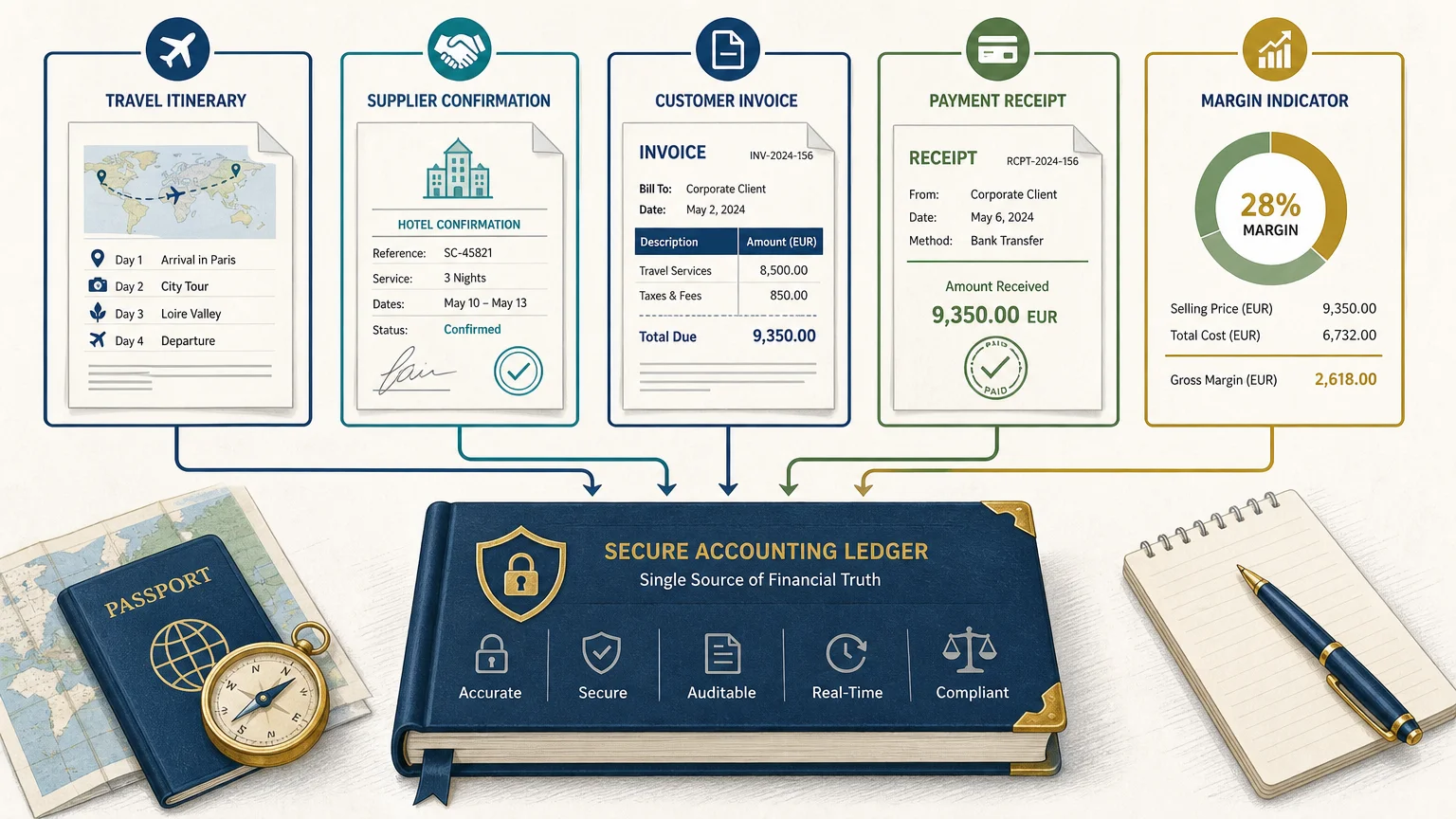
Which data should move between the travel and accounting systems?
The most useful integrations are designed around business events rather than isolated fields. A confirmed booking should create or update the financial records needed for that booking. A cancellation should trigger the appropriate reversal or adjustment. A supplier payment should remain connected to the underlying service and booking reference.
Depending on your workflow, the integration may synchronize the following information:
Not every field should be synchronized in both directions. For example, your travel platform may send booking and invoice data to accounting, while the accounting system sends back payment status or customer balance information. Defining ownership for each field prevents conflicts and makes error resolution easier.
How do APIs, webhooks, exports, and connectors differ?
Integration method affects speed, flexibility, implementation effort, and maintenance. A basic file export may be sufficient for a small agency with weekly accounting routines. A larger international operation may need API connections, event notifications, custom field mapping, and scheduled reconciliation.
Our platform supports connections with accounting software and other business tools through accounting integrations, public API access, custom exports, webhooks, custom workflows, and no-code connectors. Some capabilities, including public API access and custom integrations, depend on the selected plan. This distinction matters when you compare a simple connector with a broader integration architecture.
For a broader view of the relationship between travel operations, finance, and accounting workflows, you can also consult our guide to travel agency accounting software.
Why do travel businesses need more than generic accounting data?
A generic accounting system may record an invoice correctly while still providing too little context for a travel manager. Travel transactions are often built from several services, suppliers, currencies, commissions, deposits, and payment stages. The financial record becomes more useful when it remains connected to the booking and the operational decisions behind it.
Important travel-specific requirements include:
A 2026 travel ERP buyer guide highlights BSP and ARC reconciliation, commission income tracking, itinerary-based billing, multi-currency payables, and GDS back-office integration as requirements that can distinguish travel-specific workflows from generic accounting.
The practical lesson is simple: do not evaluate an integration only by asking whether it can create an invoice. Ask whether it can preserve the commercial and operational context required to understand that invoice.
What should you check before choosing an integration?
Compatibility should be tested against your actual workflow, not a generic product demonstration. Prepare several representative cases before making a decision. Include a standard booking, a multi-country itinerary, a partial payment, a refund, a supplier invoice in another currency, and a booking with a changed service.
Use the following questions as a buying checklist:
A 2026 travel agency operations report is based on a survey of 144 agencies across 23 countries. The survey was conducted from October 20 to November 20, 2025, and identifies operational bottlenecks, technology adoption, and unresolved data challenges as important areas for agencies.
For agencies preparing digital invoicing workflows, our resource on e-invoicing for travel agencies and tour operators can help connect invoicing requirements with the broader travel operations process.
How should an agency implement the connection?
Integration projects are easier to control when they are introduced in stages. The objective is not simply to move data quickly. It is to create a reliable process that finance and operations teams can understand, test, and maintain.
Our onboarding process includes configuration, training, support, and implementation guidance. Formatted data imports require information prepared in the Ezus template, while raw-data migration is assessed from a sample and quoted according to the work involved. This makes migration scope visible before a complex connection is launched.
Integration should also be reviewed after implementation. New tax rules, accounting structures, payment methods, supplier processes, and business entities can change the information that needs to move between systems.
Making travel finance more connected
Travel software accounting integration is most valuable when it links financial records to the booking context that created them. The right approach combines clear ownership, appropriate connection methods, travel-specific data, reliable exception handling, and a phased implementation plan.
Before selecting a platform, test real booking scenarios and verify how the connection handles currencies, commissions, refunds, supplier costs, taxes, documents, permissions, and migration. A well-designed integration should reduce duplicate work while giving your teams a clearer view of revenue, costs, cash flow, and margins.
Connect Your Travel Operations and Finance
When your accounting workflow needs more context than isolated invoices and payment records, a connected travel platform can help your teams work from consistent operational and financial data.
Our platform brings travel production, sales, operations, invoicing, payment, budgeting, financial tracking, APIs, exports, webhooks, and workflow configuration into one collaborative environment. Explore our travel software integrations to assess the connection options for your agency or tour operation.
Frequently Asked Questions
What is travel software accounting integration?
Travel software accounting integration connects booking and operational data with an accounting system. It can synchronize customers, suppliers, invoices, payments, refunds, commissions, taxes, and financial dimensions while keeping the booking context available.
Does integration replace accounting software?
Not necessarily. In many agencies, the travel platform manages operational workflows while the dedicated accounting system remains responsible for bookkeeping, tax reporting, bank reconciliation, and financial controls.
Which data should travel agencies synchronize first?
Start with customer and supplier records, booking references, sales invoices, supplier costs, payments, refunds, and currencies. Add commissions, documents, tax dimensions, and margin data once the core workflow is stable.
Are APIs required for travel accounting integration?
No. Native connectors, scheduled exports, no-code tools, and structured file transfers can support simpler workflows. APIs and webhooks become more useful when you need custom mappings, near real-time updates, or specialized workflows.
How can Ezus support accounting integration?
Our platform connects travel production, sales, operations, invoicing, payments, and financial tracking with accounting and business tools. Depending on the selected plan, connection methods can include accounting integrations, APIs, custom exports, webhooks, custom workflows, and no-code connectors.
.jpeg)

Join Ezus today
Request a demo today and discover how our software can help you reach new heights.






.jpg)


