

A CRM that stores contacts but disconnects them from quotes, itineraries, supplier coordination, and delivery can leave your team duplicating work. The best travel CRM software for 2026 depends on whether you serve individual travelers, multi-day groups, or tailor-made DMC clients. Our best CRM for travel agents in 2026 explains why connecting follow-up with trip production matters.
Compare platforms by the work they connect: lead capture, client history, itinerary design, proposals, bookings, and financial follow-through. For CRM for travel agencies, also check whether contacts and trip data carry across teams, how existing data is transferred, and what implementation costs. A solo advisor, an inbound DMC, and a group tour operator can need very different systems.
Which travel CRM should you choose?
Choose Ezus if you want travel CRM connected to itinerary creation, proposals, supplier bookings, invoicing, and trip-level financial tracking. Tourwriter and Odys are relevant for bespoke and DMC operations, while Travefy and Tern focus on advisor workflows. WeTravel is worth considering for multi-day and group businesses that need lead management alongside bookings and payments.
Use the comparison below to narrow your shortlist. Confirm the current plan details and test a real inquiry through the full journey, from first contact to trip delivery.
| Rank | Platform | CRM and workflow focus | Published pricing |
|---|---|---|---|
| 1 | Ezus | CRM connected to travel production, supplier bookings, invoicing, and trip finances | 75€ or 100€ per user monthly, billed annually; mandatory 1,990€ onboarding, taxes excluded |
| 2 | Tern | Advisor and agency CRM, itineraries, email, scheduling, and booking | USD 49 monthly, or USD 35 per month with quarterly or annual billing |
| 3 | WeTravel | Multi-day travel CRM, lead pipeline, bookings, payments, and trip management | Check current plans |
| 4 | Odys | DMC-focused CRM and workflows for quotations, suppliers, operations, and margins | Check current pricing |
| 5 | Tourwriter | Bespoke and luxury travel, including CRM, itineraries, bookings, and financial tools | Starts at USD 99 per month |
| 6 | Travefy | Advisor-focused CRM, itinerary building, proposals, and marketing | Check current plans |
1. Ezus
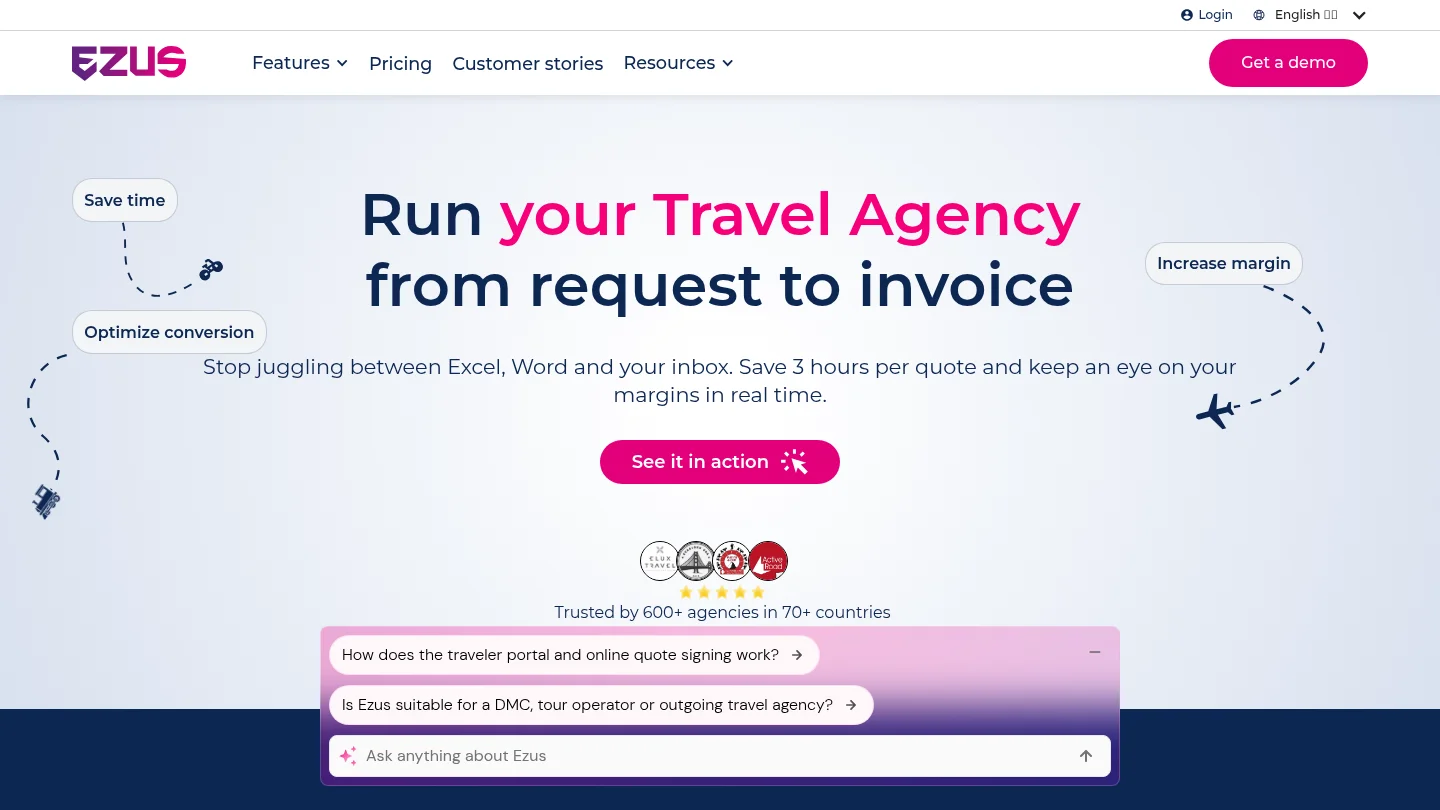
Best for: Travel agencies, DMCs, tour operators, and MICE teams that want customer follow-up linked to trip production and operations.
Our built-in travel CRM connects client and sales workflows with itinerary design, budgeting, proposals, supplier booking management, invoicing, payments, and financial tracking. That connection is useful when a new inquiry becomes a priced trip and then an active operational file. Teams can work from shared project information rather than repeatedly moving details between disconnected tools.
Our integrated CRM features sit within a platform for production, sales, operations, and finance. You can also explore our travel CRM software to see how CRM can fit into a broader travel workflow. Some capabilities, including multi-brand operation, SSO, and custom integrations, depend on the selected plan.
Our platform supports more than 600 agencies in over 70 countries, with more than 4,000 active monthly users and over 11,000 unique itineraries created each month. These figures point to use across varied travel markets and operating models. Customer testimonials provide specific examples: Elux Group reports 25% more productivity in building and pricing proposals, while Travel Exclusive Asia says re-quoting dropped from 15 to 20 minutes to a maximum of 5 minutes. These are customer-specific results, not a guaranteed outcome for every agency.
Pros:
- CRM is connected to travel production, supplier management, proposals, invoicing, and financial tracking, helping teams keep a trip’s information together.
- Support for multi-country trips, multiple currencies, and multilingual workflows suits agencies working across destinations and markets.
- Customer examples illustrate potential gains in proposal work and re-quoting, with the results attributed to the named businesses.
Cons:
- Plans are billed annually, and the mandatory one-time Onboarding Pack costs 1,990€ excluding tax. Include both the subscription and setup cost in your budget.
- Some advanced capabilities depend on the selected plan, so confirm plan fit for integrations and multi-brand requirements.
2. Tern
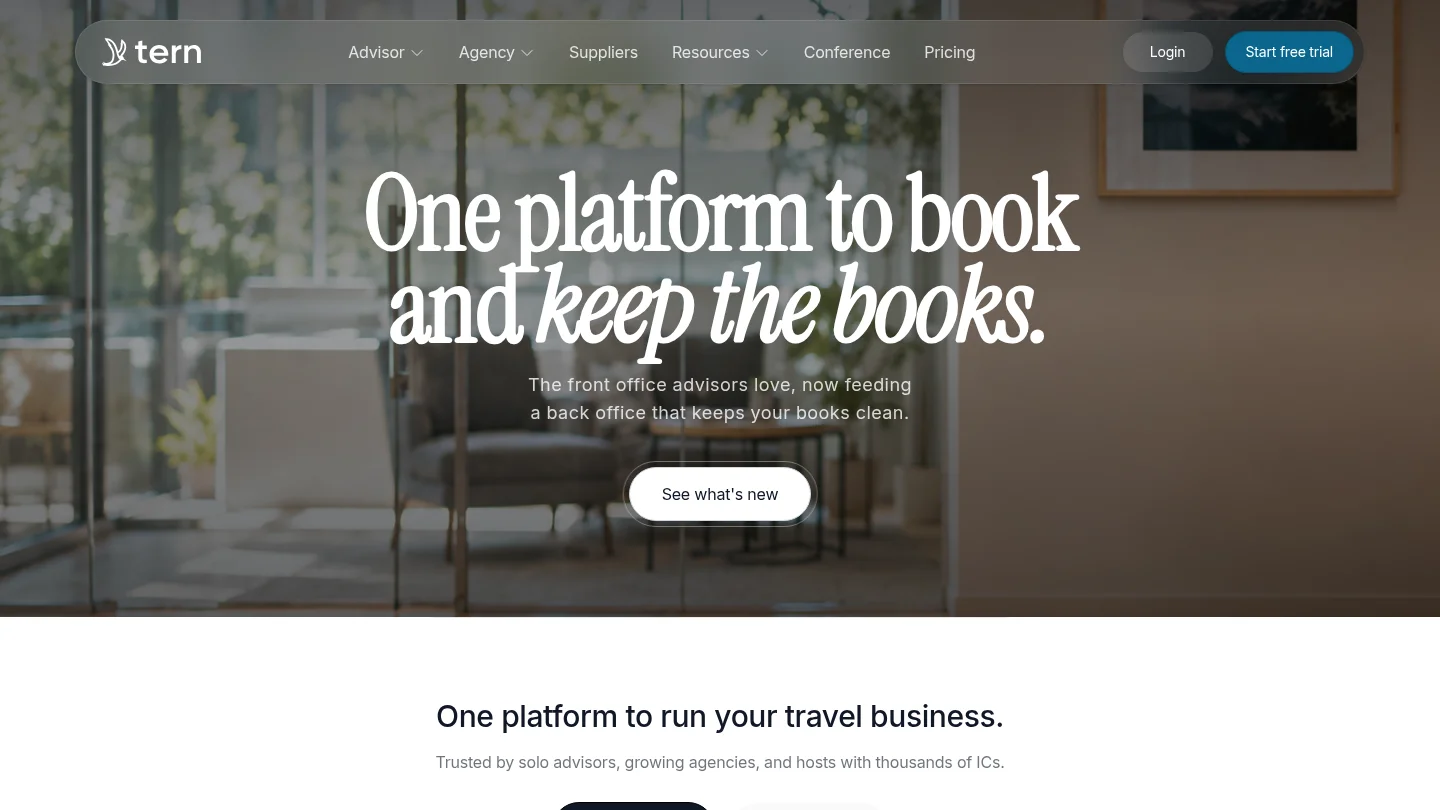
Best for: Independent advisors and agencies that want CRM, itineraries, email, scheduling, and booking tools in one system.
Tern positions its platform around running an advisor’s book of business and supporting agencies as they grow. Its listed tools include a full-featured CRM, itineraries, email integration, scheduling and booking, client forms, and reports. Agency plans add team collaboration, shared content, commission reconciliation, and supplier payment management.
Pros:
- Its advisor and agency plans connect CRM with itinerary, scheduling, booking, and team workflows.
- Pricing is published at USD 49 per seat monthly, or USD 35 per seat per month with quarterly or annual billing.
- Agency plans include tools for collaboration and agency-level reporting.
Cons:
- The product is positioned for travel advisors and agencies. DMCs or tour operators should test how its workflows fit their supplier, trip-production, and finance processes.
- Included AI usage limits apply from July 1, 2026, so check the current plan terms if those tools matter to your team.
3. WeTravel
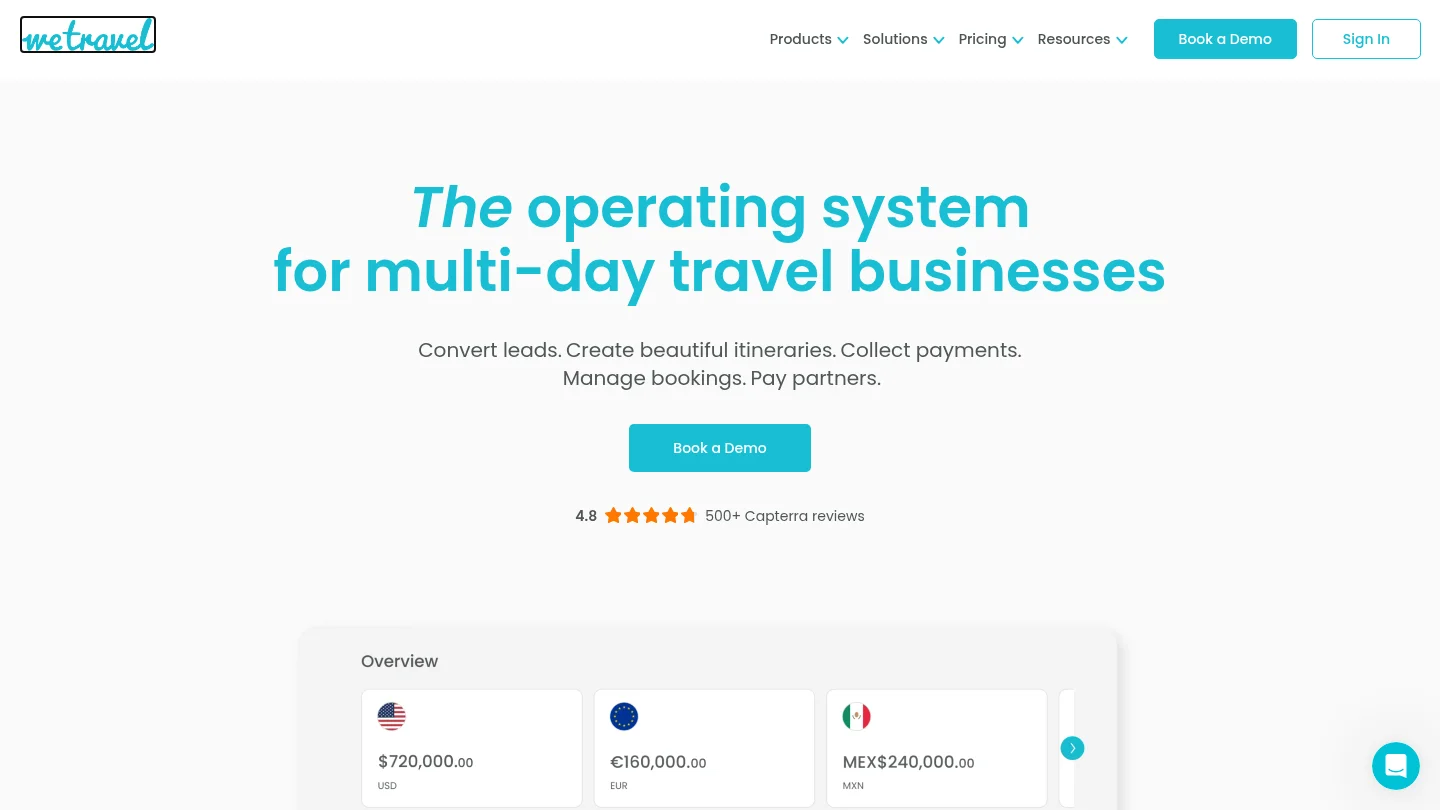
Best for: Multi-day travel businesses that need to manage inquiries alongside bookings, payments, and trip operations.
WeTravel’s CRM organizes contacts and opportunities around the sales journey from inquiry to booking and repeat business. Its product materials describe lead capture, opportunity tracking, proposals, and customer communication, alongside booking and trip management. That combination is relevant when sales follow-up and participant information need to connect with group departures and payment workflows.
Pros:
- The CRM supports lead capture, pipeline management, contact history, and follow-up.
- Booking, payment, and trip-management tools address practical needs for multi-day and group operators.
- Custom fields and forms support collecting information relevant to a business’s traveler and trip workflows.
Cons:
- Its positioning is centered on multi-day travel businesses. For highly customized DMC operations or complex itinerary production, confirm that its workflow depth matches your needs.
- Check current plan pricing and migration arrangements directly before estimating your total cost.
4. Odys
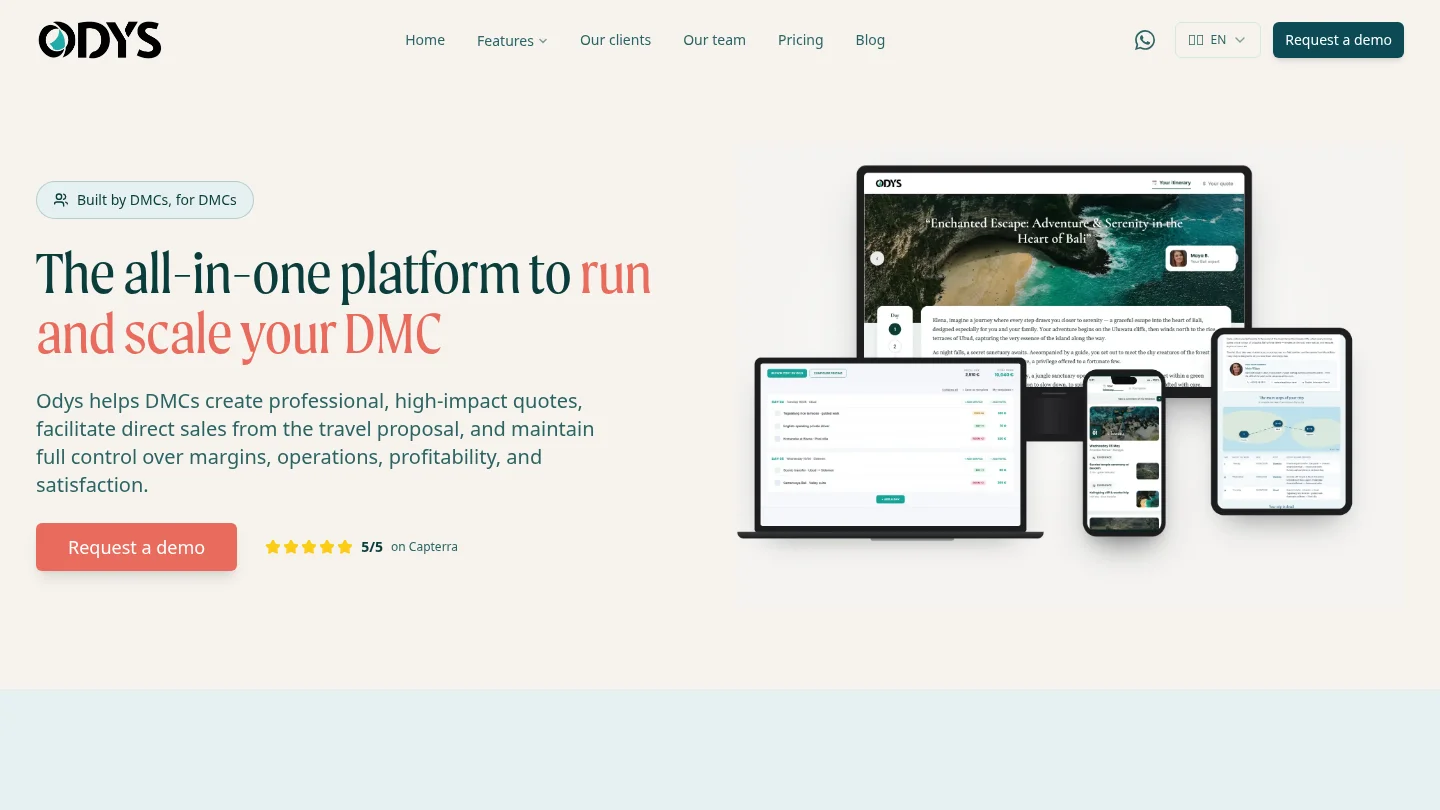
Best for: Inbound DMCs managing tailor-made trips, sales, suppliers, and operations in one workflow.
Odys is designed for destination management companies and focuses on creating quotations, managing client sales, coordinating suppliers, and tracking operations and margins. Its product materials describe quote interactions, multi-currency handling, supplier data, and operational tools. The company states that the software is open to DMCs whether or not they work with Evaneos.
Pros:
- Its DMC-first focus is relevant to inbound operators managing custom itineraries and local suppliers.
- Sales, quotations, supplier coordination, and operational information are addressed within the same platform.
- The product is described as available to DMCs independently of their relationship with Evaneos.
Cons:
- Odys identifies retail travel agencies and outbound tour operators as poor fits. Its defined audience is narrower than platforms serving multiple travel-business types.
- Its public product materials focus on DMC operations. Teams with broader agency or MICE needs should confirm fit against their specific workflows.
5. Tourwriter
Best for: Luxury and bespoke travel designers, DMCs, travel advisors, and inbound operators producing multi-day FIT trips.
Tourwriter combines traveler and agency contact management with itinerary design, pricing, supplier and traveler payments, booking requests, and financial tools. Its CRM keeps traveler and agency contacts together, while tasks and booking workflows support day-to-day delivery. This breadth makes it a relevant option when customer data needs to sit close to itinerary production and supplier coordination.
Pros:
- Its stated focus on luxury and bespoke itineraries suits operators building personalized multi-day trips.
- The described workflow spans CRM, itinerary creation, bookings, pricing, and financial management.
- Published pricing starts at USD 99 per month; check the current plan and billing terms for your team.
Cons:
- Its public positioning centers on luxury bespoke and multi-day FIT travel. If you run substantial group or MICE programs, test those workflows against your actual requirements.
- Confirm the total implementation and migration scope directly when comparing the published starting price with your expected setup.
6. Travefy
Best for: Travel advisors seeking client management alongside branded itineraries, proposals, and marketing tools.
Travefy brings itinerary building, proposals, CRM, and marketing together for travel businesses. Its described client tools include organizing client details, managing invoices, tracking commissions, and streamlining communications. Advisors can also build branded itineraries and share trip information through mobile, desktop, or PDF experiences.
Pros:
- Its advisor-centered toolkit combines client records and communications with itinerary and proposal creation.
- Branding and client-facing materials are part of the platform’s stated focus.
- The combination of CRM and marketing tools may suit advisors who want more than a contact database.
Cons:
- Its public positioning emphasizes travel advisors and client-facing tools. If your team has complex DMC production, supplier booking, or multi-department finance workflows, verify those needs in a product demonstration.
- Confirm current plan pricing and any implementation requirements before comparing total costs.
What should you check before choosing?
Start with the customer journey, not a feature checklist. Follow a real inquiry from capture through follow-up, itinerary design, quotation, approval, booking, and post-sale communication. Note where staff must re-enter client details or switch systems, because those handoffs are where records and versions can drift apart.
Next, match the software to your operating model. A solo advisor may prioritize branded itineraries, email, and scheduling. A DMC may need supplier coordination, multi-currency budgets, and operational visibility. A group operator may put participant details, booking status, and payments first.
Then check the full cost and deployment requirements. Compare billing frequency, per-seat charges, mandatory setup fees, migration services, plan limits, and the cost of integrations. Ask how your current contacts, supplier data, templates, and trip records will move into the new system. A clear implementation plan matters as much as the feature list.
Finally, test access and ownership in a realistic demo. Give sales, production, finance, and operations staff the permissions they need, then check whether each role can see the right client and trip information. Ask how you can export your records and what support is available during onboarding.
Choose a CRM that follows the trip
The right travel CRM for your agency should keep client follow-up connected to the work that fulfills the trip. For an integrated workflow across CRM, itinerary production, quotations, supplier coordination, and finance, Ezus is a strong option. Travefy, Tourwriter, Tern, WeTravel, and Odys suit different business models, so evaluate each against your actual customer journey, team, and setup budget.
See how Ezus fits your travel workflow
If your client records, proposals, supplier details, and trip finances are spread across separate tools, compare how a connected workflow would fit your agency. Consider the steps your team repeats most often, then use those tasks to guide your evaluation.
Our cloud platform connects travel CRM with itinerary production, budgeting, proposals, supplier booking management, invoicing, payments, and financial tracking. Professional starts at 75€ per user per month when billed annually, and Premium starts at 100€ per user per month when billed annually. Subscription prices exclude tax, and a mandatory one-time Onboarding Pack costs 1,990€ excluding tax. Explore our travel agency CRM software and assess its fit for your workflows.
Frequently Asked Questions
What is travel CRM software?
Travel CRM software organizes client details, inquiries, communication, and follow-up for a travel business. Travel-specific platforms may also connect customer records to itineraries, proposals, bookings, or trip operations.
How is a travel CRM different from a general CRM?
A general CRM focuses on customer relationships and sales processes. A travel CRM may connect those records to trip planning and delivery, which is useful when your team needs client details alongside itineraries, suppliers, and bookings.
Which CRM is suitable for a DMC?
Choose a platform that fits your inbound or tailor-made trip workflow, including quotations, supplier coordination, and operational handoffs. Odys is DMC-focused, while Ezus also serves travel agencies, tour operators, and MICE teams.
What should tour operators check before buying a CRM?
Test how the system handles inquiry follow-up, itinerary and proposal creation, participant or traveler details, booking workflows, and reporting. Confirm migration needs, integration options, plan limits, and the full setup cost.
Does Ezus require an annual subscription?
Yes. Ezus subscriptions are billed annually per user and renew annually unless cancelled under the service agreement. A mandatory one-time Onboarding Pack is also required when the subscription starts.


Únete a Ezus hoy mismo
Solicite una demostración hoy mismo y descubra cómo nuestro software puede ayudarle a alcanzar nuevas cotas.