For a DMC, growth rarely comes from advertising. It comes from being on the shortlist when a tour operator, a MICE planner or an outbound agency needs a reliable partner on the ground. Networks are one of the fastest routes onto that shortlist, and one of the easiest decisions to get wrong.
Join the wrong network and you pay an annual fee, absorb hours of reporting and see almost no pipeline. Join the right one and your agency sits in front of qualified international buyers year after year. This toolkit covers the four types of DMC networks, eight criteria to score them, the checklist to get your application accepted, and how to measure whether membership actually pays.
What a DMC network is, and the four types that exist
A DMC network is any structure that connects independent destination management companies with each other, with international buyers, or with both. The label covers very different models, and treating them as interchangeable is the first mistake agencies make.
Global commercial networks
These groups sell under a single global brand while members stay independent. You gain access to a shared sales force, an inbound RFP flow and global corporate accounts that a single-destination agency would never reach alone. In exchange, expect destination exclusivity clauses, a referral fee or revenue share, and strict service standards.
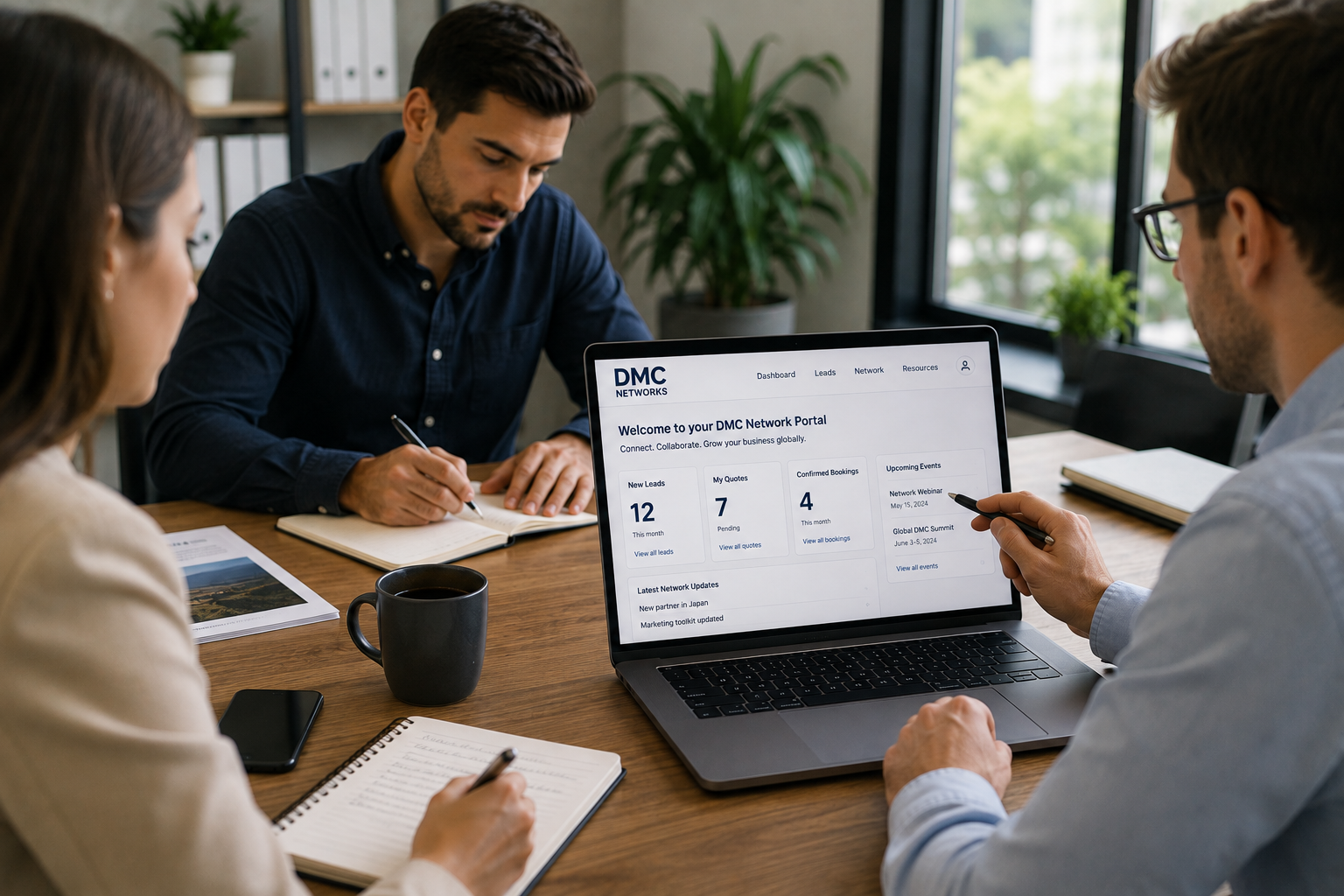
The DMC Network is a clear example of the model in practice. Member agencies keep their own brand and their own ownership, with owner profiles published network-wide, while sharing access to corporate and incentive business. Its footprint runs across North American cities including Chicago, Miami, Las Vegas and Dallas, alongside partners in Costa Rica, Spain and more recently Greece. For a buyer, that means one directory and one service standard instead of vetting each agency separately.
1DMC World takes the worldwide directory approach, organised region by region across Europe, Asia Pacific, the Americas and Africa, then country by country, from the Maldives and Hong Kong to Chile, Portugal and Namibia. That structure makes destination exclusivity the central question for any applicant: the value of membership depends almost entirely on being the recognised partner for your country.
Professional associations
Associations such as SITE, ADMEI or ATTA do not sell on your behalf. They certify, set standards, run education programmes and organise peer events. The return is credibility and relationships rather than direct leads. For a young DMC, an association badge often unlocks the first conversation with a cautious buyer.
Buyer consortia and luxury travel networks
Consortia such as Traveller Made, Virtuoso or Serandipians are built around the agencies and advisors serving high net worth travellers. Membership is curated and genuinely hard to obtain, but it opens a high value buyer pool that is otherwise closed. Selection weighs heavily on service quality and on the exclusivity of your local access.
Regional alliances and DMO-backed groups
National inbound associations and preferred supplier lists run alongside the local destination marketing organisation are the cheapest entry point and the most locally useful. They rarely bring international volume on their own, but they position you for familiarisation trips and MICE bids. Our guide on DMO vs DMC details how that relationship works in practice.
The toolkit: 8 criteria to score a network before you apply
Before paying a single euro, score any network against these eight criteria. Rate each from 1 to 5 and weight the first two double, because they decide whether membership produces revenue at all.µ
- Buyer profile: who exactly are the members buying, and do they run the trip type you actually deliver?
- Lead mechanics: how are RFPs distributed, who owns the client relationship, and can you reach buyers directly?
- Destination exclusivity: are you the only member in your territory, or competing internally with three other DMCs?
- Commercial terms: annual fee, referral percentage, revenue share, and whether fees also apply to renewals.
- Service standards: response time commitments, quote formats and escalation rules you must meet.
- Reporting and tech: the data, formats and platforms the network expects you to feed.
- Vetting depth: a network that barely checks its members carries little credibility with buyers.
- Exit terms: notice period, post-exit client restrictions and what happens to accounts you sourced.
The membership application checklist
Most networks run a formal vetting process. Prepare these items before you apply rather than assembling them under deadline pressure.
- Legal and financial file: company registration, travel licence, professional liability insurance, last two years of accounts.
- Three references from international buyers, ideally in different source markets.
- A sample proposal in your branding, in the buyer's language and currency.
- Your rate structure: net rates, markup logic, seasonality and payment terms.
- Supplier portfolio evidence: contracted hotels, transport, guides and any unique access.
- A written response time commitment for quotes and for emergencies.
- Your sustainability policy and any certification you hold.
- A named account manager plus a backup contact.
The sample proposal is where most applications are decided. A committee reviewing thirty candidates will spend more time on your document than on your company description, so it has to look like the work of an agency that already serves international buyers: clean layout, correct currency, clear inclusions and exclusions. See the five essential DMC software features for how leading agencies produce that standard consistently.
What membership costs and how to measure the return
Cost arrives in three layers, and only the first appears on the invoice. There is the annual membership fee, then the transaction cost of referral percentages or revenue share on every file the network sends, then the operational cost of meeting service levels and reporting obligations. That third layer is routinely underestimated.
To judge the return, track five numbers over a full twelve month cycle: RFPs received, RFP to quote conversion, quote to confirmation rate, average margin on network files compared with your direct business, and total payback against all three cost layers. Network files often convert better but carry thinner margins, so revenue alone will mislead you.
That comparison only works if your margin data is reliable. Tracking projected versus actual margin per file in multiple currencies is what a budgeting tool built for travel handles, while an integrated CRM lets you tag files by source and compare channels honestly.
Turn Network Membership Into Real Pipeline
Networks reward agencies that already operate well. The vetting, the service standards and the reporting obligations all assume you can respond fast, quote accurately and deliver consistently across currencies and languages. Choose one or two networks that match your buyer profile, prepare the application properly, then judge it on real margin data rather than on a gut feeling.
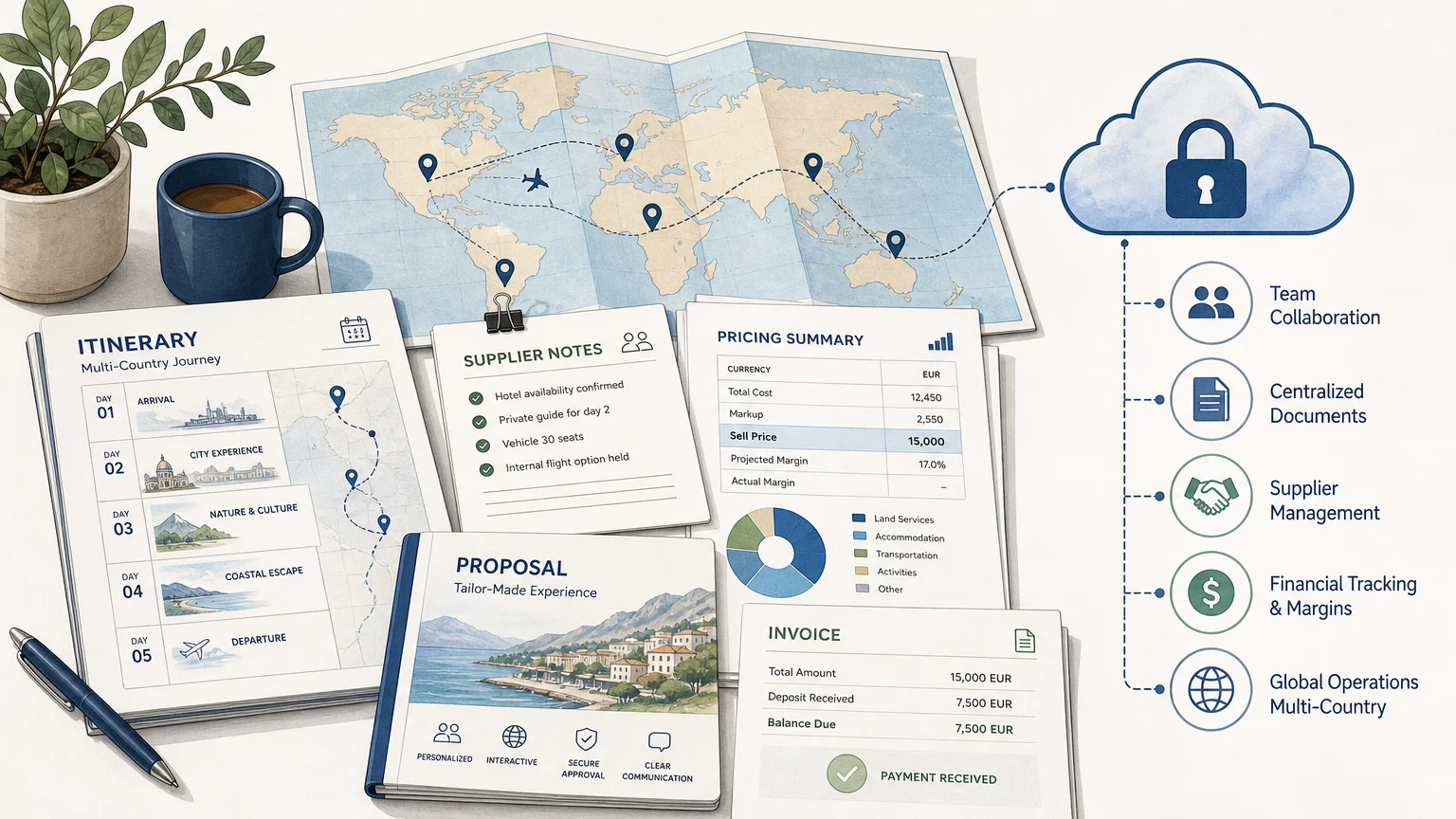
That level of operational readiness is hard to reach with spreadsheets and email threads. Ezus centralises itinerary building, supplier catalogues with net rates, multi-currency budgeting, a travel CRM and one click branded documents in a single workspace, trusted by more than 600 travel agencies, DMCs and tour operators across 70+ countries. Compare the options in our guide to the best DMC software in 2026.
Book a demo with Ezus and discover how to respond to network RFPs faster while protecting your margin on every file.
Frequently Asked Questions
What is a DMC network?
A DMC network is a structure connecting independent destination management companies with international buyers, with each other, or both. Models range from global commercial brands that sell on members' behalf, to professional associations that certify standards, to curated buyer consortia and regional alliances backed by local tourism bodies.
How much does it cost to join a DMC network?
Costs vary widely by model and destination, and they arrive in three layers: an annual membership fee, a referral percentage or revenue share on files the network sends you, and the operational cost of meeting service and reporting standards. Always ask for all three in writing before signing.
Is joining a DMC network worth it for a small agency?
It can be, provided the buyer profile matches what you actually deliver and you can meet the response times. Small DMCs usually get more value from a professional association or a regional alliance first, then move to a global commercial network once operations can absorb the volume.
What do DMC networks look for in an application?
Financial stability, valid licences and insurance, verifiable international references, a strong supplier portfolio, and above all a sample proposal that looks buyer ready. Many committees weigh document quality more heavily than team size.
How can Ezus help a DMC meet network service standards?
Ezus centralises supplier data with negotiated net rates, calculates multi-currency budgets and margins in real time, and generates branded proposals, vouchers and invoices in one click and in several languages. That combination lets a DMC hit tight RFP deadlines without cutting corners on accuracy.
How do I measure whether network membership is profitable?
Track RFPs received, RFP to quote conversion, quote to confirmation rate, and the average margin on network files against your direct business over twelve months. With a platform like Ezus you can tag every project by source and compare true margin per channel.
.jpg)

Join Ezus today
Request a demo today and discover how our software can help you reach new heights.



.jpeg)