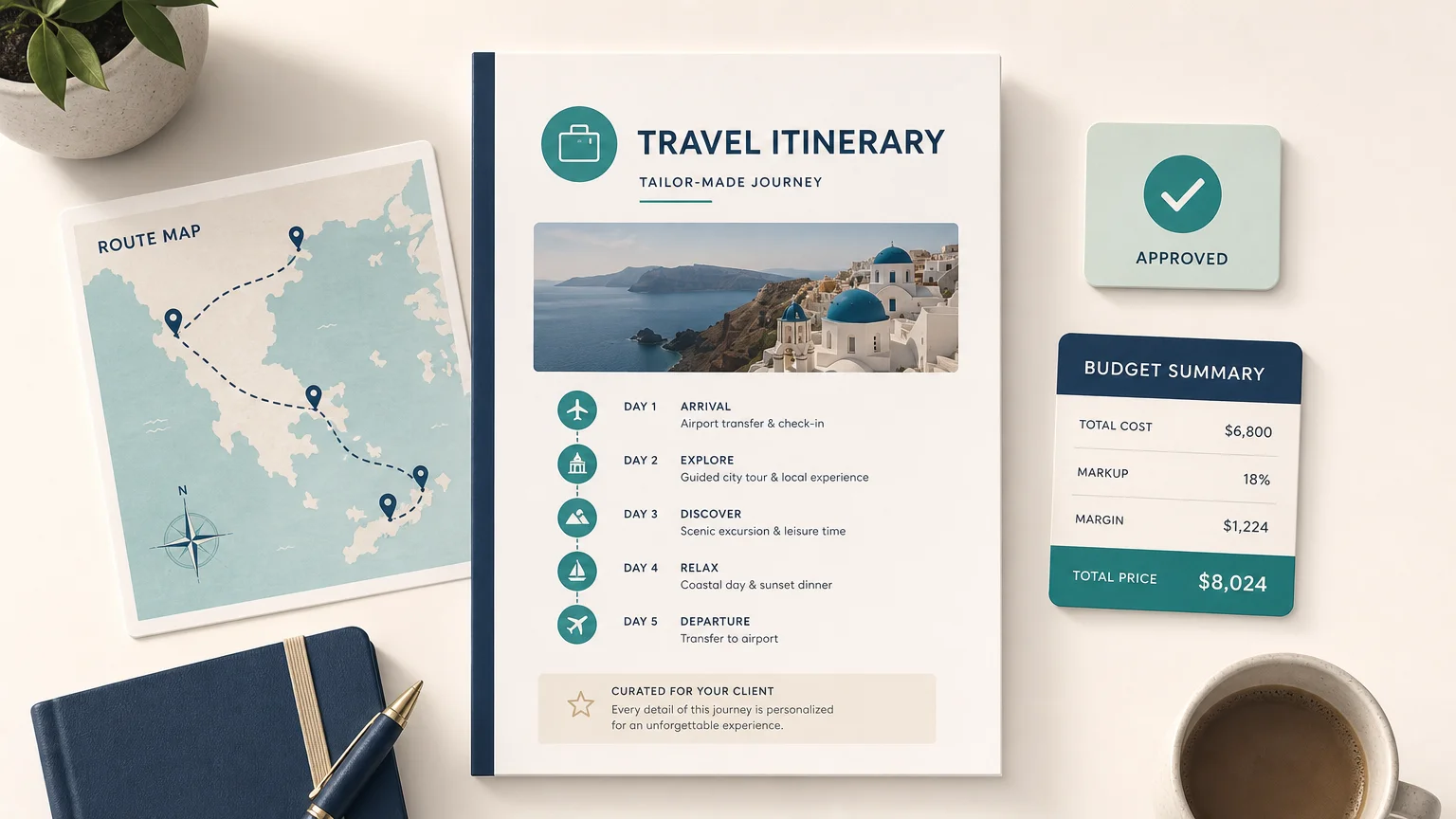

Running a Destination Management Company is nothing like running a standard travel agency. You operate on net rates with B2B markups, juggle multi-country VAT rules, coordinate dozens of local suppliers, and deliver service vouchers to tour operators who expect white-label precision. A generic travel tool built for B2C advisors cannot handle that complexity.
DMC software is a travel management platform built specifically for inbound agencies. It centralizes itinerary building, supplier catalogs with negotiated net rates, multi-currency budgeting, real-time margin tracking, B2B proposal generation, and voucher management in one place. The best DMC software in 2026 depends on your team size, destinations, and operational maturity. Here is a quick ranked overview before the full comparison.
The 7 best DMC software in 2026 at a glance:
- Ezus: best all-in-one DMC software for growing inbound agencies
- Moonstride: best for high-volume B2B DMC operations
- Tourwriter: best for luxury, itinerary-first DMCs
- Toogo: best lightweight back office for French-speaking DMCs
- Lemax: best for standardized packages with live inventory
- TravelStudio: best enterprise-grade option for complex multi-country operations
- WeTravel: best for DMCs focused on group payment collection
What DMC software does (and why generic travel tools fall short)
The core difference is the customer. A DMC serves tour operators and outbound agencies, not end travelers, and that shifts every workflow. You need software that understands commissionable rates, package pricing by supplier tier, seasonal rate cards, confirmation workflows, and operational documents like service vouchers and rooming lists.
The stakes are rising. According to IMARC Group, the global travel technology market reached $11.3 billion in 2025 and is projected to reach $18.7 billion by 2034. DMCs are digitalizing fast to keep pace with global tour operators, and teams still working from spreadsheets lose a large share of every week to manual admin instead of selling destinations.
The 6 features every DMC software must include
Before comparing solutions, you need a clear checklist. These six features separate DMC-ready platforms from generic travel tools:
- Multi-currency and net rate management: convert rates in real time, track both net and commissionable prices, and apply markups automatically.
- Supplier catalog with contracts: centralize hotels, activities, transfers, and guides with negotiated rates, blackout dates, allotments, and payment terms.
- Multi-country VAT and margin scheme: apply the right VAT rule per destination, including the European travel agency margin scheme, without manual calculations.
- B2B proposal and voucher generation: one click to produce branded proposals, service vouchers, and rooming lists.
- Real-time margin tracking: see your projected margin update as you build the itinerary, catching pricing errors before they reach the client.
- Multi-language output: generate documents in EN, FR, ES, IT, PT, or any language your buyers speak.
If a platform misses even two of these, it will cost you hours per file and slowly erode your margins.
The 7 best DMC software compared in 2026
Here is how the seven leading platforms compare across the criteria that matter most to inbound agencies in 2026.
1. Ezus: best all-in-one DMC software for growing inbound agencies
Ezus is a cloud-based DMC platform that connects every back-office function in one workspace. The visual itinerary builder feeds directly into the smart budgeting module, which calculates margins, multi-currency rates, and VAT in real time, while proposals, programs, vouchers, and invoices are generated in one click with your branding. The integrated CRM tracks leads through customizable pipeline stages and the supplier catalog centralizes all partner data. More than 600 DMCs, travel agencies, and tour operators in 70+ countries use Ezus. Its main limitation is the absence of a direct GDS connection such as Amadeus or Sabre, which inbound agencies working with local ground suppliers rarely need.
2. Moonstride: DMC software with a B2B booking focus
Moonstride covers quote creation, reservation management, a booking engine, and accounting, which makes it a fit for larger DMCs with high-volume B2B operations and established tour operator relationships. It is more complex to onboard and better suited to agencies with a dedicated operations team.
3. Tourwriter: itinerary-first DMC software
Tourwriter excels at producing magazine-style itineraries and is popular in the luxury safari segment, so it suits DMCs where the visual quality of the proposal is the main selling point. It is weaker on CRM and sales pipeline features, with less advanced multi-currency and VAT handling for European DMCs.
4. Toogo: French-speaking DMC software
Toogo covers itinerary building, budgeting, and document generation with a focus on the French market, making it a fit for small to mid-sized French-speaking DMCs that want a lightweight, affordable back office. Its international reach, multi-currency, and multi-country VAT handling are limited outside Francophone markets.
5. Lemax: tour operator and DMC software with inventory
Lemax supports B2B and B2C distribution with booking engines and channel manager connectivity, which fits larger DMCs managing standardized packages alongside tailor-made trips with a need for real-time availability. It has a steeper learning curve and is best suited to agencies with mature processes and larger volumes.
6. TravelStudio by Open Destinations: enterprise DMC software
TravelStudio covers the full DMC workflow from sales and operations to accounting integrations, designed for enterprise-grade inbound operators with complex multi-country operations and a dedicated IT budget. Its implementation cost is high and onboarding is long, so it is rarely a good fit for agencies under 10 users.
7. WeTravel: DMC software focused on group payments
WeTravel combines a booking and payment platform with light itinerary and CRM tools, which makes it useful for DMCs running group tours where collecting payments from individual travelers is the main pain point. It is weaker on B2B workflows, supplier management, and advanced budgeting, functioning more as a payment tool than a full DMC back office.
How to choose the right DMC software for your team size
There is no universal best. The right choice depends on your team size, destinations, and maturity. Use this framework to narrow your shortlist:
- Solo inbound agent or small DMC (1 to 3 users): prioritize ease of use, affordable pricing, and fast onboarding. Ezus, Toogo, or Tourwriter are strong starting points.
- Growing DMC (4 to 15 users): look for an all-in-one platform that scales with you and removes Excel from daily operations. Ezus is specifically designed for this stage.
- Established DMC (15+ users, multi-destination): evaluate enterprise solutions like TravelStudio or Lemax alongside flexible platforms like Ezus that handle complex setups without the enterprise overhead.
For a broader comparison covering tour operators and outbound agencies too, see our 2026 guide to the best travel agency software. For a deeper look at the features that matter most, read our guide on the 5 essential features of DMC software.
Transform your DMC operations today
Choosing the right DMC software is one of the highest-leverage decisions an inbound agency can make. The right tool does not just save time, it protects your margins, accelerates your quote-to-confirmation cycle, and gives your team a single source of truth for every operation. Moving from Excel and scattered tools to an integrated DMC platform typically cuts quote production time by half.
Ezus is built specifically for the operational reality of DMCs, with native multi-currency, multi-country VAT, supplier management, and multilingual documents. More than 600 travel agencies, DMCs, and tour operators in 70+ countries trust Ezus to centralize their back office and scale their business.
Book a demo with Ezus and discover how the right DMC software can cut your quote production time in half. Request your free demo here.
Frequently Asked Questions
What is DMC software?
DMC software is a specialized travel management platform for Destination Management Companies, also known as inbound agencies. It centralizes itinerary building, supplier catalogs with net rates, multi-currency budgeting, B2B proposal generation, and operational documents like vouchers and rooming lists. It differs from standard travel agency software by handling B2B workflows, commissionable rates, and multi-country VAT.
How much does DMC software cost?
DMC software pricing typically ranges from $50 to $300 per user per month, depending on features and agency size. Enterprise solutions can cost significantly more with high upfront implementation fees. Most modern cloud platforms, including Ezus, bill annually based on the number of users with no per-booking or per-trip fees.
Is there free DMC software?
A few tools offer a free entry point. WeTravel, for example, is free to use and monetizes through payment processing fees, but it only covers booking and payments rather than full back-office operations. Production-grade platforms that handle budgeting, multi-country VAT, and supplier management are paid, since that depth of functionality is what protects a DMC margin.
How does a platform like Ezus help with multi-currency and multi-country VAT?
Ezus natively converts supplier rates from local currency to your client billing currency in real time, with editable exchange rates per project. It also applies the correct VAT rule per destination, including the European travel agency margin scheme, without manual calculations. This protects your margin on every B2B quote.
Can DMC software handle group operations and rooming lists?
Good DMC software handles group trips, incentive travel, and MICE operations natively. Ezus includes group-specific features like traveler databases, rooming lists, per-person pricing with quantity thresholds, and package building.
What is the difference between DMC software and a travel CRM?
A travel CRM focuses on client relationship management: contacts, pipeline, and communication history. DMC software covers CRM plus the entire operational workflow: itinerary building, supplier management, budgeting, VAT, and document generation. Ezus combines both in one platform.
How long does it take to implement DMC software?
Implementation typically takes 2 to 6 weeks for small to mid-sized DMCs, depending on data migration complexity and team size. Ezus offers a structured onboarding program with dedicated support, video tutorials, and check-ins during the first three months.
.jpg)

Join Ezus today
Request a demo today and discover how our software can help you reach new heights.
.jpeg)