




Summary: Travel management software centralizes booking, quoting, budgeting, and invoicing in a single platform so travel professionals reduce manual work and protect margins. The global market is expanding at double-digit rates, and agencies increasingly adopt these tools to respond faster, cut errors, and gain real-time visibility into costs and performance.
The value of a single quote can hinge on how quickly you send it. For travel agencies and destination management companies, a proposal that arrives in minutes rather than days often decides whether a client books. This is precisely why a modern travel management software has moved from a convenience to an operational necessity, replacing the scattered mix of documents, spreadsheets, and inbox threads that slows teams down. To understand how the right platform fits your budget, you may review our pricing plans before comparing options.
Demand for these tools is accelerating quickly. According to a Research and Markets report, the global travel management software market will grow from $10.28 billion in 2025 to $11.38 billion in 2026, at a compound annual growth rate of 10.7%. That trajectory reflects a broader shift toward centralized, cloud-based systems that streamline planning, booking, and expense tracking across the entire trip lifecycle.
What travel management software actually does
At its core, this category of tools consolidates the many moving parts of a trip into one coordinated system. Instead of juggling separate applications for itineraries, budgets, supplier rates, and client communication, you manage them together. The same market analysis defines these platforms as specialized tools that integrate itinerary planning, flight and hotel bookings, and the management and tracking of travel expenses, with the primary aim of saving time and ensuring efficiency.
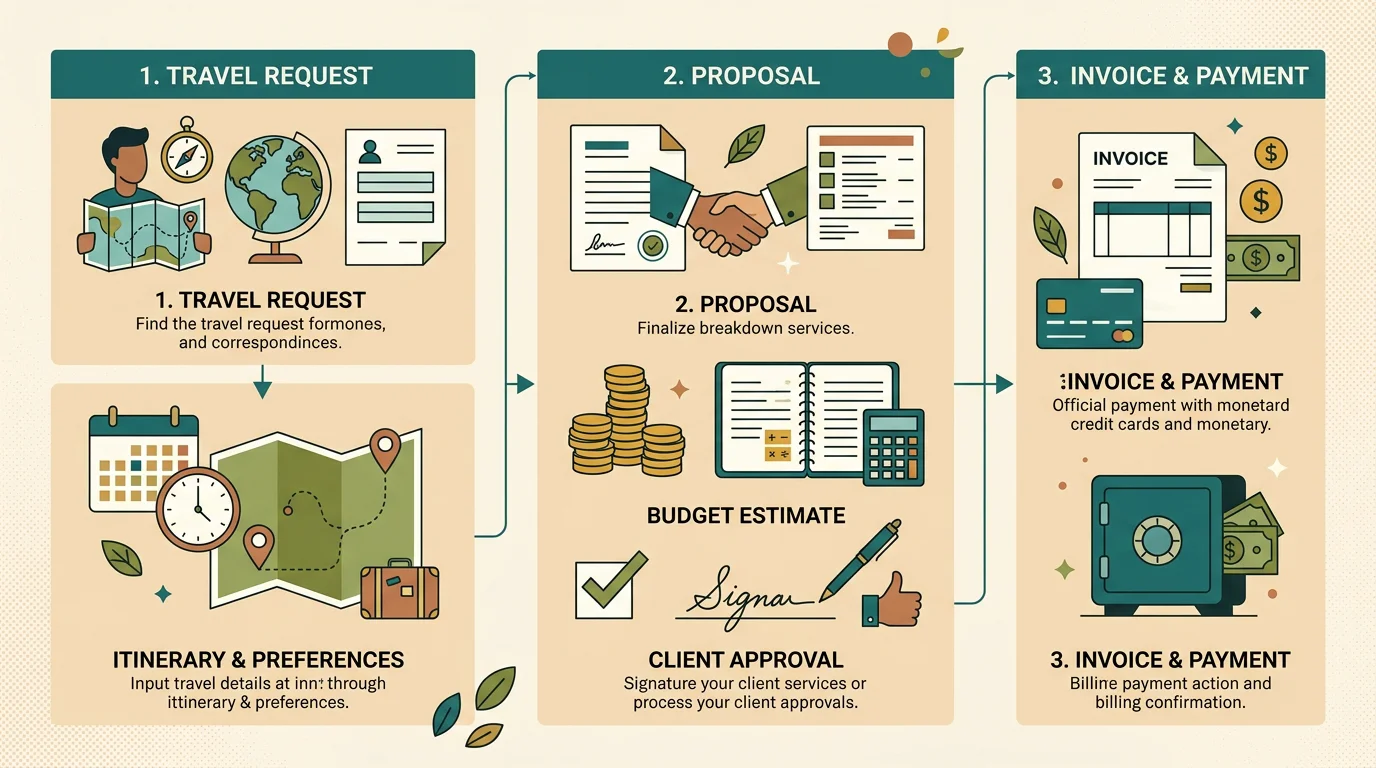
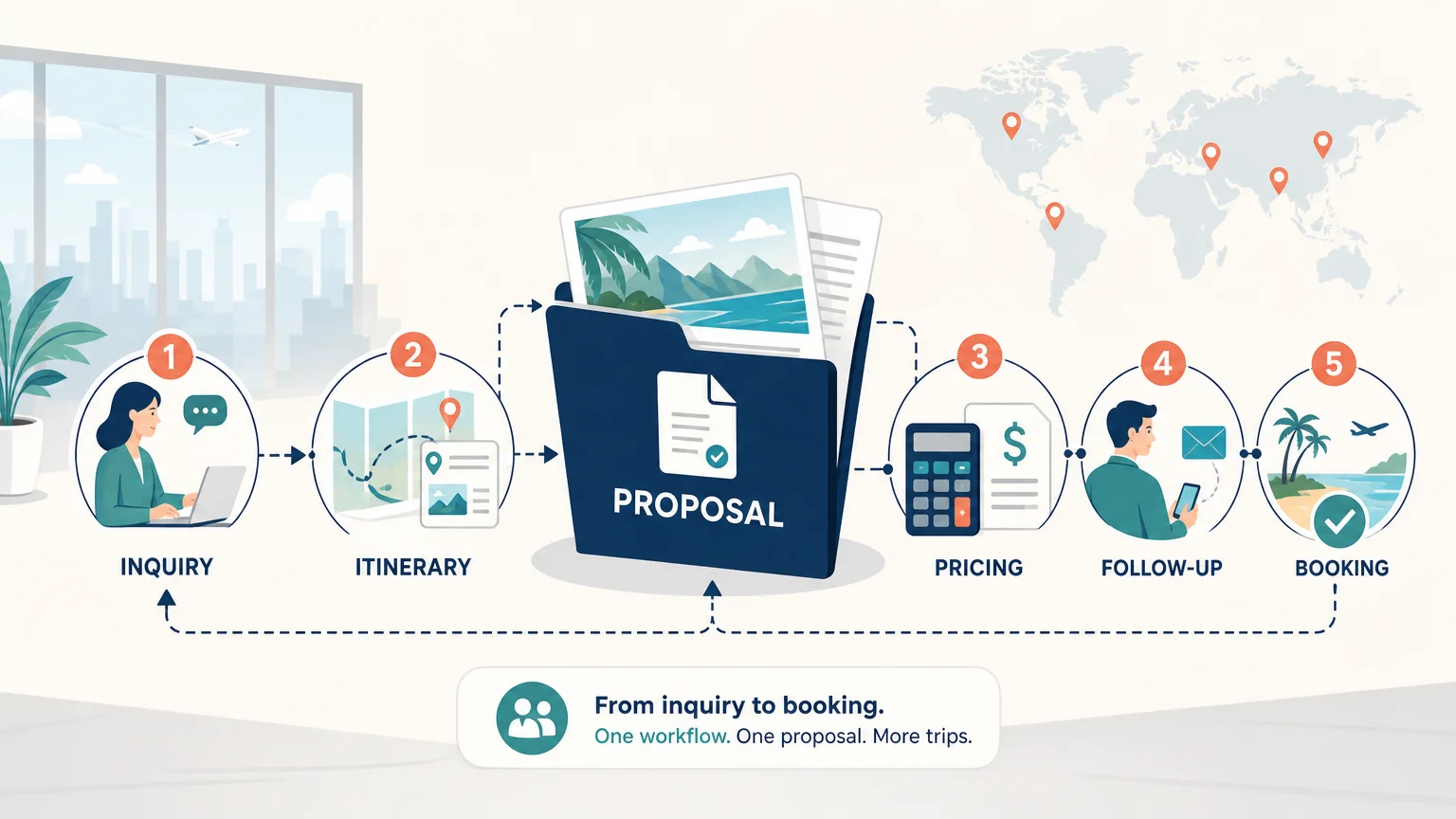
For agencies and DMCs specifically, the scope extends beyond booking. It covers the full commercial workflow: capturing a request, building a costed proposal, securing client approval, and issuing an invoice. Consolidating these steps removes the version-control problems and lost files that plague teams working across disconnected applications. If you are mapping how these workflows apply to your operation, our travel workflow use cases illustrate common scenarios in detail.

Why adoption is rising across the industry
The growth is not confined to large enterprises. Smaller operators are catching up fast because manual coordination no longer scales. Research from Global Growth Insights indicates that around 39% of small and medium-sized enterprises now use automated travel booking and expense reporting tools, primarily to gain clearer visibility into spending and reduce inefficiencies caused by decentralized practices.
Several forces are driving this. International travel volumes have rebounded strongly, and a market study reported by Yahoo Finance noted a 31% increase in international visitors to the United States, reaching 66.5 million travelers in 2023. Rising volumes create complexity that manual methods cannot absorb, which pushes teams toward software that automates bookings, assures compliance, and manages expenses at scale.
Cost pressure adds urgency. Recovery in corporate travel spending has been uneven; Deloitte data cited by Fortune Business Insights found that 34% of corporate travel managers anticipated reaching half of 2019 spending levels, although only 8% actually did. In that climate, controlling every dollar and protecting margins becomes a competitive priority.
Core features to prioritize
Not every platform serves the same audience. Corporate booking tools focus on employee trips and expense reconciliation, while agency-oriented platforms focus on selling and delivering travel to clients. Regardless of category, a strong solution should cover a consistent set of capabilities.
If you would like a deeper breakdown before shortlisting vendors, our guide to essential software features explains what to weigh against your workflow.
The agency and DMC angle: from request to invoice
Here is a distinction that matters. Most widely marketed platforms are built for corporate travel, meaning they optimize how a company books trips for its own employees and controls internal spend. Agencies and DMCs face a different challenge: they sell travel to external clients and must produce polished, profitable proposals at speed.
That is the workflow we designed our platform around. We help you generate a costed, on-brand proposal in one click, share it through a branded client portal, and convert approval into an invoice without rekeying data. Real-time dashboards let you compare projected against actual margins, so profitability is visible before a trip is confirmed rather than discovered afterward. The table below clarifies where different tool types fit.
How to choose the right platform
Selection should start with your operating model, not a feature checklist. A DMC coordinating multi-day itineraries has different needs than a company booking occasional flights. Begin by mapping your actual workflow, then test whether a platform supports it end to end without forcing workarounds.
Weigh a few decisive factors. Consider how the tool handles multi-currency and multi-language operations if you work internationally, how it enforces margin control, and how easily it integrates with the systems you already use. Onboarding support and the depth of customization also determine whether a rollout succeeds. For a structured framework, our guide on choosing agency software walks through the evaluation step by step.
Measuring the return on your investment
The clearest justification for adopting a platform is time reclaimed on repetitive work. When quoting, formatting, and document generation are automated, staff redirect hours toward selling and client relationships. The compounding effect matters: faster responses raise conversion, and speed to quote translates directly into speed to close.
Financial control is the second lever. Manual pricing and currency updates are a common source of revenue leakage, and correcting that with real-time margin visibility protects profitability as volumes grow. With the broader market expanding at double-digit rates through 2030, the operational gap between teams using modern tools and those relying on spreadsheets will only widen.
Bringing it together
Choosing a travel management platform is less about chasing features and more about matching a system to how your team truly works. For agencies and DMCs, the decisive criterion is whether the tool carries a client from initial request through proposal, approval, and invoice while keeping margins visible at every step. Start by auditing your current workflow, identify where manual effort and version conflicts cost you time, and prioritize a solution that closes those specific gaps. The market data confirms the direction of travel; the practical advantage goes to teams that act deliberately rather than reactively.
Take action with Ezus
If your team still moves between documents, spreadsheets, and email to build quotes, the friction is costing you both time and margin. You deserve a single, always-updated system that turns a request into a polished, profitable proposal and then into an invoice without duplicated effort.
With our all-in-one travel agency software, you automate itinerary, budget, and document generation, share branded proposals through a client portal, and monitor projected against actual margins in real time. Built for agencies and DMCs managing the full journey from request to invoice, it helps you quote faster, reduce errors, and protect profitability as you scale. Request a demo to see how it fits your workflow.
Frequently Asked Questions
What is travel management software?
It is a platform that centralizes trip planning, booking, budgeting, and expense or invoice management in one place. For agencies and DMCs, it also covers quoting, client approvals, and proposal generation, replacing disconnected documents and spreadsheets with a single coordinated system.
How is it different from a corporate booking tool?
Corporate booking tools are built for companies managing their own employees' trips and internal spend. Agency-focused platforms, such as our software, are designed to sell travel to external clients, emphasizing fast quoting, branded proposals, and margin control from request to invoice.
Is this software only for large companies?
No. Adoption among smaller operators is rising sharply, with research indicating that roughly 39% of small and medium-sized enterprises already use automated travel and expense tools. Scalable, cloud-based platforms make these capabilities accessible to teams of nearly any size.
How does it help protect profit margins?
It replaces manual pricing and currency updates, a frequent source of revenue leakage, with automated smart pricing and markup tracking. Real-time dashboards let you compare projected against actual margins before a trip is confirmed, so profitability is visible rather than discovered too late.
How long does it take to see results?
Many teams notice time savings quickly, particularly on quoting and document formatting, which previously consumed hours per proposal. The pace depends on onboarding quality and how completely the tool matches your workflow, so tailored support and configuration are important factors in early results.
.jpeg)

Join Ezus today
Request a demo today and discover how our software can help you reach new heights.




.jpg)


.jpg)
