
Summary: Ezus is the strongest choice for travel businesses that need one system for tailor-made trip production, sales, operations, supplier management, and financial control. Other tour operator software options on Capterra suit narrower needs, including DMC operations, luxury itinerary design, group payments, online activity bookings, or reseller distribution.
What should you expect from the best best tour operator software when your team manages complex trips, suppliers, documents, payments, and margins? The answer depends on whether you primarily sell tailor-made journeys, manage inbound operations, process activity bookings, or distribute tours through third-party channels.
The phrase tour operator software capterra usually signals a search for practical comparisons rather than another generic booking tool. Capterra’s category includes systems for reservations, itinerary creation, payments, customer management, pricing, inventory, and distribution. Its listings are useful for building a shortlist, but your final decision should also reflect your production workflow, migration needs, support expectations, and commercial model. Explore the Capterra tour operator category alongside product demonstrations and detailed implementation questions.
How to assess tour operator software on Capterra
The most important distinction is between software designed to produce complete trips and software designed mainly to sell individual activities. A tailor-made operator may need itineraries, supplier rates, branded proposals, client approvals, payments, invoicing, and margin tracking in one workflow. An activity operator may prioritize availability, capacity, point-of-sale tools, waivers, check-in, and online distribution.
For a broader view of travel technology, our best travel agency software comparison explains how travel CRM tools, itinerary builders, and operational platforms differ. The table below focuses on products with identifiable tour operator, DMC, travel production, booking, or distribution use cases.
The order reflects practical fit for travel businesses that need more than an online checkout. It is not a universal score. One planned database name, Odys, was not included because the available public description did not establish an identifiable tour operator software product.
1. Ezus
Best for: Tailor-made tour operators, DMCs, travel agencies, MICE teams, and international travel businesses that need production, sales, operations, and finance in one platform.
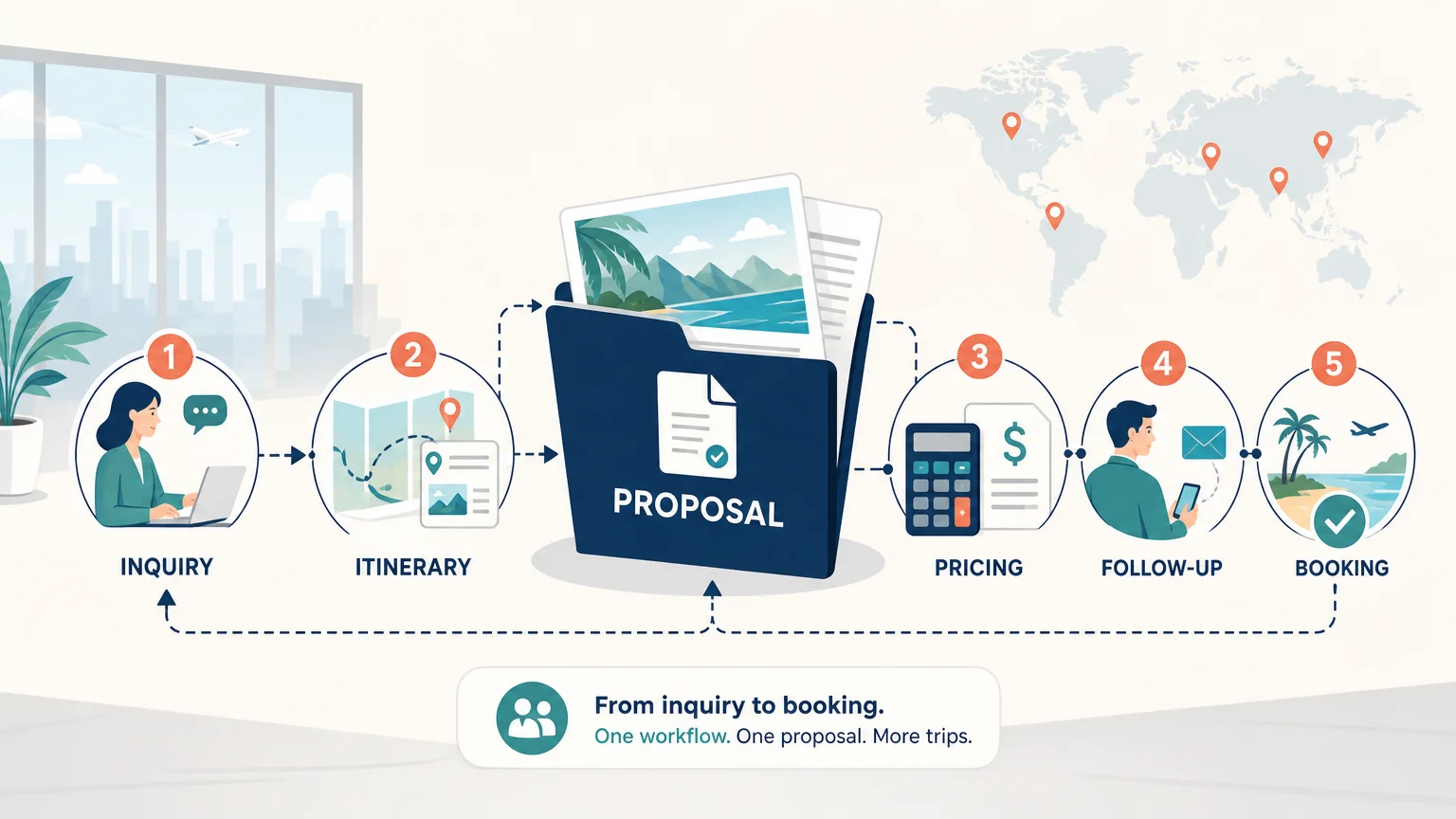
We combine itinerary creation, dynamic budgeting, branded documents, traveler portals, CRM, supplier management, invoicing, payments, and financial tracking in one travel-specific workspace. This makes our platform particularly relevant when your team moves from a client request to a priced proposal, supplier booking, payment, and final invoice.
Our strongest distinction is the connection between travel production workflow and real-time margin control. You can manage costs, markups, currencies, taxes, projected margins, and actual financial results while building the trip. Reusable templates also help teams respond faster without recreating successful programs from scratch.
We report more than 600 agencies using our platform across more than 70 countries. We also report more than 4,000 active monthly users and more than 11,000 unique itineraries created each month. These are company-reported activity figures, but they show the intended scale and international scope of the product.
Pros:
Cons:
2. DMCraft
Best for: Inbound DMCs that manage B2B files, supplier relationships, accounting, and direct experiences from the same operational system.
DMCraft presents itself as an operating system built around DMC workflows. Its modules cover files and bookings, quotes and proposals, accounting, supplier data, experiences, analytics, email, and AI-assisted operations. It also supports both B2B work with agencies and B2C sales through experience pages and booking widgets.
The platform is especially relevant for teams that want to connect operational files with a public experience catalog. Its stated capabilities include real-time margin calculation, supplier contracts and analytics, customizable proposals, online client acceptance, multilingual content, and multi-currency support.
Pros:
Cons:
3. Tourwriter
Best for: Luxury travel designers, boutique DMCs, and bespoke operators producing visually polished multi-day itineraries.
Tourwriter is positioned around the full lifecycle of luxury travel design. Its feature set includes drag-and-drop itinerary creation, travel CRM, automatic pricing, supplier and traveler payments, accounting integrations, booking requests, tasks, analytics, and reporting.
The platform’s focus is particularly attractive when proposal quality and operational control must work together. It can connect supplier resources to an itinerary, calculate pricing, manage bookings, and produce client-facing outputs. Plans start from USD 99 monthly in the reviewed material.
Pros:
Cons:
4. itinovo
Best for: European travel agencies and tour operators that need CRM, quoting, client portals, EU tax workflows, and agency-level pricing.
itinovo combines lead management, quote creation, supplier catalogs, client payments, invoicing, travel documents, email automation, groups, MICE management, analytics, and a branded client portal. Its quote builder calculates costs, markups, margins, and TOMS VAT on margin in real time.
Its strongest point is the depth of its European compliance positioning. The platform includes EU-focused contracts, e-invoicing formats, multilingual documents, EU data residency, and full data export. This can be valuable for agencies that need the operational workflow and the administrative framework to remain connected.
Pros:
Cons:
5. Toogo
Best for: Travel agencies and tour operators that want cloud-based trip building connected to sales, logistics, supplier, and finance processes.
Toogo is described as a cloud-based platform for creating and managing travel products. Its workflow includes detailed itineraries, quotation review, prospect tracking, logistics coordination, financial reporting, supplier relationships, booking automation, vouchers, invoices, confirmations, and payment tracking.
An integrated content management system can support product marketing, while API functionality may help connect existing systems. Toogo is therefore more relevant to a travel business that manages complete programs than to a simple activity provider seeking only a booking widget.
Pros:
Cons:
6. WeTravel
Best for: Adventure tour operators, group travel businesses, retreats, and companies that prioritize bookings, payments, and participant logistics.
WeTravel focuses on the commercial and operational side of organized trips. Its capabilities include itinerary builders with maps, trip pages, package options, add-ons, participant information, inventory tracking, payment plans, automated reminders, digital documents, supplier payments, and team permissions.
International payment support is a major part of its positioning. The platform supports itinerary pricing in 34 currencies and promotes local payment methods for travelers in different markets. This can reduce friction for cross-border group trips, although the exact payment and transaction terms should be reviewed for your destinations.
Pros:
Cons:
7. Travefy
Best for: Travel advisors and smaller travel businesses that want branded itineraries, proposals, CRM, marketing, and client communication.
Travefy brings together itinerary design, proposals, client details, invoices, commissions, marketing tools, communication, and a mobile client experience. Its drag-and-drop builder is suited to advisors who want to present travel plans professionally without assembling documents manually.
The platform also promotes more than 200 supplier integrations, a simple website option, mobile-friendly itineraries, flight updates, and offline access. It is a strong customer-facing tool, but operators with extensive supplier purchasing, complex margins, or back-office finance requirements should compare it against a broader travel production platform.
Pros:
Cons:
8. Bókun
Best for: Tour and activity operators that want online bookings, OTA distribution, reseller partnerships, and centralized availability.
Bókun is built around experience booking and distribution. Its central calendar combines website, OTA, marketplace, affiliate, phone, and walk-in reservations. Other capabilities include product management, capacity rules, resource allocation, customer communications, check-in, reporting, website widgets, payment processors, and reseller tools.
Its distribution network is a central differentiator. The platform connects with more than 70 global OTAs in its reviewed positioning and includes a marketplace for travel and leisure partners. The reviewed offer lists a $49 monthly plan, a 1.5% online booking fee, and a 14-day trial without a credit card.
Pros:
Cons:
9. Peek Pro
Best for: Experience and attraction operators focused on direct online conversion, automation, point-of-sale, and guest experience.
Peek Pro combines online bookings, mobile operations, dynamic pricing, abandoned-booking recovery, digital waivers, scheduling, check-in, POS, guest communications, and reporting. Its platform is designed for tours, activities, rentals, and attractions that need to manage high volumes of guest transactions.
The company states that operators see an average 30% revenue increase. This is a company-reported performance figure, not a universal result. Peek Pro uses custom, commission-based pricing, so buyers should calculate the total cost against direct bookings, OTA sales, payment volume, and operational savings.
Pros:
Cons:
10. Rezdy
Best for: Tour and activity businesses that need booking automation, reseller distribution, payment gateways, and international channel connections.
Rezdy provides online booking, tour management, automated communications, reporting, billing, channel management, reseller connections, and payment tools. Its platform is designed for operators that want to control direct bookings while reaching local and global distribution partners.
The reviewed product information highlights more than 25,000 resellers, more than 100 countries, support for around 90 currencies, and more than 30 payment gateways. It also promotes a 21-day trial and unlimited products, users, and connections on its plans.
Pros:
Cons:
11. Checkfront
Best for: Experience businesses that need flexible booking types, resource management, payments, notifications, and waivers.
Checkfront focuses on making activities bookable while controlling the operational details behind each reservation. Its features include daily, multi-day, timeslot, and flexible-time bookings, real-time availability, automated resources, deposits, installment options, notifications, digital waivers, seasonal pricing, private bookings, and OTA connections.
This makes Checkfront practical for businesses managing capacity, equipment, schedules, and customer communications. It is less clearly positioned around complex tailor-made proposals, multi-stage supplier purchasing, or full travel-agency financial production, so those requirements should be tested during a demonstration.
Pros:
Cons:
Which tour operator software should you choose?
The right platform depends on the commercial engine behind your business. Choose an activity-focused system when availability, capacity, online checkout, POS, waivers, and OTA distribution drive your revenue. Choose a travel production platform when your team must build complex itineraries, manage supplier rates, create branded proposals, follow approvals, collect payments, and protect margins.
For international DMCs, tailor-made agencies, and tour operators that need those workflows connected, tour operator software for production and operations offers a broader foundation than a booking engine alone. Before signing, test a real client request, import sample supplier data, review the margin calculation, and confirm the cost of onboarding, users, payments, integrations, and future expansion.
See how our tour operator software fits your workflow
If your team is moving between spreadsheets, documents, email threads, supplier files, and separate payment tools, the right platform can create a more consistent operating process. We help travel businesses structure trips, standardize proposals, collaborate across departments, and maintain visibility from the first request to the final invoice.
Our tour operator software combines itinerary creation, quotation, dynamic budgeting, CRM, supplier management, branded documents, traveler portals, invoicing, payments, and financial tracking. Plans start at €75 per user per month when billed annually, with a mandatory €1,990 onboarding package excluding tax. Request a demonstration using your own travel workflow and assess the fit before implementation.
Frequently Asked Questions
What is tour operator software?
Tour operator software centralizes the processes used to design, price, sell, and manage trips. Depending on the platform, it may include itinerary building, booking management, supplier data, CRM, payments, customer communication, invoicing, reporting, and margin control.
Which option is best for tailor-made travel?
Ezus, Tourwriter, itinovo, DMCraft, and Toogo are the most relevant options in this selection for complete or bespoke travel workflows. Your choice should depend on the depth of itinerary production, supplier management, financial control, localization, and client portal functionality you require.
Which tools are best for online activity bookings?
Bókun, Peek Pro, Rezdy, Checkfront, and WeTravel are strong candidates for activity, experience, group, or booking-led businesses. Compare availability, resource management, payment processing, channel connections, waivers, check-in, and the cost of booking fees.
Are Capterra ratings enough to choose a platform?
No. Ratings can help you identify products worth reviewing, but they do not show whether a system matches your internal processes. Test a real itinerary, quotation, supplier booking, payment, and reporting workflow before making a decision.
What onboarding costs should a buyer investigate?
Review implementation fees, training, migration, custom templates, integrations, user additions, payment charges, and annual renewal terms. For example, our plans include a mandatory €1,990 onboarding package excluding tax, while formatted data import and other optional services may be priced separately.
.jpeg)

Join Ezus today
Request a demo today and discover how our software can help you reach new heights.




.jpg)

.avif)