


Summary: The best software for a small travel agency centralizes quoting, itineraries, CRM, invoicing, and payments in one platform. Prioritize automation, a branded client portal, multi-currency support, and transparent pricing. These features reduce manual work, protect margins, and let a lean team respond to travel requests in minutes rather than days.
How much time does your team lose switching between spreadsheets, inboxes, and disconnected booking tools? For a lean agency, that friction directly slows sales. The global market for travel agency software was worth roughly USD 1.2 billion in recent estimates, and a large share of that momentum comes from smaller operators modernizing their operations. Adopting the right travel agency CRM is now a competitive necessity rather than a luxury for independent agencies and destination management companies.
Choosing travel agency software for small business means finding one system that handles requests, quotes, and invoicing without an army of administrators to run it. According to market analysts, the sector is projected to reach around USD 2.5 billion by 2034, growing at a 9.2% compound annual rate. That expansion reflects a clear shift: agencies of every size now compete on speed, personalization, and margin control.
Why small agencies need dedicated software
A brick-and-mortar approach built on Word, Excel, and email breaks down as request volume grows. Version mismatches, lost files, and slow replies cost bookings. This is exactly why demand for a purpose-built travel agency management system keeps rising among independent operators. According to industry research, small and medium-sized enterprises already account for roughly 35% of the travel agency software market, and demand for automation drives around 45% of overall market growth.
The same research notes a real hurdle: about 20% of small businesses cite the high initial investment of advanced systems as a barrier. The answer is not to avoid software, but to choose a platform that scales with you and delivers measurable time savings from day one. When you understand how to choose travel agency software, you can avoid overpaying for enterprise features a small team will never use.

Core features to look for
Not every platform delivers the same value, and the features that matter most depend on your workflow. For a small agency or DMC, the goal is one connected system rather than a patchwork of tools. Before comparing vendors, review these essential features to look for and match them against your daily tasks.
Our platform was built to automate these essentials, so a small team can generate a polished, on-brand proposal in one click and share it through a branded portal for fast client approvals.
Comparing options for a small agency
Direct comparison clarifies the trade-offs between all-in-one platforms and narrower booking tools. The table below uses publicly available details to position each option by focus and entry pricing. Our software appears as the most complete fit for agencies that want request-to-invoice workflows in a single place.
Booking-centric tools cover reservations well but often leave quoting, budgeting, and margin tracking to separate systems. An all-in-one toolkit removes those handoffs, which matters most when a small team wears many hats.
Turning speed-to-quote into speed-to-close
Speed is now a decisive advantage. Agencies that reply to a travel request in minutes win work that slower competitors lose. According to Reports and Data, agencies entered recent years under pressure to defend margins as airline distribution fees and dynamic pricing reduced commission predictability. Automated pricing and quoting tools are the direct response to that squeeze.
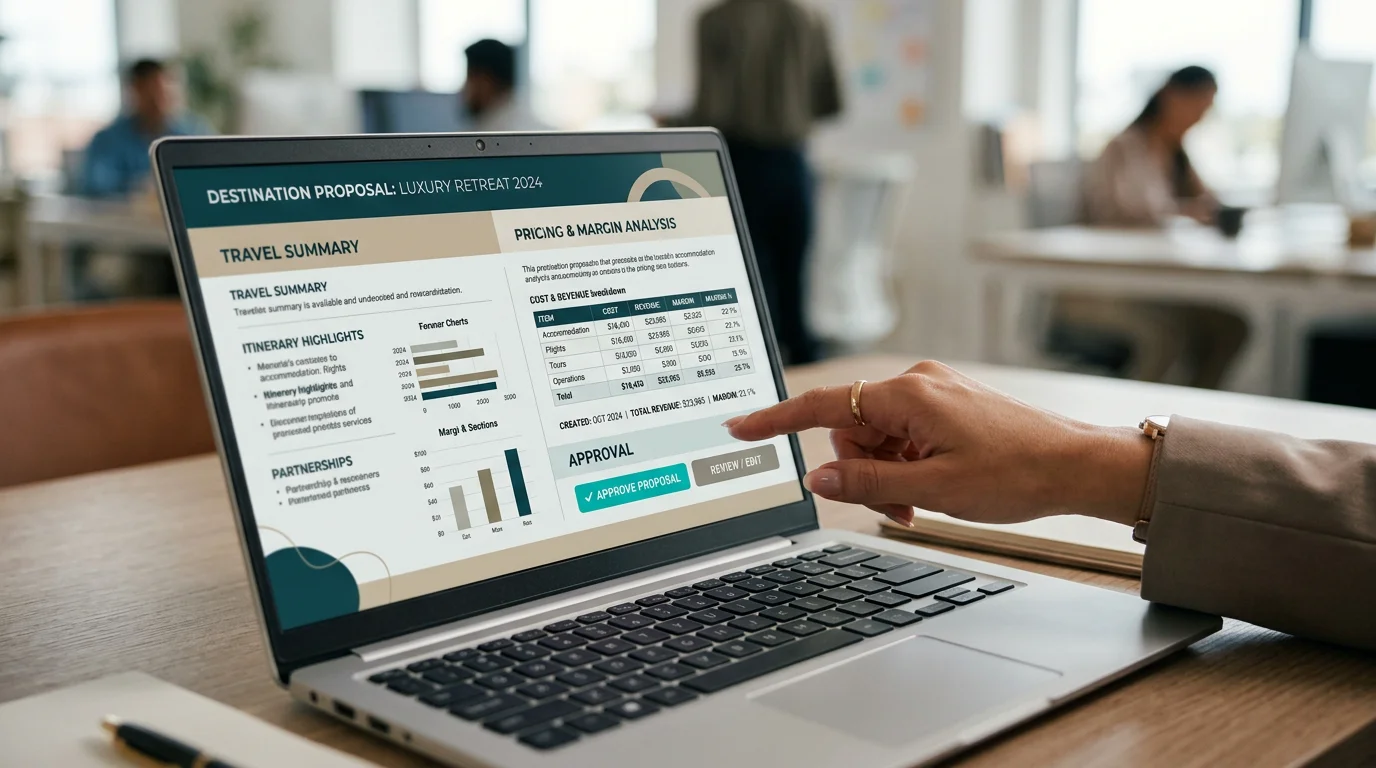
This is the differentiating value of a connected platform. When itineraries, budgets, and proposals are generated automatically, your team spends time selling rather than formatting documents. Our smart pricing dashboards compare projected versus actual margins in real time, so you can adjust markups and protect profitability before a quote goes out. Reducing manual steps also lowers the errors that quietly erode revenue.
Understanding the cost
Pricing models vary widely, from flat monthly subscriptions to per-user plans and per-booking fees. For a small agency, transparent and predictable pricing usually beats complex enterprise contracts. Before committing, it helps to understand how much travel agency software costs across different models and what drives the total.
The good news is that entry barriers are falling. Reports and Data also observed that subscription pricing and modular deployment have lowered the cost of entry for independent agencies that previously relied on manual operations. Evaluate the return, not just the sticker price: a tool that saves several hours per quote pays for itself quickly when your team handles dozens of requests each month.
Planning for growth and integrations
Scalability should shape your decision even if you are a two-person team today. The broader travel technology market is expanding fast, which signals rising expectations from clients and suppliers alike. The travel management software segment is projected by The Business Research Company to reach USD 16.08 billion by 2030, driven by cloud adoption and integration with payment and booking systems.
Choose a platform that supports multi-currency, multi-language, and multi-brand operations, and that connects to the wider tools in your stack. Our system links to thousands of applications, so quotes, payments, and data stay synchronized as you add destinations, brands, and team members. That flexibility prevents the costly migration many agencies face when they outgrow a narrow tool.
Final thoughts
Selecting the right software for a small travel agency comes down to consolidation: fewer tools, less manual work, and clearer visibility into margins. Prioritize automation, a branded client portal, smart pricing, and honest pricing over long feature lists you will never use. Start with your most painful workflow, test a platform against it, and confirm that it scales as your bookings grow. A focused, well-integrated system frees your team to do what technology cannot, namely building relationships and designing memorable trips.
Take action with Ezus
If juggling documents and disconnected tools is slowing your quotes, a single connected workspace changes the daily reality for your team. You gain time back on every proposal and a clearer view of your margins.
With our all-in-one travel agency and DMC platform, you can manage travel workflows from request to invoice in one place, generate branded proposals in one click, collect client approvals through a portal, and track budgets with real-time margin visibility. Built for agencies, DMCs, and tour operators, it helps you respond faster, reduce errors, and protect profitability as you scale. Book a demo to see how much time your team could save on every quote.
Frequently Asked Questions
What does travel agency software actually do?
It centralizes the operations of a travel business in one system, from client requests and quotes to itineraries, invoicing, and payments. Good platforms automate document creation and reporting, which reduces manual work and errors. This lets a small team manage more bookings without adding staff.
Is dedicated software worth it for a very small agency?
Yes, because the time saved on quoting and administration usually offsets the subscription cost quickly. Even a two-person agency benefits from automated proposals, a shared CRM, and real-time margin tracking. Look for a plan that scales so you do not have to migrate systems later.
How much should a small travel agency expect to pay?
Pricing ranges from roughly $35 to well over $100 per user each month, and some tools add per-booking fees. Focus on the value returned rather than the lowest price, since a platform that saves hours per quote pays for itself. Free trials help you compare real workflows before committing.
Can one platform replace my spreadsheets and email tools?
An all-in-one system is designed to do exactly that by combining quotes, CRM, budgets, and invoicing. Our platform centralizes these tasks so you eliminate version mismatches and lost files. That consolidation is often the single biggest efficiency gain for a small agency.
What features matter most when choosing?
Prioritize automated document generation, instant quoting with branded proposals, integrated CRM, smart pricing with margin visibility, and multi-currency support. Broad integrations with your payment and accounting tools also matter. Match these features against the workflow that currently causes the most friction.
.jpeg)

Join Ezus today
Request a demo today and discover how our software can help you reach new heights.







.jpg)


