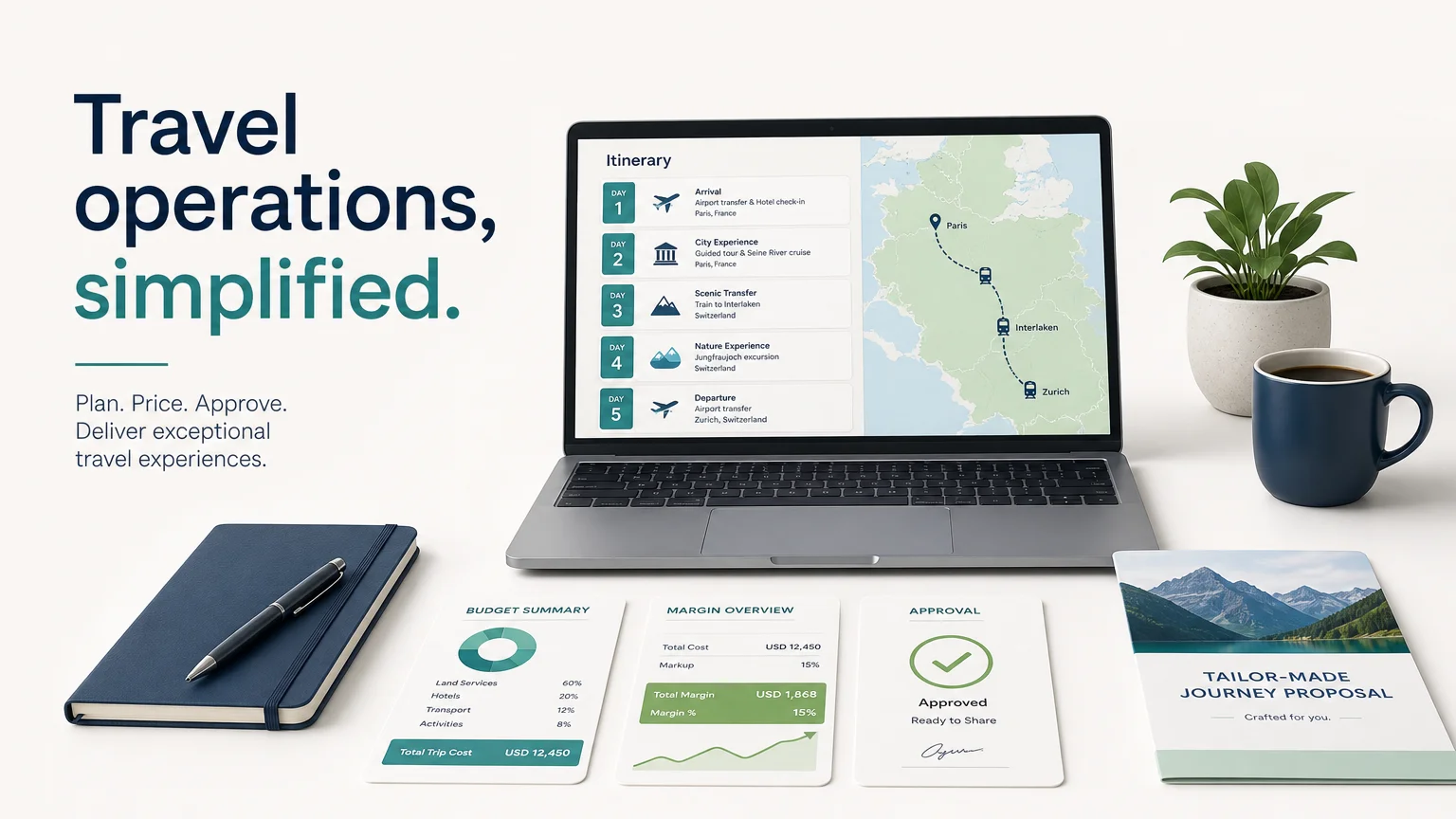
Summary: Company travel software centralizes bookings, policies, expenses, approvals, reporting, and traveler support for organizations managing business trips. However, travel agencies and corporate travel departments need different workflows. The right choice depends on whether you manage employee travel or design, sell, and operate tailor-made trips for clients.
When travel requests, supplier details, budgets, approvals, and documents live in separate tools, even a simple trip can create unnecessary administrative work. A clear system should match your operating model, not merely offer a long feature list. For agencies designing bespoke journeys, our travel management software connects the commercial and operational stages of trip production.
The phrase company travel software often describes corporate travel management platforms, but it can also refer to software used by travel businesses. These categories overlap around booking data, reporting, and automation, yet their users, workflows, and success measures are different. Understanding that distinction is the first step toward a sound purchase decision.
What does company travel software actually manage?
Corporate travel software usually manages employee travel from trip request to expense reconciliation. It may provide online booking for flights, hotels, rail, and rental cars, while applying travel policies and approval rules before payment is made.
These systems often serve finance, human resources, procurement, travel managers, and employees. Their priorities include approved supplier usage, budget control, traveler visibility, expense capture, reporting, and duty of care. The platform is designed around business travel purchased by an organization for its own workforce.
Travel agency software supports a different commercial process. A travel agency, DMC, tour operator, or MICE company may need to transform a client brief into a detailed itinerary, supplier program, quote, proposal, approval workflow, booking file, invoice, and payment record.
That distinction changes the meaning of essential functionality. A corporate travel department may prioritize policy compliance and employee self-service. A tailor-made travel business may prioritize dynamic budgeting, markups, reusable itineraries, branded proposals, client portals, supplier management, and projected versus actual margins.
Why does workflow fit matter more than feature volume?
Consider two organizations planning international travel. The first needs employees to book approved flights and hotels. The second needs consultants to design a multi-country itinerary, collect supplier costs, apply markups, present a branded proposal, and revise the program after client feedback.
Both organizations need centralized information, but they do not need the same operating system. A corporate booking platform can be unsuitable for a DMC because it may not support detailed itinerary production, client-facing proposals, supplier catalogs, or travel-agency financial workflows.
The reverse is also true. A platform built for travel sellers may not provide the employee policy controls, corporate card connections, traveler tracking, or expense automation expected by a corporate travel department.
Adoption is another important test. The 2026 Skift research reported that 80% of surveyed travelers sometimes book outside their company platform. The same report found that group booking remained manual for many organizations, while many travelers spent more than 30 minutes filing expenses.
These findings illustrate a practical principle: a platform only improves control when users accept it as part of their normal work. If the booking experience is inconvenient, or if the system does not reflect the way teams actually sell and operate travel, employees and travel professionals may return to email, spreadsheets, consumer websites, and disconnected documents.
Which capabilities should you compare before buying?
A structured comparison should begin with your highest-value workflow rather than with individual features. For most organizations, the following capabilities deserve close attention:
Ease of use should be evaluated alongside depth. A technically powerful system can still create friction if users require excessive training, repeat data entry, or manual formatting. Review the number of steps needed to create a trip, change a price, update a supplier service, request approval, and produce a final document.
For a travel agency, our essential travel software features cover the practical areas that connect production, sales, operations, finance, collaboration, and client communication. This type of joined-up workflow is more relevant than a platform that only handles booking or expense reporting.
How can software improve margins and operational consistency?

Margin control begins before a client receives a proposal. Teams need to know what each service costs, how a markup is applied, which currency is being used, and how changes affect the total price.
When this work happens in separate spreadsheets, a revised hotel, transfer, or activity can create mismatched totals. Sales may use one version, production another, and finance a third. The problem is not only time. It is the risk of quoting an incorrect price or accepting a booking with an inadequate margin.
A suitable travel-business platform can connect supplier data, itinerary items, budgets, quotations, invoices, and payment records. It can also show projected and actual financial results at trip level. This gives managers a clearer basis for deciding whether to adjust a markup, replace a supplier, or renegotiate a component.
Templates add another layer of consistency. A successful itinerary can be saved with its structure, destinations, content, products, pricing logic, and supporting documents. Teams can then duplicate it for a new request instead of rebuilding every trip from an empty file.
For agencies managing multiple destinations or brands, our software for travel businesses is designed to bring these commercial and operational activities into one configurable workspace. The value comes from reducing repeated work while preserving the flexibility required for tailor-made travel.
What do implementation and governance involve?
Implementation is often treated as a technical task, but it is also a process design exercise. Before selecting software, identify who owns the system, which data must be migrated, which documents need redesigning, and how users will be trained.
Budget pressure makes this planning especially important. In Deloitte’s 2025 corporate travel study, 68% of travel managers said they expected to expand travel budgets for 2026, while cost remained a major restriction on travel decisions. The Deloitte travel study shows why organizations need visibility before they commit to additional travel activity.
Ask vendors to separate recurring subscription costs from onboarding, migration, training, customization, support, and integration charges. A low subscription price may not represent a low total cost if your team must spend months preparing data or maintaining manual connections.
Governance should cover user rights, approval responsibilities, document ownership, data retention, security, and export procedures. It should also define what happens when an employee changes role, a supplier changes rates, a brand adds a new market, or a business opens another account.
For travel agencies, onboarding should include workflow configuration and practical training. The goal is not simply to activate user accounts. It is to ensure that the system reflects how your team receives requests, builds programs, manages suppliers, produces proposals, collects payments, and tracks profitability.
What should international teams verify?
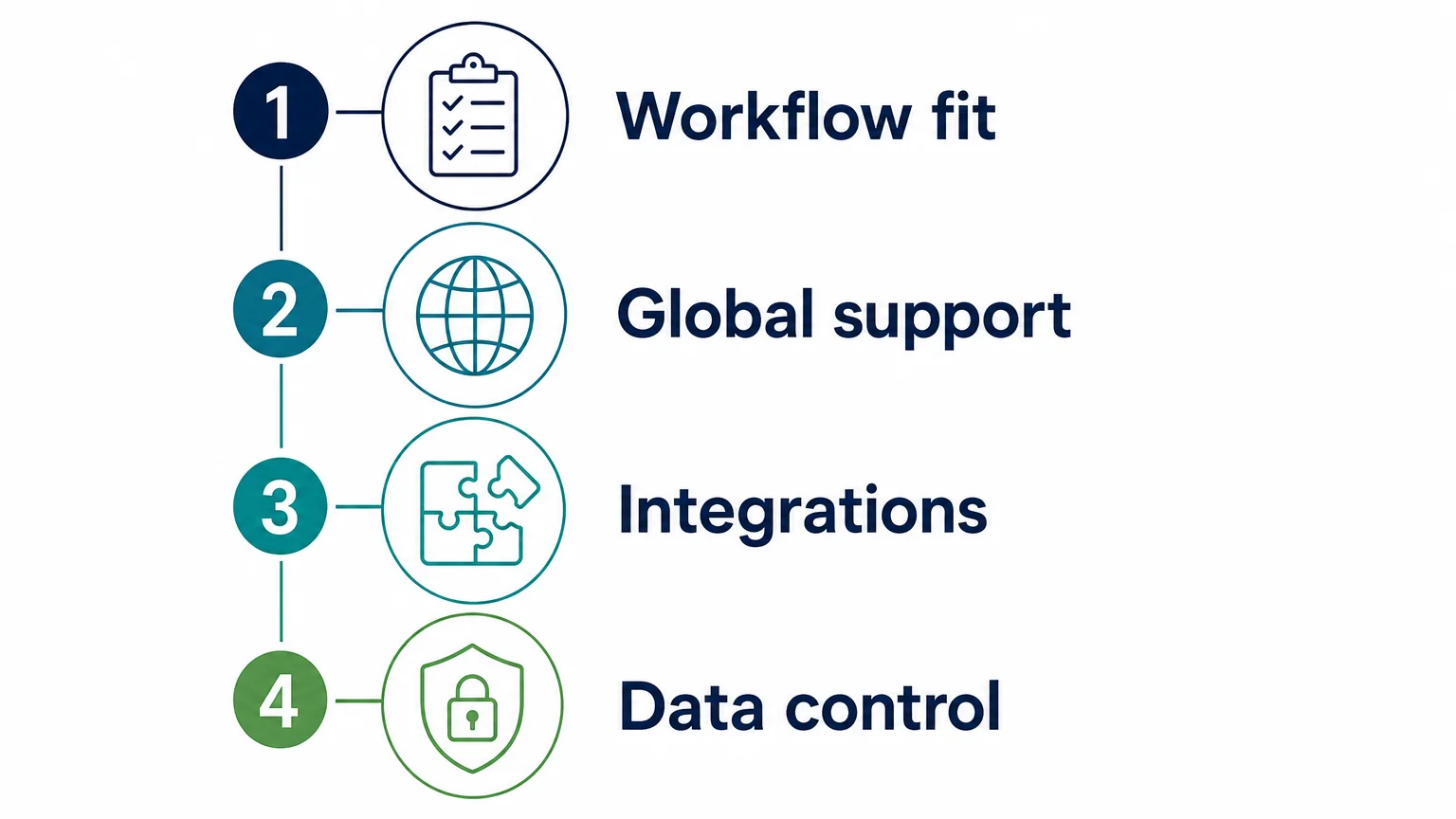
International operations add complexity that may not appear during a basic product demonstration. A platform must support the currencies, languages, legal entities, brands, destinations, and working practices relevant to your organization.
Global travel programs also face fragmented data. In a March 2026 survey of corporate travel buyers, the GBTA research found that 61% reported challenges managing global travel programs, while 72% identified hotel booking price differences as a major pain point.
For corporate buyers, verify whether the software consolidates bookings from the channels employees actually use. Confirm whether it supports negotiated rates, traveler profiles, approvals, expense exports, disruption alerts, and reporting across entities.
For travel sellers, verify whether the platform supports multilingual documents, multi-currency budgets, multi-country itineraries, multiple brands, role-based access, and client portals. You should also examine how supplier information is updated and whether teams can work with different tax or invoicing requirements.
Integration claims require particular care. Ask whether a connection is native, API-based, file-based, or dependent on a third-party connector. Request a demonstration using your own CRM, accounting process, payment workflow, or data export requirements instead of accepting a generic integration list.
How should you choose between corporate and travel-business software?
Start by naming the transaction you need to manage. If your organization purchases travel for employees, focus on corporate travel management. If your organization designs and sells journeys for clients, focus on travel production and sales software.
Do not compare platforms only by the number of destinations, integrations, or automation features they advertise. Compare the amount of manual work that remains after implementation, the quality of the data produced, and the extent to which the system supports your revenue model.
The strongest selection process also includes the people who will use the platform every day. Sales, production, finance, operations, procurement, and management may evaluate the same system differently. Their shared requirements should shape the final decision.
Choose software that matches your travel model
The right company travel software solution is not defined by its feature count. It is defined by how well it supports the work your organization actually performs, whether that means employee booking and expense control or the complete production and sale of tailor-made journeys. Clarify the buyer, the workflow, the financial risks, the required integrations, and the international operating model before comparing vendors. A focused evaluation will produce a more reliable choice, smoother adoption, and better visibility across every trip.
Take action with Ezus
If your team designs, sells, and operates tailor-made travel, you need more than a booking tool. You need a structured workspace that connects client requests, itineraries, budgets, proposals, approvals, suppliers, invoicing, payments, and financial tracking without forcing teams to recreate information in separate files.
Ezus supports travel agencies, DMCs, tour operators, MICE teams, and other travel professionals with configurable workflows, reusable project templates, branded proposals, traveler portals, collaboration tools, and international capabilities. To evaluate how the platform fits your processes, explore our travel agency software and request a demonstration based on your own use cases.
Frequently Asked Questions
What is company travel software?
Company travel software helps organizations manage business travel, including requests, bookings, policies, approvals, expenses, reporting, and traveler information. The term can also refer more broadly to software used by travel businesses, so you should clarify the intended workflow before comparing products.
Is corporate travel software the same as travel agency software?
No. Corporate travel software generally manages employee travel purchased by an organization, while travel agency software supports the design, pricing, sale, and operation of trips for clients. Some capabilities overlap, but the financial and operational models are different.
Which teams should be involved in the purchase?
Include the people responsible for travel, finance, procurement, operations, sales, technology, and data protection. Their combined input helps you assess adoption, reporting, integrations, permissions, implementation effort, and long-term ownership cost.
What should you test during a software demonstration?
Use a realistic workflow that includes a request, changes, approvals, pricing, documents, supplier information, and reporting. For a travel agency, test a complete bespoke itinerary rather than reviewing isolated features.
Can Ezus support international travel businesses?
Ezus is designed for travel agencies, DMCs, tour operators, MICE teams, and tailor-made travel professionals operating across destinations and markets. Its stated capabilities include multilingual and multi-currency workflows, multi-brand operation, customizable rights, supplier management, client portals, integrations, and financial tracking.
.jpeg)

Join Ezus today
Request a demo today and discover how our software can help you reach new heights.