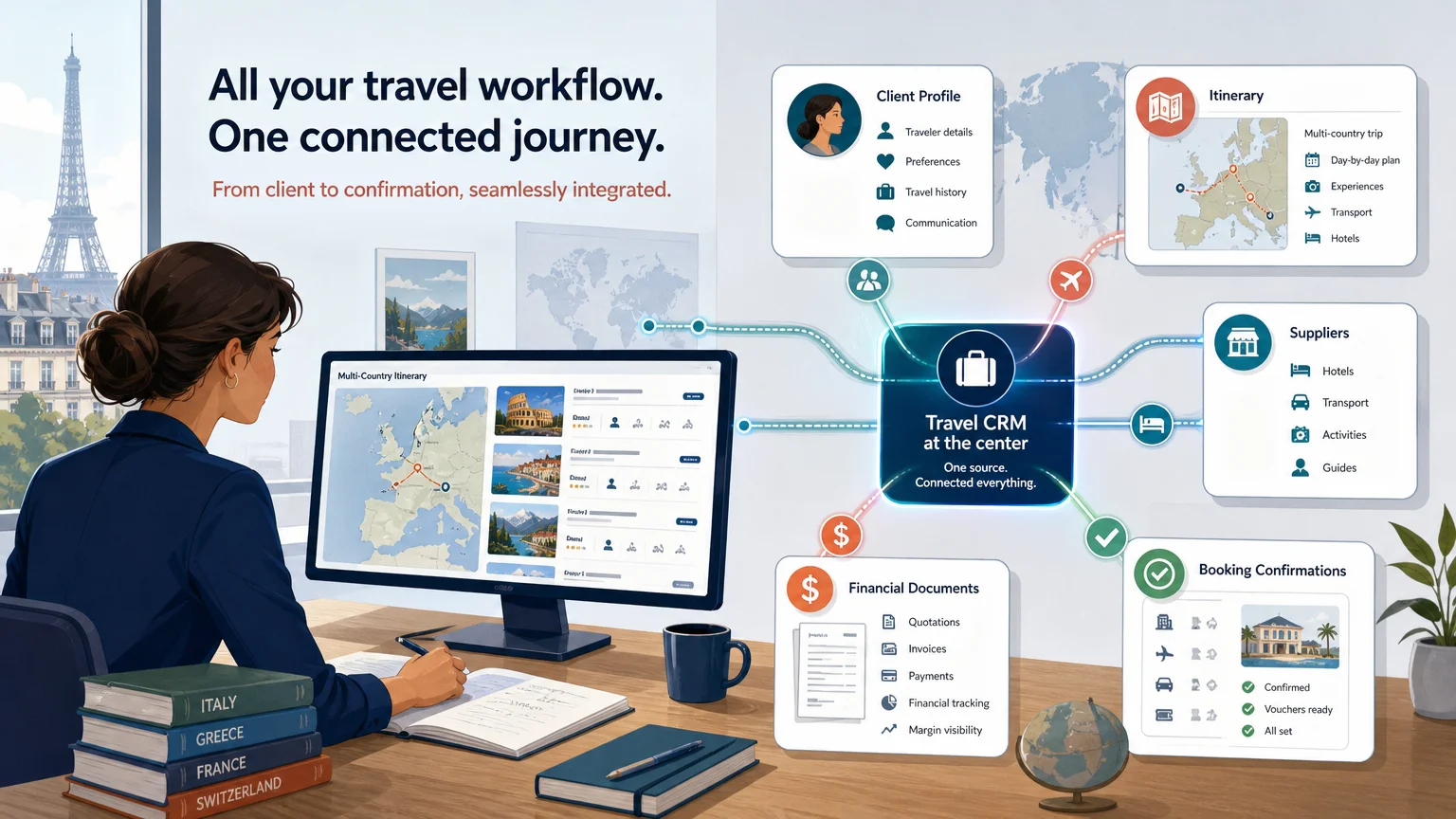
Summary: Travel agent platforms centralize quoting, itinerary building, client management, and invoicing in one system. The strongest options in 2026 reduce manual formatting, protect margins with real-time visibility, and automate proposals. Choosing well depends on your workflow scale, your need for multi-currency operations, and how quickly the software turns an inquiry into a confirmed, paid trip.
The global travel agency software market reached roughly USD 1.14 billion in 2026, and it continues to expand as agencies replace spreadsheets with connected systems. Behind that growth sits a practical problem: too many teams still juggle Excel, Word, and inboxes to build a single quote. If that describes your daily reality, our travel agency CRM for managing clients illustrates how a unified workspace removes that friction. The right travel agent platforms replace disconnected tools with one coherent flow from request to invoice.
Demand is not slowing. According to market research, the sector is projected to grow at an 8.9% compound annual rate through 2035. As competition intensifies, the software you choose shapes how fast you respond, how accurately you price, and how confidently you scale.
What travel agent software actually does
At its core, this category of tools consolidates the operational work of selling travel. Travel agency software manages reservations, itinerary creation, customer records, invoicing, and supplier connections through one centralized interface. Instead of copying data between applications, your team works from a single source of truth.
The practical value is measurable. Industry analysis notes that agencies adopt these systems to reduce manual booking work, connect with airline and hotel inventory, and improve response times for travelers. When a quote that once took hours becomes a task of minutes, your commercial capacity increases without adding headcount.
Most modern travel booking systems now cover four pillars: document automation, client relationship management, pricing and margin control, and proposal delivery. The differences between vendors lie in how deeply each pillar is integrated and how much they rely on you to fill the gaps manually.

The features that separate strong platforms from basic tools
Consider a common scenario: a client requests a ten-day multi-country program with three accommodation tiers and two currencies. A basic tool leaves you rebuilding each version by hand. A capable platform generates the variants automatically and keeps pricing synchronized.
When you evaluate travel management software, prioritize these capabilities:
Speed matters most where it touches revenue. To accelerate the design stage specifically, our itinerary builder feature shows how structured content libraries turn repetitive assembly into a few clicks. The goal is simple: spend time selling, not formatting.
Why margin control has become the deciding factor
Pricing pressure is reshaping procurement priorities. Analysts point to rising operational expenses across European travel distribution, which pressures booking margins and accelerates demand for automated pricing optimization. In that climate, guessing at profitability is a liability.
This is where real-time budgeting changes outcomes. When you can see costs, markups, and margins as you build a quote, you avoid the silent erosion that happens when a currency shift or a supplier increase goes unnoticed. Margin alerts convert a reactive problem into a proactive control. For finance and operations teams tracking performance across many active files, that visibility is not a luxury; it is the mechanism that protects the bottom line.
Comparing the main types of travel agent platforms
The market is not uniform. Some tools focus on client-facing proposals, others on back-office commission tracking, and a smaller group aims to cover the full workflow from request to invoice. The table below compares common categories against the capabilities that matter for growing agencies and DMCs.
When you weigh options, a helpful reference is our best travel agency software comparison, which frames the trade-offs by use case rather than by feature checklist. The right fit depends on whether you sell tailor-made programs, high-volume packages, or a mix of both.
How mobile and digital-first behavior is changing the requirements
Your clients now research and book differently. Grand View Research reports that mobile devices accounted for 52.4% of online travel bookings in 2025, overtaking desktop. That shift raises the bar for how your proposals look and function on a phone.
Practically, this means your platform should deliver polished, responsive proposals that clients can review and approve from any device. Procurement priorities are changing because agencies now require software that synchronizes across desktop, mobile, and third-party distribution channels. A quote that looks broken on a small screen costs conversions, regardless of how competitive the price is.

Fitting the platform to your team and your scale
A solo advisor and a DMC managing thousands of files have different needs, yet both benefit from consolidation. The broader travel technology landscape reflects this: the travel management software market alone was valued at around USD 11.38 billion in 2026, according to Research and Markets, spanning everything from lightweight tools to enterprise systems.
Before committing, map your real workflow. Ask how many quotes you produce weekly, how many currencies you handle, how many people touch a single file, and where errors currently creep in. A platform that supports collaborative, real-time workflows reduces handoffs and version-control chaos. If your bottleneck is turning requests into confirmed trips quickly, prioritize proposal speed and approval flows over peripheral features you may never use.
Making a confident choice
Selecting among travel agent platforms is less about counting features and more about matching a system to how your team actually works. The strongest options centralize quoting, pricing, and invoicing while giving you real-time margin visibility and fast, on-brand proposals. Start from your biggest daily friction, whether that is manual formatting, slow approvals, or unclear profitability, and choose the platform that removes it end to end. In a market growing steadily through 2026, the operational clarity you gain today compounds into capacity and margin tomorrow.
Take action with Ezus
If your team spends more time formatting documents than selling trips, the fix is a single connected workflow. We built Ezus to help destination management companies and travel professionals move from request to paid trip without switching between spreadsheets, documents, and inboxes.
With our all-in-one travel agent software platform, you automate itineraries, budgets, and sales documents, track costs and margins in real time, and share branded proposals through a personalized client portal for faster approvals. Trusted by more than 600 agencies, Ezus is designed to become your everyday companion within a few days of onboarding, so you respond in minutes and protect your margins with confidence.
Frequently Asked Questions
What is a travel agent platform?
It is software that centralizes the operational work of selling travel, including quotes, itineraries, client records, pricing, and invoicing. Rather than juggling separate tools, your team works from one connected system. This reduces manual formatting and version-control errors across every file.
How do these platforms help protect profit margins?
Strong platforms show projected and actual margins in real time as you build a quote. Margin alerts flag when a cost change or currency shift threatens profitability. Our platform includes real-time budget visibility and margin alerts designed to prevent revenue leakage before a trip is confirmed.
Do I need multi-currency and multi-language support?
If you serve international clients or work with suppliers in different regions, yes. Multi-currency and multi-language capabilities let you quote accurately and present proposals in your client's preferred format. Without them, cross-border pricing becomes error-prone and slow.
How long does it take to adopt a new travel agency platform?
It varies by vendor and by the size of your operation. Some systems allow individual advisors to migrate contacts and start within a day, while larger agencies typically follow a phased rollout. Clear onboarding support shortens the path from demo to daily use considerably.
Are these platforms suitable for both solo advisors and large DMCs?
Yes, the category spans lightweight tools for individuals and scalable systems for teams managing thousands of files. The key is matching the platform to your quote volume, workflow complexity, and collaboration needs. Choosing on real usage rather than feature count leads to a better long-term fit.
.jpeg)

Join Ezus today
Request a demo today and discover how our software can help you reach new heights.



.png)
.jpg)