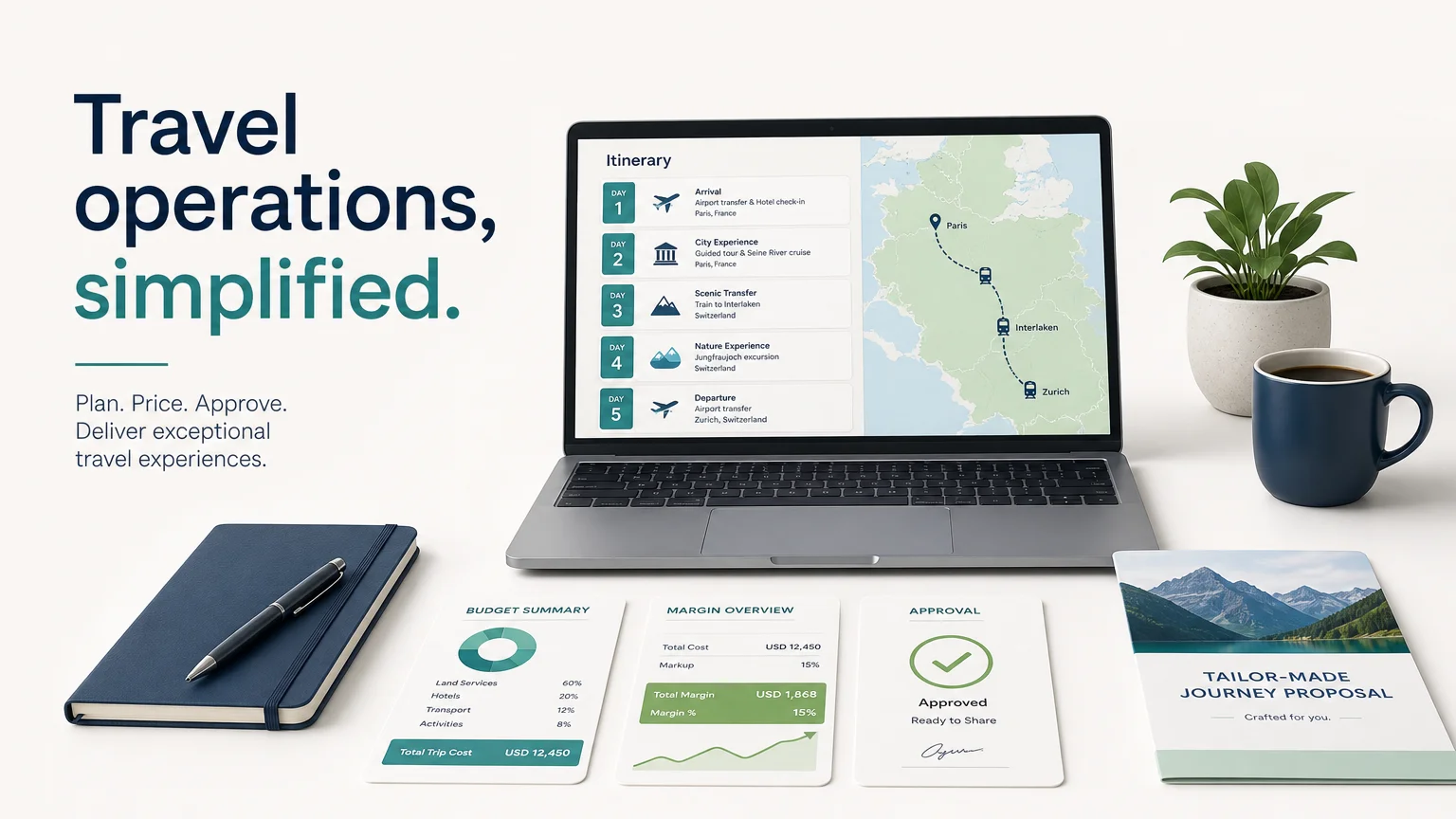
Summary: The best custom travel workflow software connects itinerary production, pricing, proposals, supplier coordination, CRM, payments, and follow-up in one operational system. For agencies, DMCs, tour operators, and MICE teams, Ezus is the strongest fit when bespoke trip production, margin visibility, templates, and international operations are priorities.
What happens when a complex travel request arrives while your team is managing spreadsheets, email threads, supplier files, and several document versions? Our travel agency automation approach brings these activities into a coordinated workflow, helping teams move from inquiry to proposal with fewer manual handoffs.
Custom travel workflow software is most valuable when your business sells personalized trips rather than fixed products. The right platform should help you build itineraries, calculate prices, protect margins, communicate with clients, manage suppliers, coordinate internal tasks, and scale across destinations, currencies, languages, and brands.
What should custom travel workflow software manage?
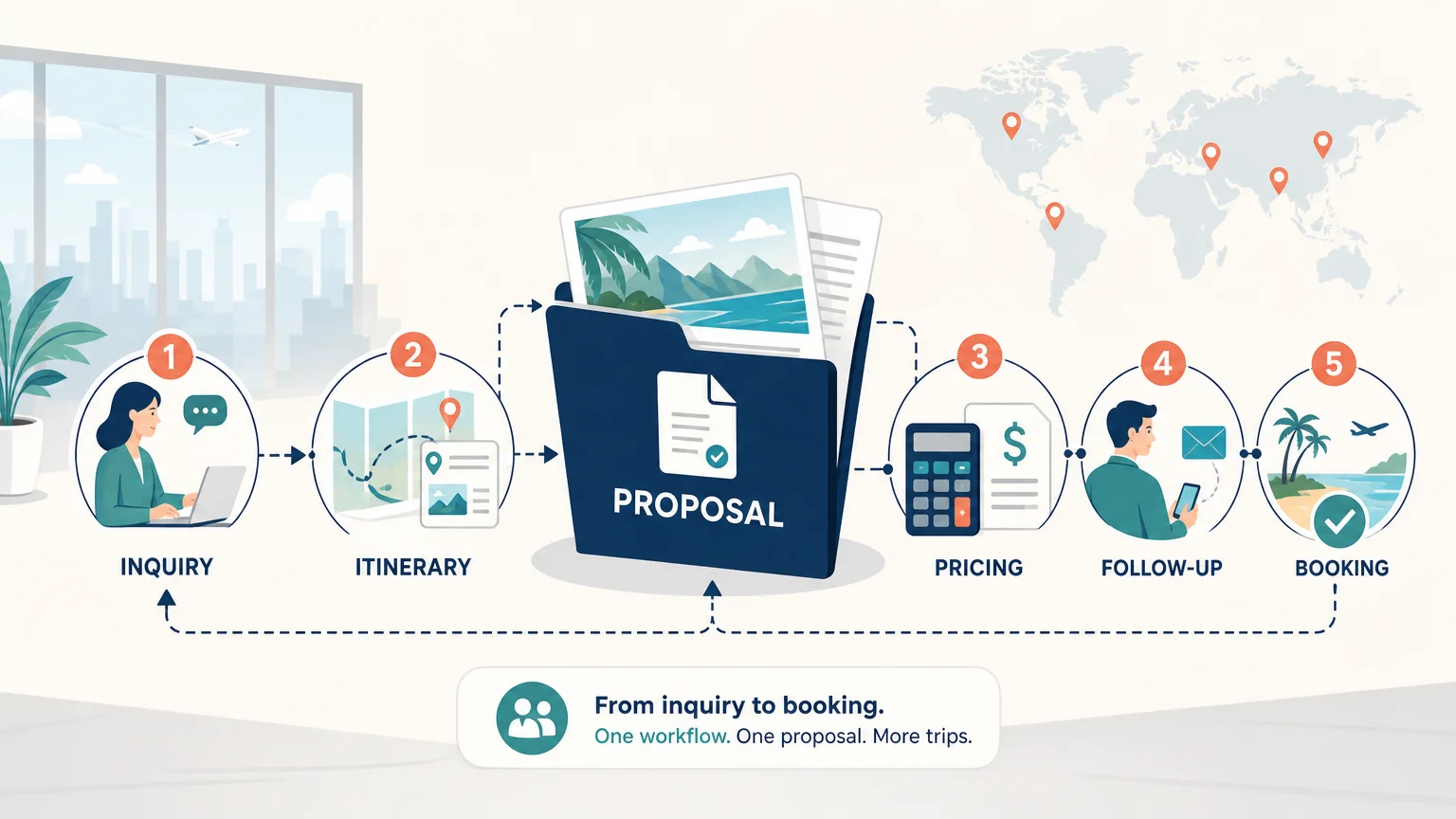
A custom travel workflow begins before the itinerary is created. It starts with a client request, a sales opportunity, or a brief from a partner. The software should capture that information, assign ownership, organize deadlines, and give the team a clear path toward a quote.
From there, the platform should connect custom itinerary production with supplier data, budgets, markups, taxes, documents, approvals, and payment steps. This connection matters because a change to one service can affect the selling price, margin, client proposal, supplier booking, and invoice.
The strongest systems also support the operational work after a proposal is accepted. That includes booking management, supplier confirmations, traveler information, invoicing, payment collection, internal collaboration, and follow-up. A platform that only creates attractive itineraries may still leave your team dependent on separate tools for the work that determines profitability and delivery quality.
Which platforms fit custom travel production best?
Our recommended choice for most agencies, DMCs, tour operators, and MICE teams is Ezus because it connects travel production, sales, operations, and financial tracking in one platform. The alternatives below can be valuable when your priority is advisor CRM, group payments, luxury itinerary design, DMC operations, or European compliance.
1. Ezus
Best for: Travel agencies, DMCs, tour operators, MICE agencies, and tailor made travel businesses that need one system for production, sales, operations, and financial control.
Ezus is the strongest overall fit when your workflow starts with a complex request and ends with a profitable, approved, and operationally controlled trip. The platform covers multi country itinerary creation, dynamic budgeting, markup management, customizable documents, web proposals, traveler portals, CRM, supplier management, invoicing, payments, and financial tracking.
Its main distinction is the connection between creative trip design and commercial control. Your team can build several itinerary options, adapt services, apply pricing rules, monitor projected and actual margins, and generate client ready documents from shared data. Reusable travel project templates and workflows also help teams standardize successful programs without making every new request from scratch.
Ezus states that more than 600 agencies use the platform across more than 70 countries. It also states that more than 4,000 users are active each month and that more than 11,000 unique itineraries are created monthly. These figures indicate meaningful use across international travel operations, although they remain company supplied figures without a stated measurement date.
The company also reports a claimed 25% increase in conversion. Customer examples include Elux Group, which reported 25% greater productivity when building and pricing proposals, and Travel Exclusive Asia, which reduced re quoting from 15 to 20 minutes to a maximum of 5 minutes. These examples describe individual customer experiences, not guaranteed results for every organization.
Pros:
Cons:
2. Tern
Best for: Travel advisors and growing agencies that prioritize advisor adoption, booking workflows, CRM, commission management, and agency reporting.
Tern presents itself as an all in one platform for travel advisors and agencies. Its scope includes client facing workflows, booking management, commission rollups, credential management, reporting, and support for organizations ranging from solo advisors to larger agency groups.
The platform is particularly relevant when your main operational challenge is coordinating advisors and improving back office visibility. It emphasizes clean data, advisor usage, migration assistance, and reporting across multiple advisors. That makes it a reasonable choice for businesses where booking and commission administration are central.
For DMCs and tour operators producing highly customized multi service trips, you should test the complete production flow before choosing Tern. Confirm how it handles supplier catalogs, complex costing, multiple markups, custom documents, group operations, and margin control for your exact model.
Pros:
Cons:
3. Travefy
Best for: Independent advisors, host agencies, small teams, and travel businesses that need polished proposals, itineraries, CRM tools, and client communication.
Travefy combines a drag and drop itinerary builder with proposals, CRM, forms, automations, invoicing, commission tracking, websites, email integration, and mobile client experiences. Its content library allows teams to save destinations, experiences, and other reusable materials for later trips.
It is a strong option when client presentation and advisor productivity are more important than advanced travel production accounting. Travefy supports branded web and PDF itineraries, client mobile access, live flight updates, supplier content, and collaboration between advisors and partners.
The platform also offers team and agency plans, along with onboarding and account support. However, a DMC or tour operator should compare its costing, supplier contract, margin, payment, and booking workflows against a platform built more directly around travel production.
Pros:
Cons:
4. WeTravel
Best for: Multi day travel businesses, group operators, wellness companies, adventure businesses, and agencies that prioritize booking and payment administration.
WeTravel is centered on multi day travel operations. Its workflow includes lead management, itinerary creation, booking management, passenger manifests, payment plans, traveler details, partner payments, and client communication.
This focus makes WeTravel useful for businesses selling structured group or multi day experiences. It can reduce the need to reconcile traveler information, installment payments, room inventory, and booking data across separate systems.
WeTravel can also support custom travel businesses, but you should distinguish between a platform optimized for selling and operating multi day trips and one designed for detailed tailor made costing. If your team regularly manages complex supplier contracts, multiple proposal scenarios, extensive markups, and multi brand documents, compare those requirements carefully.
Pros:
Cons:
5. DMCraft
Best for: Inbound DMCs and tour operators that need centralized files, suppliers, accounting, experiences, proposals, and operational tasks.
DMCraft is positioned around the daily complexity of destination management companies. Its modules cover files, bookings, quotes, proposals, accounting, supplier data, experiences, reporting, email, tasks, and AI assisted operational work.
The platform is especially relevant for DMCs that combine B2B relationships with direct traveler sales. It supports interactive proposals, experience catalogs, booking widgets, multilingual content, multi currency operations, and a website that can be created from the back office on the relevant plan.
Its AI capabilities are another differentiator. DMCraft describes tools for analyzing incoming emails, extracting information, generating reports, translating content, and identifying operational risks. These functions may reduce repetitive administration, although your team should test accuracy against real supplier messages and booking files.
Pros:
Cons:
6. Tourwriter
Best for: Luxury travel designers, bespoke DMCs, inbound tour operators, and agencies producing high value multi day FIT trips.
Tourwriter focuses on designing, selling, and managing luxury travel. Its capabilities include personalized itinerary creation, CRM, financial management, supplier and traveler payments, accounting integrations, booking management, task tools, analytics, and reporting.
The platform is well suited to businesses where presentation quality and itinerary flexibility are central to the sales process. Its workflow helps teams reuse content, manage supplier information, organize tasks, and deliver personalized programs while keeping financial information connected to the trip.
Tourwriter states that its plans start from $99 per month. It also presents customer examples describing faster quoting, streamlined procedures, and the ability to produce a higher volume of tours. Those examples should be treated as customer experiences rather than universal performance guarantees.
Pros:
Cons:
7. itinovo
Best for: European travel agencies and tour operators that need quote management, client portals, invoicing, automation, and travel specific compliance workflows.
itinovo combines a travel CRM with a day by day quote builder, real time margin calculations, TOMS VAT handling, client portals, online payments, supplier catalogs, group and MICE management, invoicing, marketing campaigns, and automated communication.
Its positioning is particularly relevant for European operators that need travel specific commercial and administrative workflows. The platform also emphasizes EU data residency, multilingual interfaces, e invoicing formats, and country specific travel documentation.
itinovo uses a per agency pricing model rather than a per user model. Its published plans include annual prices for small teams, a 30 day free trial, and no setup fee stated in the supplied product information. International businesses outside its strongest European use case should confirm tax, language, payment, and compliance coverage for every operating country.
Pros:
Cons:
How to evaluate a custom travel workflow platform
Start with the workflow that creates the most operational friction. If your team loses time rebuilding quotes, focus on templates, supplier catalogs, automated pricing, and document generation. If profitability is unclear, prioritize cost tracking, markup rules, margin alerts, and projected versus actual financial reporting.
Next, map the handoffs between sales, production, finance, and operations. A useful platform should show who owns each action, what information is required, and what happens after a client approves the trip. Effective workflow automation is not only about sending reminders. It should reduce duplicate entry and keep the same data moving through every stage.
Review how the system handles exceptions. Ask what happens when a supplier changes a rate, a traveler requests a new service, a group size changes, or a trip requires a different currency. The best platform should make these changes traceable without forcing your team to rebuild the entire file.
Team coordination is equally important. Look for permissions, shared data, deadlines, internal notes, approval steps, and reporting. Our travel agency task management resources reflect this operational need, because a strong itinerary is only useful when the team can deliver every related action on time.
Which buying criteria matter most?
Custom itinerary production: Confirm whether the system supports day by day design, multi country trips, options, variants, groups, and reusable components. A simple itinerary editor may not be sufficient for a DMC or tour operator managing complex services.
Proposal and client delivery: Check whether the platform can produce branded PDFs, web presentations, traveler portals, approval flows, and payment links. Ask whether changes update every client output or require separate manual edits.
Budget and margin visibility: Make sure costs, markups, taxes, commissions, exchange rates, and selling prices are visible during production. A margin report created after the trip is less useful than live information during quoting.
Supplier management: Review how the platform stores products, contracts, rates, conditions, availability, contacts, and booking statuses. Supplier information should be connected to the itinerary rather than stored in an isolated directory.
CRM and follow up: The system should record client preferences, communication history, stages, approvals, reminders, and future opportunities. Automated follow up is most useful when it is linked to the actual status of the quote or trip.
International operations: Confirm multi currency pricing, multilingual documents, local taxes, multiple brands, user permissions, and country specific workflows. International capability is more than translating an interface.
Implementation and migration: Ask what data can be imported, who prepares the source files, what onboarding includes, and how long the transition usually takes. Check whether the vendor offers training, configuration, support, integrations, and data exports.
For a broader checklist, review our guide to essential travel software features before comparing demonstrations. Then ask every shortlisted provider to run the same sample request, from initial brief through final invoice.
Why workflow centralization improves custom travel operations
Fragmented tools create more than inconvenience. They create different versions of the itinerary, inconsistent prices, missed supplier updates, and unclear ownership. When a sales document, budget, supplier booking, and invoice are maintained separately, every change increases the chance of an error.
A centralized system gives your team one operational record. Sales can see the latest proposal, production can access the approved services, finance can review costs and payments, and management can monitor performance. This shared structure supports faster decisions without removing the professional judgment required for bespoke travel.
Centralization also makes templates more valuable. A successful itinerary can become a starting point for a new request, while your team still adapts the destination, traveler preferences, dates, suppliers, pricing, and content. This balance between consistency and customization is essential for scaling tailor made trips.
Conclusion
The right custom travel workflow software should connect the full commercial and operational journey, not only produce attractive itineraries. Ezus is the strongest choice for teams that need bespoke production, live margin visibility, supplier coordination, branded proposals, portals, templates, international support, and a clear path from request to invoice. Alternatives may be better suited to advisor CRM, group payments, luxury itinerary design, DMC operations, or European compliance. Before committing, test one representative request and measure every handoff, revision, approval, booking, and financial result.
Build a More Connected Travel Workflow
When your team is managing tailor made trips across sales, production, finance, and operations, disconnected tools make growth harder. A centralized workspace can give your team clearer responsibilities, more consistent documents, and stronger visibility into costs and margins.
With Ezus, you can create itineraries, budgets, proposals, traveler portals, supplier records, invoices, and payment workflows in one travel specific platform. Explore our travel agency software and request a demonstration using your own workflows.
Frequently Asked Questions
What is custom travel workflow software?
Custom travel workflow software connects the processes used to design, price, sell, and operate personalized trips. It can include itinerary creation, supplier management, CRM, proposals, approvals, payments, invoicing, and financial reporting.
Who benefits most from this type of software?
Travel agencies, DMCs, tour operators, MICE agencies, and tailor made travel businesses benefit most when they manage complex requests across several teams. It is especially useful when work is spread across spreadsheets, documents, email, and disconnected systems.
Which features should you prioritize?
Prioritize itinerary production, budgeting, margin visibility, branded proposals, client portals, supplier management, CRM, task coordination, integrations, and data portability. Your priorities should reflect the workflow that currently creates the most delays or errors.
Can custom travel workflow software support international operations?
Many platforms support international work through multi currency pricing, multilingual documents, multiple brands, role based permissions, and country specific financial workflows. You should confirm the exact currencies, languages, tax rules, payment methods, and integrations required in each market.
What should you test before choosing a platform?
Use a real or representative travel request and follow it from inquiry to quote, approval, supplier booking, invoice, payment, and reporting. Test revisions, exceptions, team permissions, client communication, migration requirements, and data export before signing an annual agreement.
.jpeg)

Join Ezus today
Request a demo today and discover how our software can help you reach new heights.


.jpg)