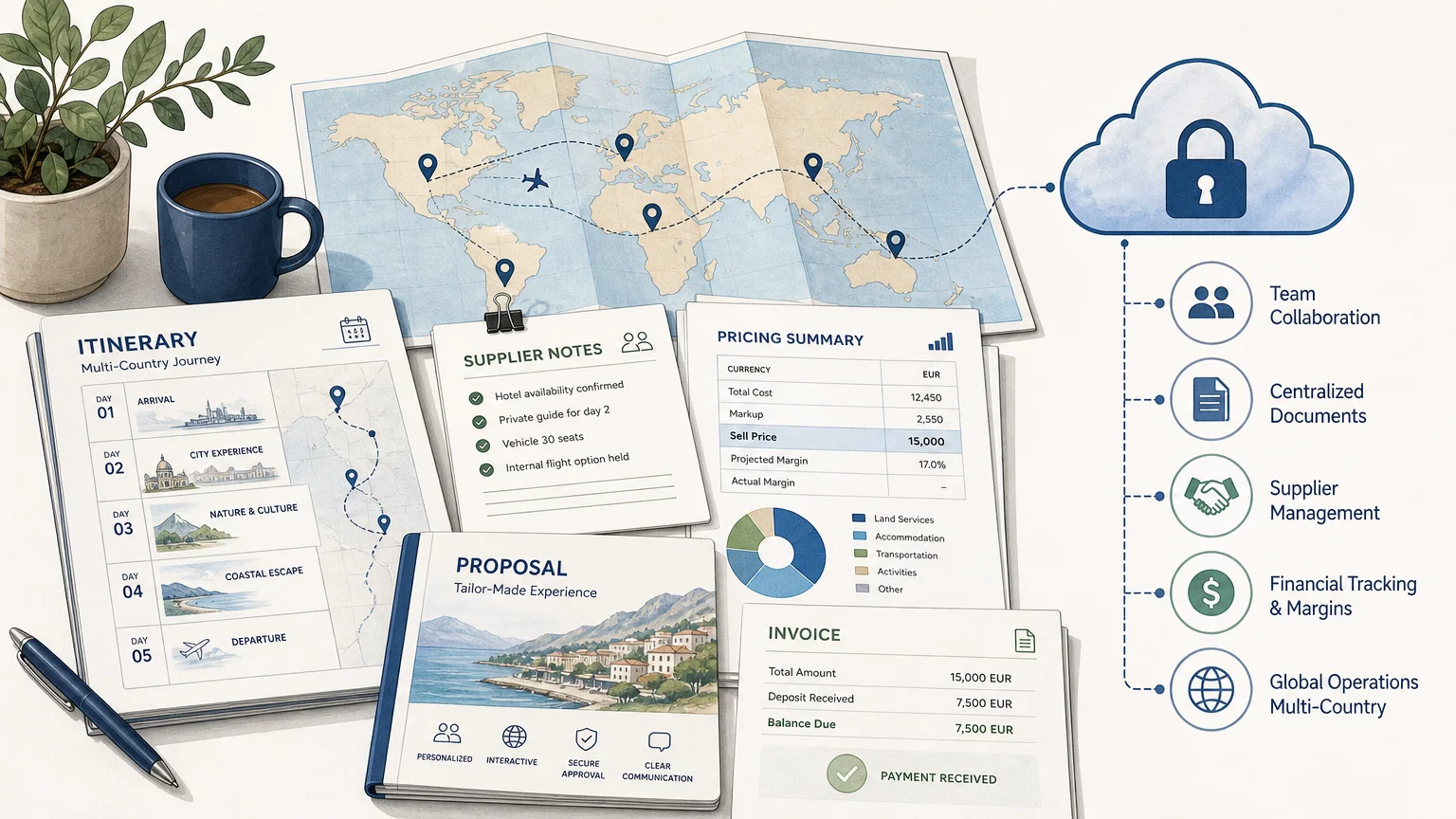
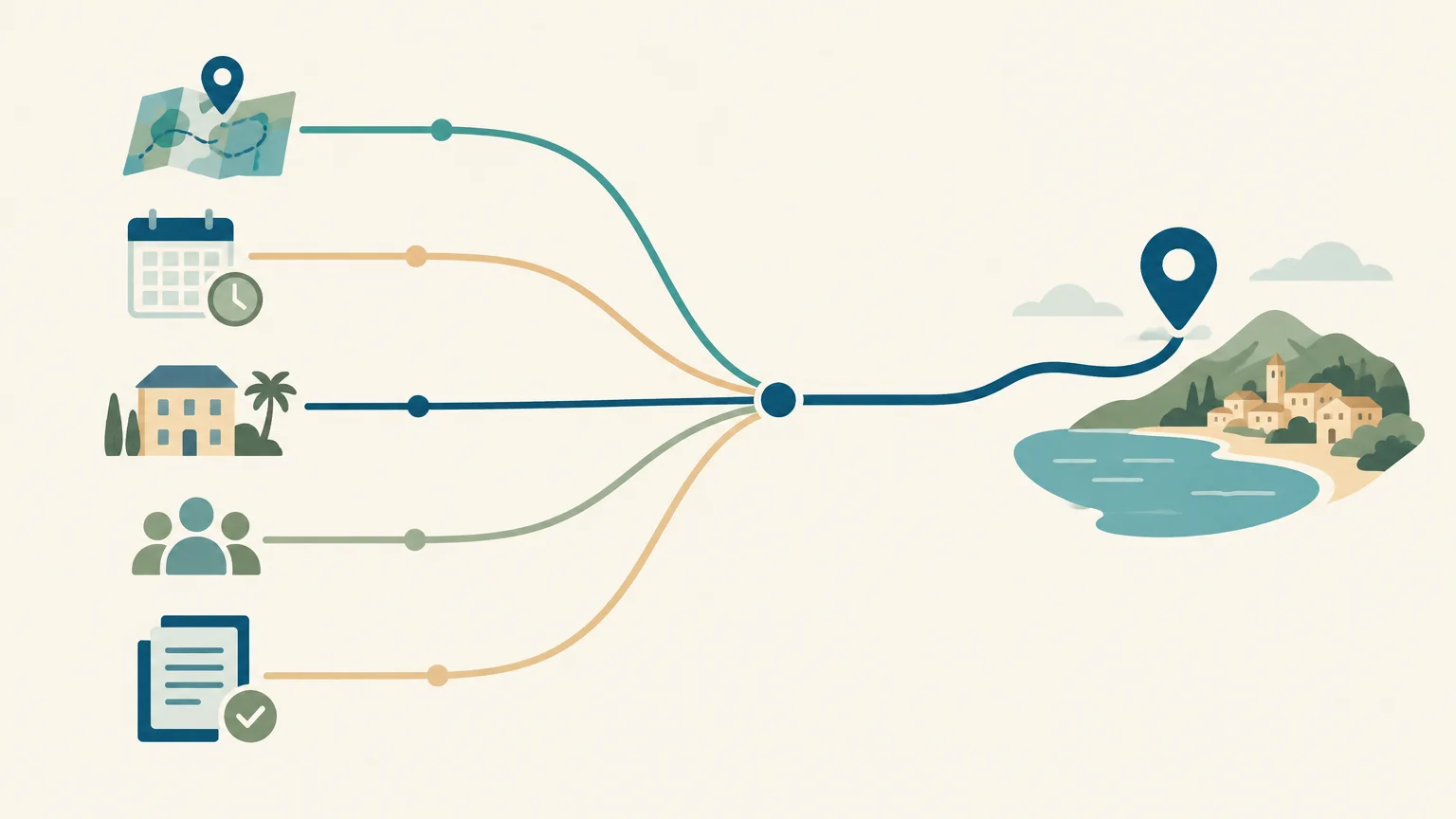
How often does your team re-enter traveler, supplier, or price details before a trip is ready? Those handoffs show whether software will reduce repetitive work or add another screen. The most useful features to look for in travel agency software connect production, sales, operations, and finance around one trip record. If you are mapping core capabilities, start with our essential features of travel software.
For traveler-facing work, polished output is only one part of quality; clarity, navigation, booking and payment ease, and helpful support also shape the experience. The ACSI Travel Study 2026 benchmarks online travel agency customer experience across these dimensions. That is a useful reminder to assess both internal processes and the client journey. Your agency model determines which functions matter most. Bespoke FIT itineraries, group departures, corporate events, and retail bookings each call for different levels of supplier, budget, and approval control.
Which workflows should one system cover?

Begin with one real case: a traveler request becomes a priced proposal, an approved trip, supplier bookings, an invoice, and a payment record. If staff copy details between files, inboxes, and separate tools at every step, duplicated work and version mismatches become routine.
Look for a shared trip record that carries traveler details, dates, services, costs, decisions, and status through each stage. The goal is not simply to collect more functions. It is to reduce breaks between the people who sell, produce, operate, and finance a trip.
Check whether the system handles the trip types you sell, including custom and multi-country itineraries, groups, or MICE programs. It should also show who can access or change relevant information, so sales and finance teams can work with appropriate permissions. We support more than 600 agencies in over 70 countries, with workflows spanning travel production, sales, operations, and finance.
An itinerary should support the client journey
An itinerary needs to do more than list destinations and activities. Test whether your team can organize services by day, adapt a trip for a new request, and present the result in a format clients can review easily. Check for interactive maps, branded documents, web proposals, and a traveler portal if those suit your service model.
Also check what happens after you share a proposal. Can a client review it, ask questions, and approve the trip without creating a separate trail of email versions? Can your team keep client preferences and follow-up history alongside the trip? These details connect client communication with production rather than treating them as unrelated tasks.
If itinerary design is central to your work, our itinerary builder supports custom and multi-country trip creation. For client history and follow-up, our integrated CRM for travel agencies keeps client records within the same working environment.
Live costs matter more than a polished quote
A professional proposal is not enough if the team cannot see how the trip is priced. Look for dynamic budgeting that connects supplier costs, pricing, and markups to the itinerary. Check whether totals update when you change a service, room configuration, or group size.
During a demo, ask to see projected and actual trip margins, not only the final selling price. Confirm how the software handles different currencies, participant numbers, commissions, and changes made after a quote is drafted. For group travel, test more than one participant basis and check that the financial view remains understandable.
A Travel Exclusive Asia testimonial says re-quoting time fell from 15 to 20 minutes to a maximum of 5 minutes with Ezus. That is one customer’s account, not a general performance guarantee, but it illustrates why teams should test quote changes using their own trip examples.
Integrations decide whether data stays connected
List the tools your agency already depends on, such as accounting, email, document storage, CRM, or supplier systems. Ask which connections are built in, which use an API or webhook, and which require a no-code connector or custom work. Confirm whether each connection is available in the plan you are considering.
In a 2024 Amadeus agency report, 55% of business travel agency respondents identified interaction with their own systems as an important booking-tool capability. For your evaluation, map what information must move between tools, in which direction, and how often.
Migration deserves the same care as integration. Ask what data can be brought across, what format is needed, who cleans duplicates, and how the team will verify imported records. At Ezus, formatted data import costs €390 excluding tax; raw-data import is quoted according to the work involved.
Migration, support, and pricing shape the real cost
Implementation affects how quickly your team can use the features it buys. Ask who configures the workspace, trains users, transfers existing content, and answers questions after launch. Check how long those services last, which support channels are available, and what additional training or customization costs.
In an April 2025 global survey of 197 travel buyers, BCD identified data fragmentation among the major challenges in working with travel data. That finding supports a practical buying test: ask whether reports use shared, up-to-date trip information, or whether your team must reconcile separate sources first.
Review the full contract cost, not just the per-user subscription. Our Professional plan is €75 per user per month and Premium is €100 per user per month when billed annually; displayed prices exclude tax. Enterprise is billed annually, priced on request, and available from 30 users. The one-time mandatory Onboarding Pack costs €1,990 excluding tax. Subscriptions renew annually unless cancelled under the service agreement, and added users are billed pro rata.
Use a demo to test the whole journey
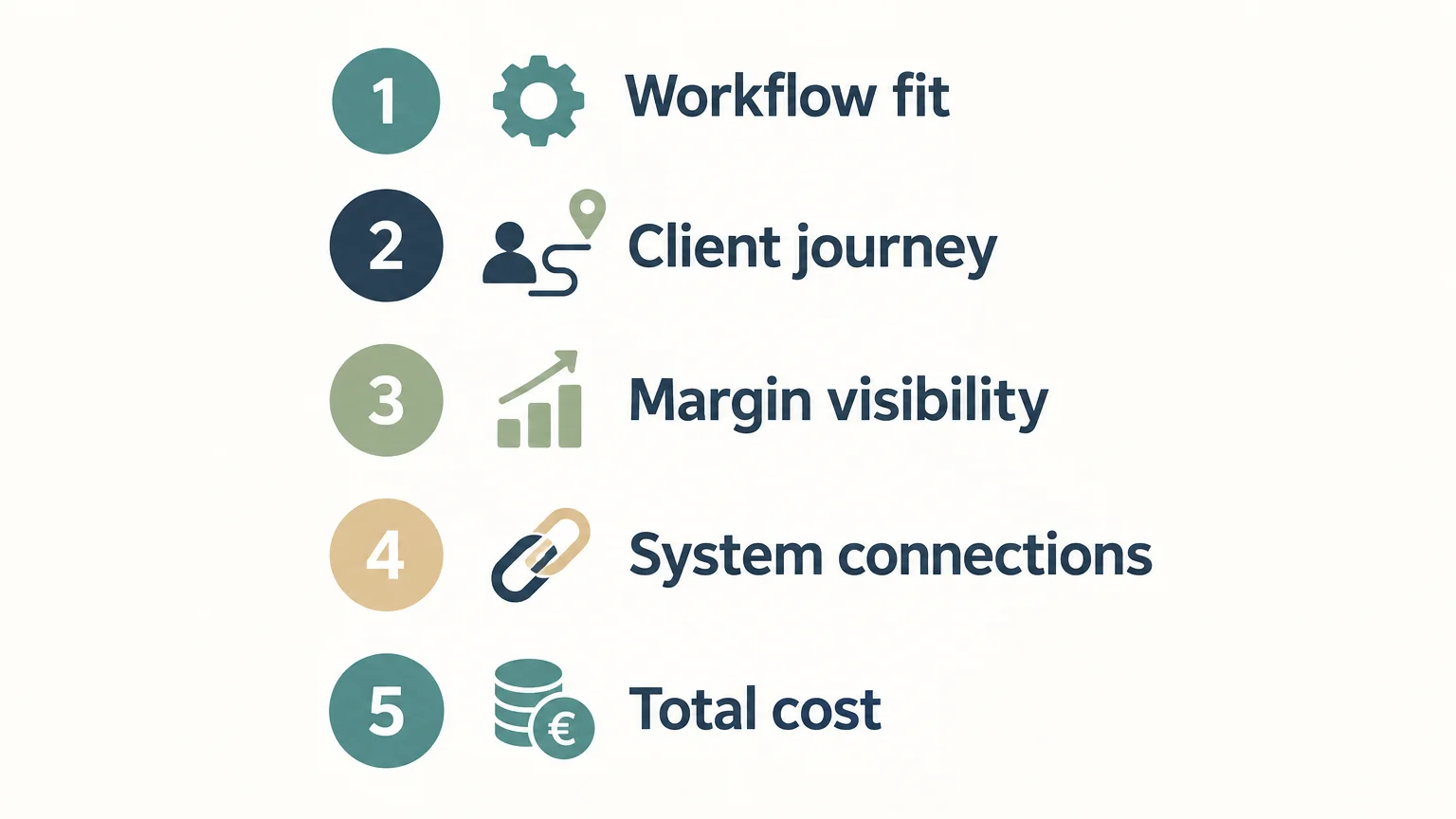
A vendor demonstration is most useful when you bring a real workflow, rather than asking for a tour of every menu. Choose a recent inquiry and follow it from first contact through pricing, approval, supplier coordination, and financial closeout. Note every step that still requires a spreadsheet, manual copy, or separate message.
Use these questions to keep the evaluation practical:
- Can you create a trip from an inquiry and keep its client details and follow-ups together?
- Do itinerary changes carry through to the proposal and budget without repeated data entry?
- Can you see costs, markups, and trip-level margin at the points where decisions are made?
- Can your team coordinate suppliers, client approvals, and internal handoffs in the same workflow?
- Are integration, migration, onboarding, support, and renewal costs clear before you sign?
Score each answer against your actual work, not a feature list. For a more structured evaluation, consult our how to choose travel agency software resource. Treat unavailable functions, plan restrictions, and extra fees as questions to resolve before purchase.
Choose software around the work your team repeats
The right system connects the tasks your agency performs repeatedly, from client inquiry and itinerary design to supplier coordination, payment, and financial review. Test those steps with a real trip, verify that data carries forward, and compare the full cost of implementation and ongoing use. Prioritize the travel agency software features that remove your most frequent handoffs while fitting your clients, team, and trip types.
Evaluate Ezus Against Your Daily Workflows
If your priority is reducing handoffs, test the same real trip across itinerary design, budgeting, client review, supplier coordination, and finance. Our cloud platform is built for travel agencies, DMCs, tour operators, tailor-made travel businesses, and MICE teams that need production, sales, operations, and finance connected in one workspace.
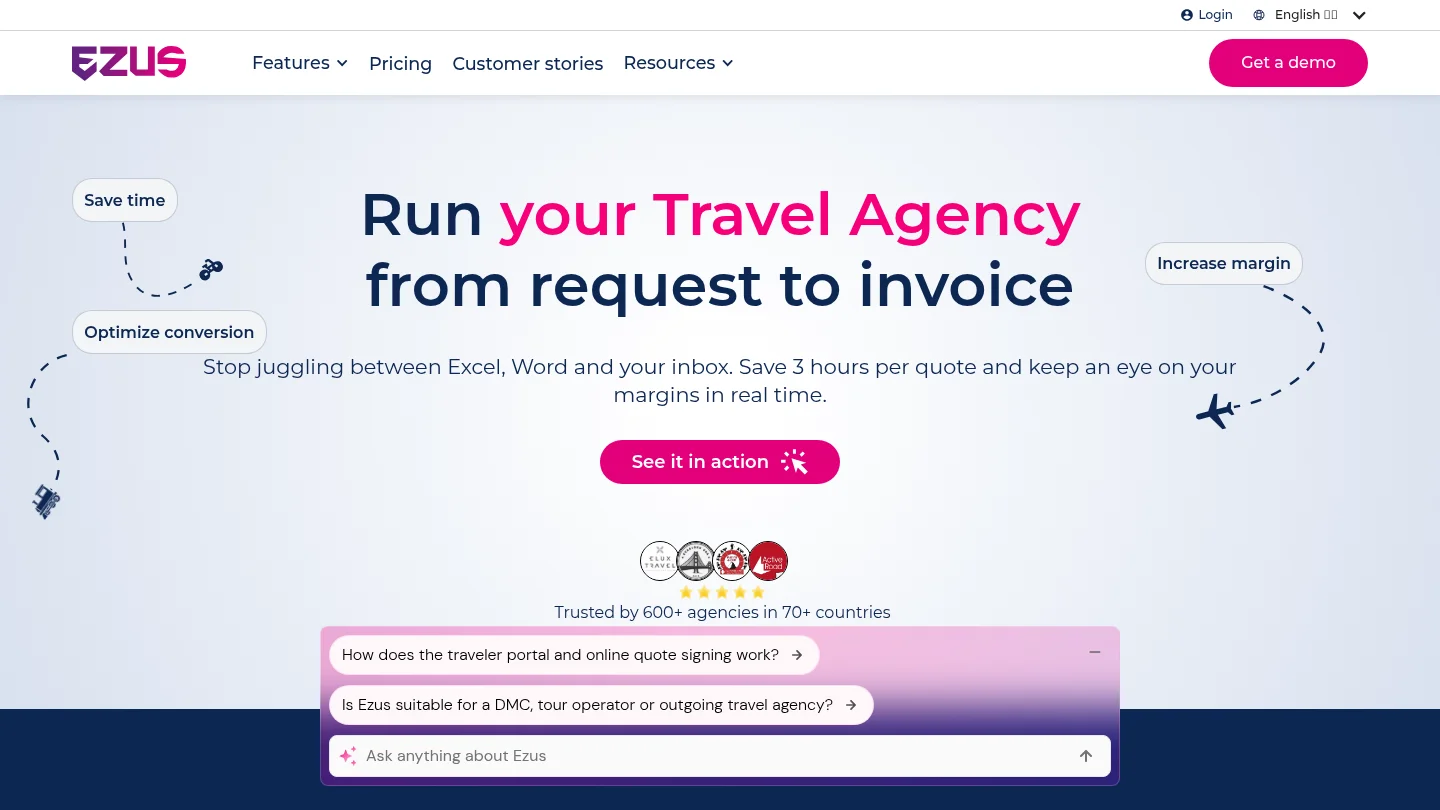
We bring together custom itineraries, dynamic budgets, branded proposals, traveler portals, CRM, supplier booking management, invoicing, payment, and trip-level financial tracking. Professional costs €75 per user per month and Premium €100 per user per month when billed annually, excluding tax. The mandatory one-time Onboarding Pack costs €1,990 excluding tax. Explore our travel agency software and request a demonstration using your own workflow.
Frequently Asked Questions
What are the essential features in travel agency software?
Start with inquiry and client records, itinerary creation, budgeting, proposals, supplier coordination, approvals, invoicing, and financial tracking. Select the functions that match your trip types and team responsibilities.
Should itinerary software include CRM?
Connected client records and itineraries reduce the need to move traveler information between separate tools. Check whether preferences, conversations, and follow-up tasks stay accessible to the staff who need them.
Why should you check software integrations before buying?
Integrations determine whether client, booking, finance, and supplier information can move between your existing systems. Confirm the required connection method, setup responsibilities, and plan availability with the vendor.
What costs should you include in a software comparison?
Include subscription fees, onboarding, data migration, training, customization, and any paid integrations. Also review billing frequency, taxes, renewal terms, and how additional users are charged.
How can you evaluate Ezus for your agency?
Bring a representative trip to a demonstration and test the workflow from inquiry through proposal, supplier coordination, and financial tracking. Ask how the relevant features, implementation, and plan terms fit your team’s requirements.


Join Ezus today
Request a demo today and discover how our software can help you reach new heights.