
How many separate tools touch a custom trip before a client receives a price? When comparing the best travel quoting software for 2026, the answer matters as much as proposal design: itinerary edits, supplier costs, markups and client approvals should remain connected. Our best travel agency software for fast quotes overview frames that workflow for agencies weighing a dedicated quoting tool against broader travel operations software.
Agencies are also investing in technology to meet changing traveler expectations. Phocuswright’s 2025 U.S. agency landscape research, based on a survey of more than 1,500 advisors, examines technology’s role in operations and client engagement. The options below suit different business models, so compare how each handles reusable trip data, pricing control, client review and the handoff from sale to delivery.
Which travel quotation software is the strongest fit?
For agencies that need bespoke quote creation connected to trip production, CRM and financial workflows, Ezus is the strongest fit in this selection. Travefy and Tourwriter are compelling for advisor-led and luxury travel workflows, while the other platforms serve more specific operational needs.
| Rank | Platform | Quote and proposal work | Wider workflow |
|---|---|---|---|
| 1 | Ezus | Custom itineraries, dynamic budgets, reusable templates and branded web or document proposals. | CRM, supplier management, bookings, invoicing and trip-level financial tracking. |
| 2 | Travefy | Branded itineraries, proposals and quotes with client approval tools. | CRM, forms, website tools, invoicing and commission tracking. |
| 3 | Tourwriter | Luxury and bespoke multi-day itineraries with automatic pricing. | CRM, bookings, finance, tasks and analytics. |
| 4 | Tern | Itinerary-led client communications and live hotel quotes. | Advisor tools, email marketing, hotel search and booking. |
| 5 | WeTravel | Itineraries and proposals for multi-day trips. | Travel CRM, bookings, payment processing and partner payments. |
| 6 | Odys | Visual DMC quotes with options, client feedback and upsell opportunities. | Margin tracking, supplier communication and trip operations. |
1. Ezus travel-business SaaS platform
Best for: Travel agencies, DMCs, tour operators and MICE teams that need quotations connected to trip production and operations.
We bring custom and multi-country itineraries, dynamic budgets, pricing and markups into a shared travel workspace. Reusable project templates help your team adapt existing itineraries, products and pricing for new requests. You can create branded proposals as web presentations or customizable PowerPoint, Excel and PDF documents, then connect client review with CRM follow-up.
Our platform also supports supplier and destination catalogs, booking management, invoicing and financial tracking per trip. That breadth matters when a quote changes after a supplier update or client request: teams can manage connected trip details rather than rebuild a proposal across separate tools. For a closer look at the quote workflow, read our travel agency quote guide and advice on how to optimize travel agency quotes.
We support more than 600 agencies in over 70 countries. In a customer testimonial, Travel Exclusive Asia reports reducing re-quoting from 15 to 20 minutes to a maximum of 5 minutes. That is one customer’s experience, not a general performance promise.
Pros:
- Connects itineraries, budgets, markups, proposals, CRM, supplier workflows and financial tracking.
- Reusable templates and customizable client documents support consistent quoting across repeat trip types.
- Professional is €75 per user per month and Premium is €100 when billed annually, excluding tax. Enterprise is priced on request for teams from 30 users.
Cons:
- The subscription is annual and billed per user. A mandatory one-time Onboarding Pack costs €1,990, excluding tax, so include setup and team size in your budget.
2. Travefy
Best for: Independent travel advisors and agencies seeking branded itinerary proposals alongside client management and marketing tools.
Travefy combines itinerary building and proposals with CRM, forms, website tools, invoicing and commission tracking. Its proposal workflow supports client approval, while itineraries can include features such as an overview map and mobile sharing. This makes it a practical option when polished client-facing travel plans are the main quoting requirement.
Travefy lists Core at $39 per month and Premium at $59 per month when billed annually. Agency plans charge separately for additional seats, so compare the full team cost rather than only the initial subscription.
Pros:
- Branded itineraries and proposals sit alongside CRM and client communication tools.
- Client approval tools and mobile itinerary sharing support a clear proposal-to-trip handoff.
- Published plans provide a starting point for comparing costs, including separate agency seat pricing.
Cons:
- Per-seat pricing makes total cost dependent on team size. Agencies with complex supplier costing should test those workflows against a realistic trip before choosing.
3. Tourwriter
Best for: Luxury and bespoke travel designers, inbound operators and DMCs focused on multi-day FIT trips.
Tourwriter combines drag-and-drop itinerary design with automatic pricing, CRM, booking management, invoicing, accounting integrations, tasks and analytics. Its published product information also describes supplier and traveler payment workflows. The platform’s broad operational scope makes it relevant when custom trip design and delivery need to work together.
Tourwriter lists pricing starting from USD $99 per month. Its stated positioning centers on luxury and bespoke multi-day FIT travel, so teams with different needs, such as group or MICE programs, should confirm those workflows during a demonstration.
Pros:
- Combines itinerary building, pricing and several operational functions in one platform.
- Designed around luxury and bespoke multi-day travel workflows.
- Published pricing provides a starting point for evaluating subscription cost.
Cons:
- Its stated focus is multi-day FIT travel. Agencies with substantial group or MICE activity should verify that their specific workflows are supported.
4. Tern
Best for: Travel advisors and agency teams that prioritize client relationships, trip communications and hotel research.
Tern brings advisor tools together with an email marketing suite, an itinerary workflow, AI-assisted drafting and a curated hotel library. Its product information also describes live hotel quotes, hotel booking and agency commission. This mix suits teams that want hotel sourcing and client engagement tied to their advisor workflow.
Pros:
- Combines advisor trip management with email marketing and client communication.
- Includes hotel search and live hotel quoting in its described workflow.
- AI tools can assist with itineraries and client emails.
Cons:
- Its published product information emphasizes advisor workflows and hotels. Confirm how it handles detailed costing for multi-service custom trips and financial handoffs if those are central to your quoting process.
5. WeTravel
Best for: Multi-day travel businesses that need proposals connected to bookings, traveler details and payment collection.
WeTravel presents itself as an operating platform for multi-day travel businesses. Its tools include an AI-powered travel CRM, an itinerary builder, bookings and trip management, payment processing, and partner payments. That combination is relevant when the quote is part of a group or multi-day booking journey rather than a standalone proposal document.
Pros:
- Connects itineraries and lead management with bookings and payments.
- Supports operational tasks such as traveler information and trip management.
- Includes a partner payment workflow alongside traveler payments.
Cons:
- Its public positioning centers multi-day travel operations, bookings and payments. Confirm supplier-level costing and per-trip margin tracking if those are essential to your quote process.
6. Odys
Best for: Smaller DMCs and inbound operators seeking sales-focused proposals with options and margin visibility.
Odys focuses on professional travel quotes, client feedback and operational workflows for DMCs. Its product information describes alternatives within proposals, upsell opportunities, multi-currency margin calculation, supplier communications and an operational calendar. This makes it a specific option for DMCs that want to connect quotation decisions with trip operations.
Pros:
- Supports visual quotes with alternatives, client feedback and upsell options.
- Includes margin calculations in multiple currencies and supplier-related operational tools.
- Its stated focus is built around DMC workflows.
Cons:
- Odys identifies its target as DMC and inbound operators with teams of 3 to 25 employees. Its product information says it is not intended for retail travel agencies, outbound tour operators or groups of multiple DMCs.
What should you verify before choosing?
During a demonstration, use one realistic trip request and follow it through a revision. Change a hotel category or service, then check whether the budget, markup and client proposal stay aligned. Review the internal handoff too: a polished document matters less if the approved trip must be rebuilt for booking, supplier coordination or invoicing.
For tour, activity and attraction operators, Arival’s 2025 global operator report examines booking technology adoption, challenges and the features businesses consider when choosing a platform. Match each product to your operating model, then test the workflows that matter to your team rather than relying on a general feature list.
If a tool uses AI to draft proposals or client messages, include human review in your process. Travel Weekly’s 2025 industry survey found that 59% of respondents had used AI tools, up from 41% the prior year; respondents also raised concerns about accuracy and a loss of personal touch.
Choose software that carries the quote forward
The best travel quotation software should match how you sell trips and what happens after a client approves. Advisors focused on itineraries may prefer an advisor-centered workflow, while DMCs and bespoke operators should examine costing, supplier coordination, margins and operational handoffs. Test a real trip request, compare the full subscription and setup costs, and choose the platform that keeps the most important steps connected.
See whether Ezus fits your quoting workflow
If your team manages custom itineraries, supplier information, budgets and client proposals, assess how those steps work together rather than judging a document in isolation. We built our platform for travel agencies, DMCs, tour operators, tailor-made travel businesses and MICE teams that need a shared workspace across production, sales, operations and finance.
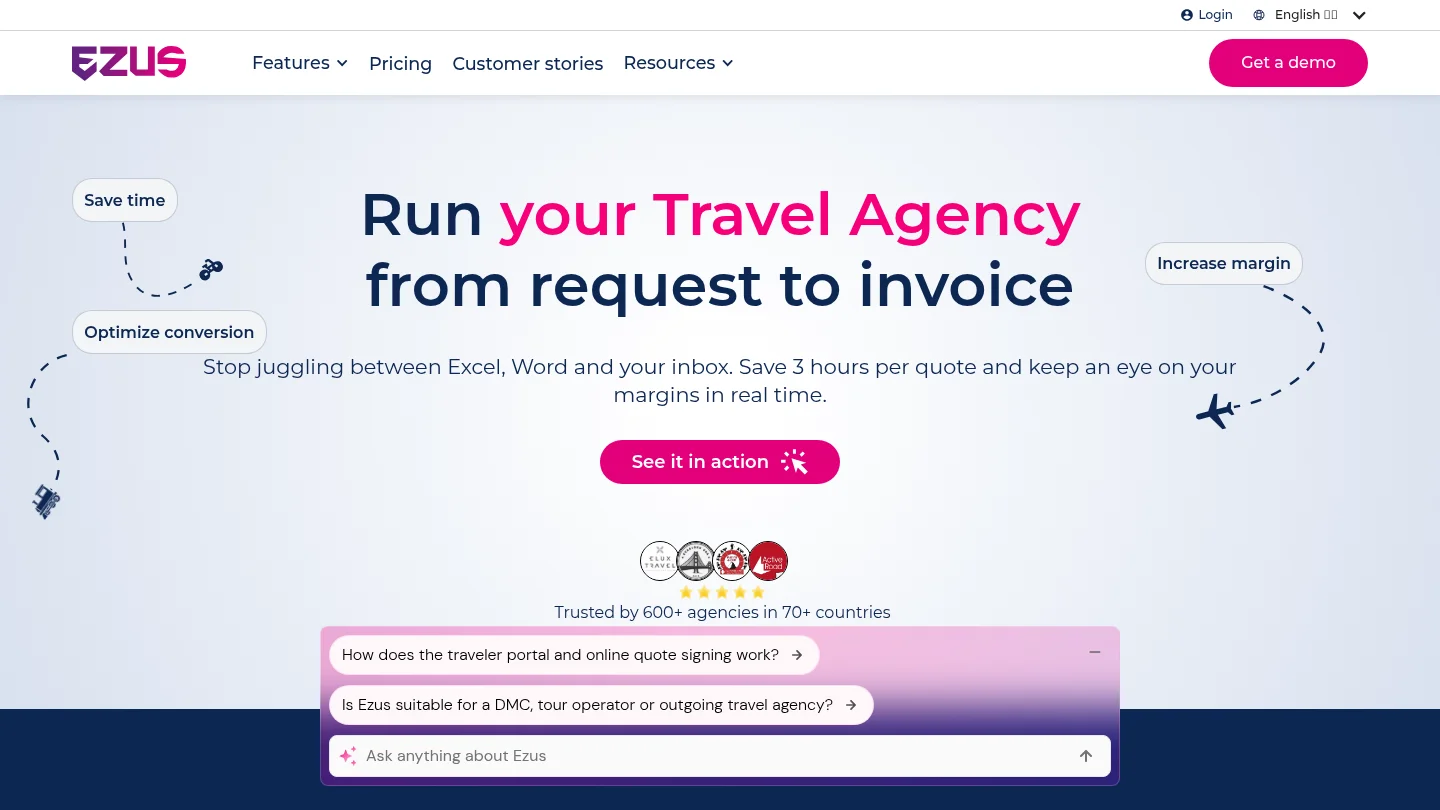
Our platform supports dynamic budgeting, reusable project templates, branded proposals, client portals, CRM follow-up and financial tracking. The annual subscription is billed per user, and a mandatory one-time Onboarding Pack is required at subscription start. Request a demonstration to try a representative trip workflow, then review our travel agency software for creating quotes for your team.
Frequently Asked Questions
Which types of travel businesses should consider Ezus?
Ezus is designed for travel agencies, DMCs, tour operators, tailor-made travel businesses and MICE agencies. It is especially relevant when quoting connects to itineraries, budgets, supplier workflows and post-sale operations.
What is the difference between a travel quote and an itinerary?
A quote presents a proposed trip and its pricing for a client to consider. An itinerary organizes trip details, while travel proposal software can combine the two and support client review or approval.
What should I test during a software demonstration?
Use a realistic request, revise one trip component and check whether the budget and client-facing proposal remain consistent. Also test how the approved trip moves into supplier coordination and invoicing.
Should I choose an advisor tool or an all-in-one travel platform?
Choose an advisor-focused tool when itineraries and client communication are your main priorities. Consider a broader platform when quoting must connect to costing, operations, supplier management or finance.
How can I compare software costs fairly?
Compare subscription terms, the number of users, setup requirements and any optional implementation services. Check which capabilities are included in the plan you would actually purchase.


Join Ezus today
Request a demo today and discover how our software can help you reach new heights.