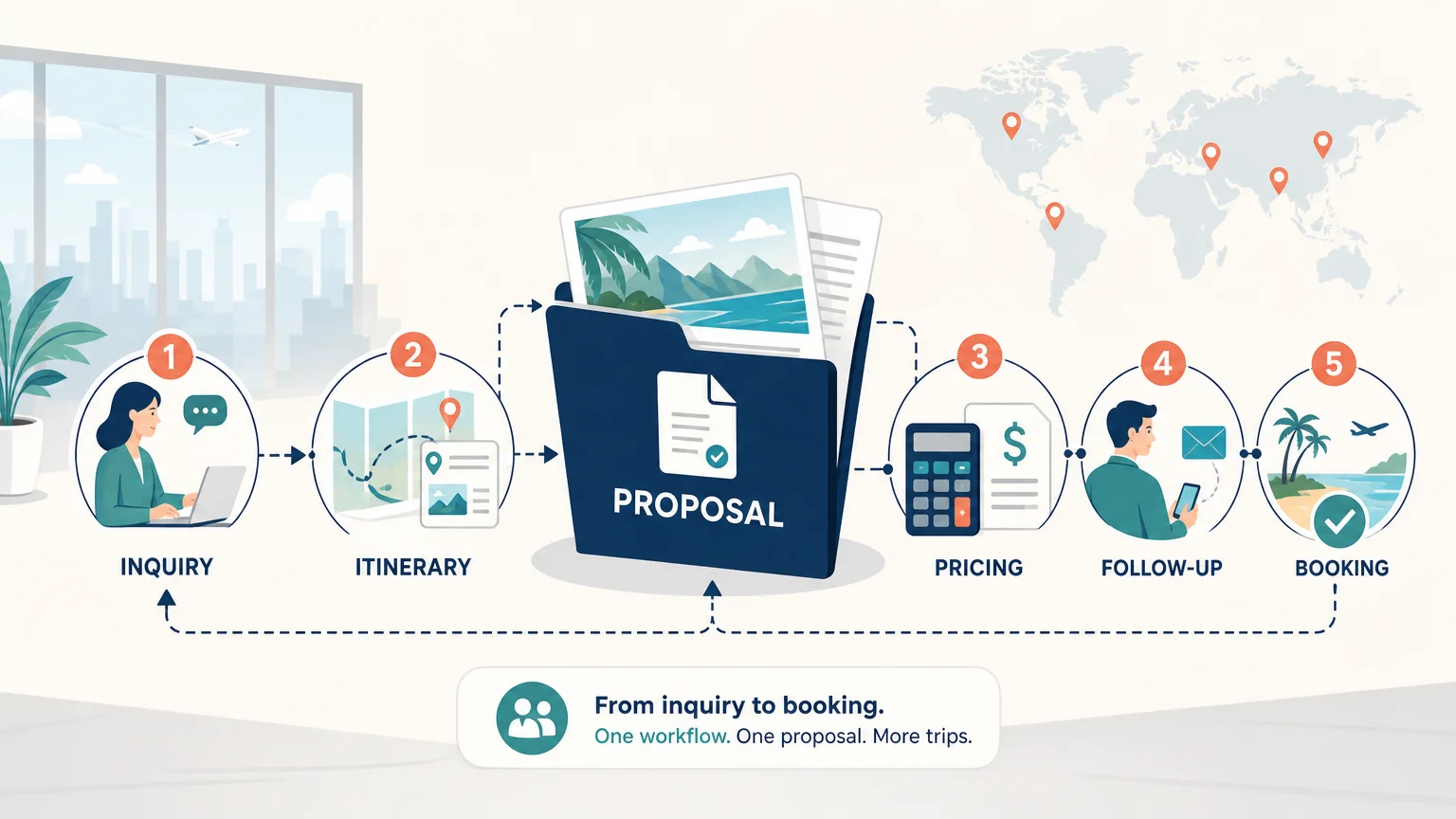
Summary: A dedicated itinerary builder replaces static templates with dynamic, branded trip plans that integrate suppliers, pricing, and client collaboration. It reduces creation time from hours to minutes, strengthens your brand, and improves proposal conversion. The right choice depends on integrations, margin visibility, ease of use, and how well the tool fits your daily workflow.
Most travel professionals still lose one to two hours building a single quote inside disconnected documents. That time compounds across every request, every revision, and every follow-up. A travel agent itinerary builder exists to remove that friction, turning repetitive formatting into automated, on-brand output. If you have outgrown copy-and-paste templates, our itinerary builder feature illustrates how the modern approach works in practice.
The stakes are rising because travelers now expect polished, interactive plans. Industry research indicates that more than 70% of travelers prefer digital channels for planning and managing trips, and over 65% of online bookings are completed on smartphones. Meeting that expectation with a manual process is no longer realistic for agencies that want to scale.
What a modern itinerary builder actually does
At its simplest, an itinerary building tool generates structured, professional trip plans from reusable content instead of blank documents. The difference between a template and a builder is significant. A template is a static file: what you see is what you get, with no integrations and heavy manual editing. A builder is dynamic, pulling in supplier content, images, maps, and pricing automatically.
This distinction matters for both speed and quality. Templates are freely available and acceptable for occasional one-off plans, yet they demand far more manual effort to brand and customize. A purpose-built solution is designed for travel agencies, tour operators, and destination management companies, producing a more professional result in a fraction of the time. If you want to create itinerary online without wrestling with layout, that automation is the core value.

Why the shift to dedicated software is accelerating
The market context explains the urgency. The global travel agency software market was valued at roughly USD 1.14 billion in 2026, with cloud-based solutions representing about 60% of the market and small and medium businesses now accounting for around 35%. Adoption is no longer limited to large operators.
Growth is expected to continue at pace. One forecast puts the segment on a 9.2% compound annual growth rate through 2034. This expansion reflects a structural change: as cross-border tourism rebounds, transaction volumes exceed what spreadsheets and disconnected inboxes can handle. Automation has become a competitive necessity rather than a convenience.
The core features that separate strong tools
Not every builder offers the same depth. When you evaluate options, focus on the capabilities that directly affect your daily output and your margins. The following features consistently distinguish a professional-grade platform from a basic document generator.
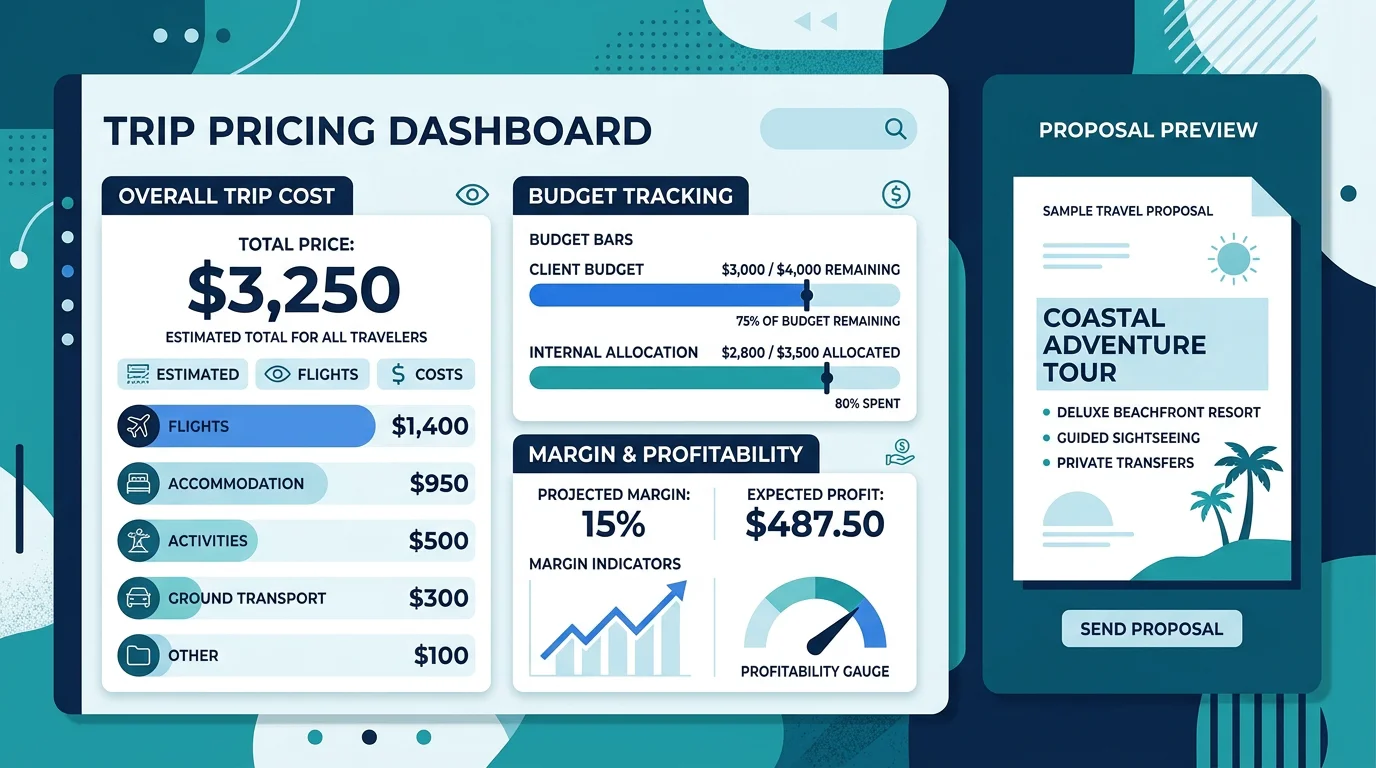
Pricing accuracy deserves particular attention. Manual quoting invites errors that quietly erode profit. To keep costs and markups under control, our customized travel itineraries approach pairs document automation with live budget tracking, so every proposal reflects real numbers rather than guesswork.
Templates versus builders: a practical comparison
To make the trade-offs concrete, the table below compares a manual template workflow, a generic builder, and our own approach across the criteria that matter most to working agencies.
The comparison highlights why static files struggle at scale. They remain useful for a rare, informal plan, but they cannot integrate live data, track margins, or let clients interact with their trip.
Automation and margin control as the real differentiator
Speed alone is not the whole story. The deeper value of a professional platform lies in protecting revenue while accelerating output. Manual formatting and repetitive pricing steps do not only waste time; they introduce version-control chaos and hidden margin leakage.
This is where automation compounds. Analysis of the travel technology market attributes roughly half of its growth to SaaS and AI adoption for automation across airlines, hotels, and travel agencies. In practice, that means generating budgets, sales documents, and proposals in one flow, then monitoring projected versus actual margins on a dashboard. To streamline that end-to-end process, our travel itinerary planner connects document creation directly to pricing and reporting, so you sell rather than reformat.
How to choose the right builder for your agency
Selection should start from your workflow, not a feature list. Ask how many itineraries you produce, which suppliers and consortia you rely on, and where your current process breaks down. A tool that fits your volume and your integrations will pay back faster than one chosen on appearance alone.
Consider budget alignment, supplier and consortia integration, design flexibility, user friendliness, and vendor track record. Rising cross-border activity is a factor too: reports note that international tourist arrivals recovered to nearly pre-pandemic levels during 2024, increasing demand for booking automation and customer management tools. Most reputable platforms offer a free trial, so test two or three before committing, and prioritize the one your team will genuinely adopt.
Final thoughts on selecting your tool
Choosing a travel agent itinerary builder is ultimately a decision about time, professionalism, and profit. Static templates remain a valid starting point for the occasional plan, but they cannot integrate live content, safeguard margins, or give clients an interactive experience. As adoption grows across agencies of every size, the practical question is no longer whether to automate, but which platform aligns with your volume, your suppliers, and your brand. Test a shortlist, involve your team, and let real workflow fit guide the final call.
Take action with Ezus
If manual quoting and scattered documents are slowing your team, the path forward is a single, connected workflow. You need itineraries, budgets, and proposals that stay accurate, on-brand, and ready to share in minutes rather than days.
We help destination management companies and travel professionals run operations from request to invoice, saving up to three hours per quote while keeping margins visible in real time. Explore our itinerary builder software to automate documents, generate branded proposals in one click, and turn requests into paid trips with a personalized client portal.
Frequently Asked Questions
What is the difference between an itinerary template and an itinerary builder?
A template is a static document that requires manual editing and offers no integrations. A builder is dynamic software that pulls in supplier content, images, and pricing automatically. The result is a faster, more professional, and interactive trip plan.
How much time can a dedicated builder save?
Manual templates often take two to three hours per quote, while dedicated builders typically reduce this to minutes. Our platform is designed to save up to three hours per quote. Across a busy week, that time can be redirected toward selling and client relationships.
Are free itinerary tools good enough for a professional agency?
Free tools can work for occasional, informal plans where branding and integrations do not matter. For professional agencies handling volume, they usually lack supplier connections, margin tracking, and client portals. Investing in dedicated software becomes worthwhile as your business grows.
Can an itinerary builder handle international operations?
Yes, strong platforms support multi-currency, multi-language, and multi-brand operations. This matters as cross-border tourism increases transaction volumes that spreadsheets cannot manage. Verify these capabilities before committing if you serve international clients.
How do I choose between competing platforms?
Start with your workflow, itinerary volume, and key supplier integrations, then compare pricing and ease of use. Most vendors offer a free trial, so test a shortlist with real scenarios. Prioritize the tool your whole team will realistically adopt every day.
.jpeg)

Join Ezus today
Request a demo today and discover how our software can help you reach new heights.