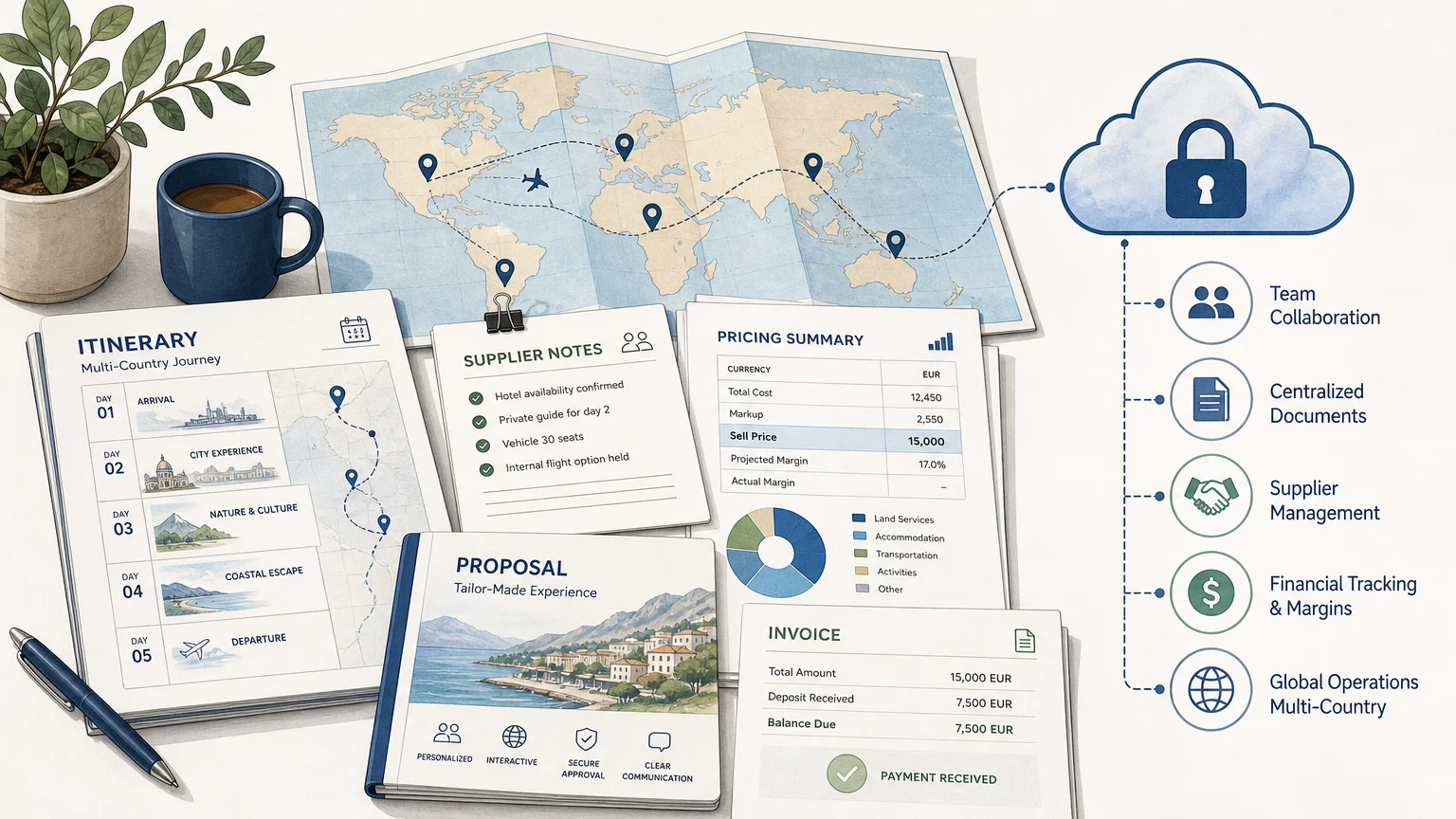
Summary: The right travel agency software in the US connects client inquiries, itinerary production, supplier coordination, payments, financial tracking, and follow-up in one controlled workflow. Your decision should reflect your agency type, trip complexity, team size, integration needs, implementation capacity, and total cost rather than a long feature list alone.
What should travel agency software in the US actually do? It should connect inquiry intake, quoting, itinerary design, client communication, supplier coordination, payments, and financial follow-up instead of adding another isolated tool. To compare the main capabilities through a practical buyer lens, start with our best travel agency software comparison.
The US market includes independent advisors, host agency contractors, retail agencies, tour operators, DMCs, MICE specialists, and larger travel companies. A 2025 survey from Travel Weekly and Phocuswright collected responses from 1,562 travel advisors, including agency employees, independent contractors, owners, and managers, as shown in the 2025 Travel Industry Survey. That variety explains why the best system depends on the workflow you need to control.
What should travel agency software include?
Travel agency software is not one single category. It is an operating layer that may combine booking, sales, itinerary creation, customer management, supplier coordination, payment collection, and accounting workflows.
A booking engine may help you search and reserve flights, hotels, activities, or other travel products. An itinerary and proposal software platform may focus on trip design, pricing, branded documents, and client approvals. A travel CRM may organize leads, client preferences, communications, and follow-up. Back-office software may handle invoicing, commissions, reconciliation, supplier payments, and reporting.
Some platforms concentrate on one layer. Others combine several layers in a single cloud workspace. Products such as Travefy and Tern focus on advisor workflows that connect proposals, client management, bookings, or commissions. WeTravel focuses on multi-day and group travel workflows with itinerary building, booking management, and payments. Enterprise platforms such as TravelOperations bring CRM, ERP, mid-office, back-office, and finance into a broader business system.
For agencies producing tailor-made trips, the most important question is whether the software connects the entire commercial and operational chain:
Our platform is designed around this connected workflow. It brings travel production, sales, operations, finance, CRM, supplier management, invoicing, payments, collaboration, and traveler communication into one environment. Some capabilities depend on your plan, integrations, and implementation configuration, so you should confirm the exact scope before subscribing.
Which platform fit matches your agency?

A solo leisure advisor does not need the same architecture as a DMC managing multi-country programs, a tour operator selling group departures, or a MICE agency coordinating corporate events. Begin with the shape of your business before comparing vendors.
Independent advisors and small agencies
Small teams often prioritize speed, ease of use, client management, proposals, payment collection, and professional presentation. A system should reduce repetitive copying without forcing you to maintain a complex enterprise architecture.
For this group, a practical platform should make it simple to store client preferences, create reusable itineraries, issue branded proposals, collect approvals, track payment milestones, and follow up on open requests. Team permissions still matter, especially when an owner, advisor, bookkeeper, and external contractor share client information.
DMCs and tailor-made travel businesses
DMCs and bespoke operators usually need deeper production controls. Their workflow may include supplier catalogs, detailed costing, multiple currencies, local operations, custom programs, different brands, and frequent quote revisions.
Our platform is particularly relevant when the agency needs to manage a request from first brief through quote, proposal, approval, supplier booking, invoicing, payment, and financial tracking. Reusable project templates can preserve successful itineraries, content, products, budgets, and pricing structures for future requests.
Tour operators and MICE agencies
Tour operators and MICE teams often manage groups, multiple stakeholders, deadlines, rooming details, activity schedules, and changing budgets. The software should support shared visibility without giving every user unrestricted access to every financial or client record.
Role-based permissions, group management, task ownership, approval workflows, reporting, and centralized supplier information become more important as the number of participants and internal handoffs increases.
The practical test is simple: can your team use the same system to sell the trip, produce it, coordinate it, and understand its financial position? If the answer is no, you may be comparing a useful component with a complete operating platform.
Why does workflow coverage matter more than a long feature list?
A platform may advertise dozens of functions and still leave your team dependent on spreadsheets, email threads, and separate documents. Feature count does not show whether information flows cleanly from one step to the next.
Map one real request before you evaluate software. Follow it from the original inquiry to the final payment. Note where the client brief is stored, where supplier details are recorded, how prices are updated, how revisions are approved, and how the finance team knows which margin is current.
This exercise usually reveals the real gaps. A team may not need another itinerary editor. It may need a single record that connects the itinerary to the budget, supplier booking, client approval, payment status, and follow-up task.
Use our guide on how to choose travel agency software to structure this evaluation around real workflows rather than isolated demonstrations. Ask each provider to show the same scenario, including a new inquiry, a revised quote, an accepted proposal, a supplier change, and a final financial review.
Speed is one useful outcome, but it should not be treated as a universal promise. One customer testimonial describes Travel Exclusive Asia reducing re-quoting from 15 to 20 minutes to a maximum of 5 minutes. This is a customer-reported result from a specific workflow, not a guaranteed outcome for every agency.
Why should back-office visibility receive equal weight?
A polished itinerary may win attention, but weak financial control can damage profitability after the sale. Your system should help you understand what a trip costs, what has been marked up, what the client has paid, what suppliers are owed, and what margin remains.
Back-office automation becomes especially important when several departments touch the same file. Sales may focus on conversion, production on delivery, operations on supplier coordination, and finance on payment and reconciliation. Without shared information, each team may work from a different version of the trip.
Look for visibility into:
Our platform connects budgeting, pricing, markups, invoicing, integrated payments, supplier booking management, and financial tracking. It also supports dashboards for costs, projected margins, actual margins, and broader business performance.
For a closer explanation of these workflows, see our guide to travel agency back-office software. The key point is that back-office functionality should not be treated as an afterthought. It influences which trips you sell, which suppliers you prioritize, and whether growth produces healthy margins.
How should US agencies evaluate integrations and migration?
Integration questions become more important when your agency already uses a GDS, accounting system, CRM, email platform, payment provider, website, or supplier portal. Replacing every tool is rarely practical, so the new platform must fit your existing technology environment.
The US-focused Deloitte travel outlook for 2026 combines three primary research efforts conducted in 2025. That timing matters because an outlook is planning context, not a live benchmark of every agency’s operations. Your software evaluation should therefore focus on the workflows and systems your team uses now.
Ask vendors to clarify whether each connection is native, available through an API, handled by a no-code connector, or dependent on custom development. Also ask who owns the integration, how errors are surfaced, and what happens when a supplier changes its format.
Important integration areas include:
Data migration deserves the same attention as integrations. Formatted imports may require you to place information into a specific template. Raw-data migration may require a sample review and a separate quote because the work depends on data quality, structure, and source systems.
Our onboarding process includes configuration, training, support, and guidance for importing existing data. Most agencies are described as becoming autonomous within a few weeks, although timing varies with the size of the team, the complexity of the workflow, and the migration effort required.
What will travel agency software cost beyond the subscription?
Comparing monthly seat prices alone can produce an incomplete budget. You should calculate the first-year cost and the recurring cost separately.
For 2026 planning, our Professional plan is listed at €75 per user per month when billed annually. Our Premium plan is listed at €100 per user per month when billed annually. Enterprise is billed annually and priced on request from 30 users. Displayed subscription prices exclude tax.
Our one-time Onboarding Pack is mandatory at the start of the subscription and listed at €1,990 excluding tax. Additional services may include formatted data import, raw-data migration, training, customizations, workflow configuration, and custom integrations. Formatted import is listed at €390 excluding tax, while raw-data work is quoted according to the effort involved.
For a US agency, clarify the billing currency and payment route before signing. Payment can be made by card, or by international transfer in euros or US dollars on request. Subscriptions renew annually, added users are billed pro rata, and the displayed prices exclude tax.
Also confirm:
A transparent quote should show subscription, onboarding, migration, integrations, training, custom work, taxes, and any payment-related charges. This makes it easier to compare a complete platform with a lower-priced tool that may require several additional systems.
How do you test client delivery before buying?
Client-facing delivery affects how your agency is perceived. A platform should help you provide clear proposals, organized travel documents, timely approvals, and a consistent branded experience.
The 2026 U.S. Travel Group Travel Report notes that uncertainty affected some parts of group travel demand, including international travelers and large companies. For agencies serving group, incentive, or corporate programs, this reinforces the value of flexible proposals, clear approvals, fast revisions, and accurate payment information.
Test a complete client journey instead of viewing a static sample. Ask the vendor to demonstrate how a client receives a proposal, reviews changes, approves an option, receives documents, and accesses the latest trip information.
Check whether the system supports:
Our Web-Page feature supports interactive web proposals, branded presentations, approvals, client communications, and personalized traveler portals. It is designed for agencies that want a polished delivery layer without separating the proposal from the production and pricing data behind it.
Do not assume that every platform provides the same type of client experience. Some products focus on advisor CRM and proposals. Others emphasize group bookings and payment plans. Some specialize in a branded mobile app or a guest-facing itinerary. The right choice depends on how your clients expect to review and manage their trips.
What is the fastest way to shortlist providers?
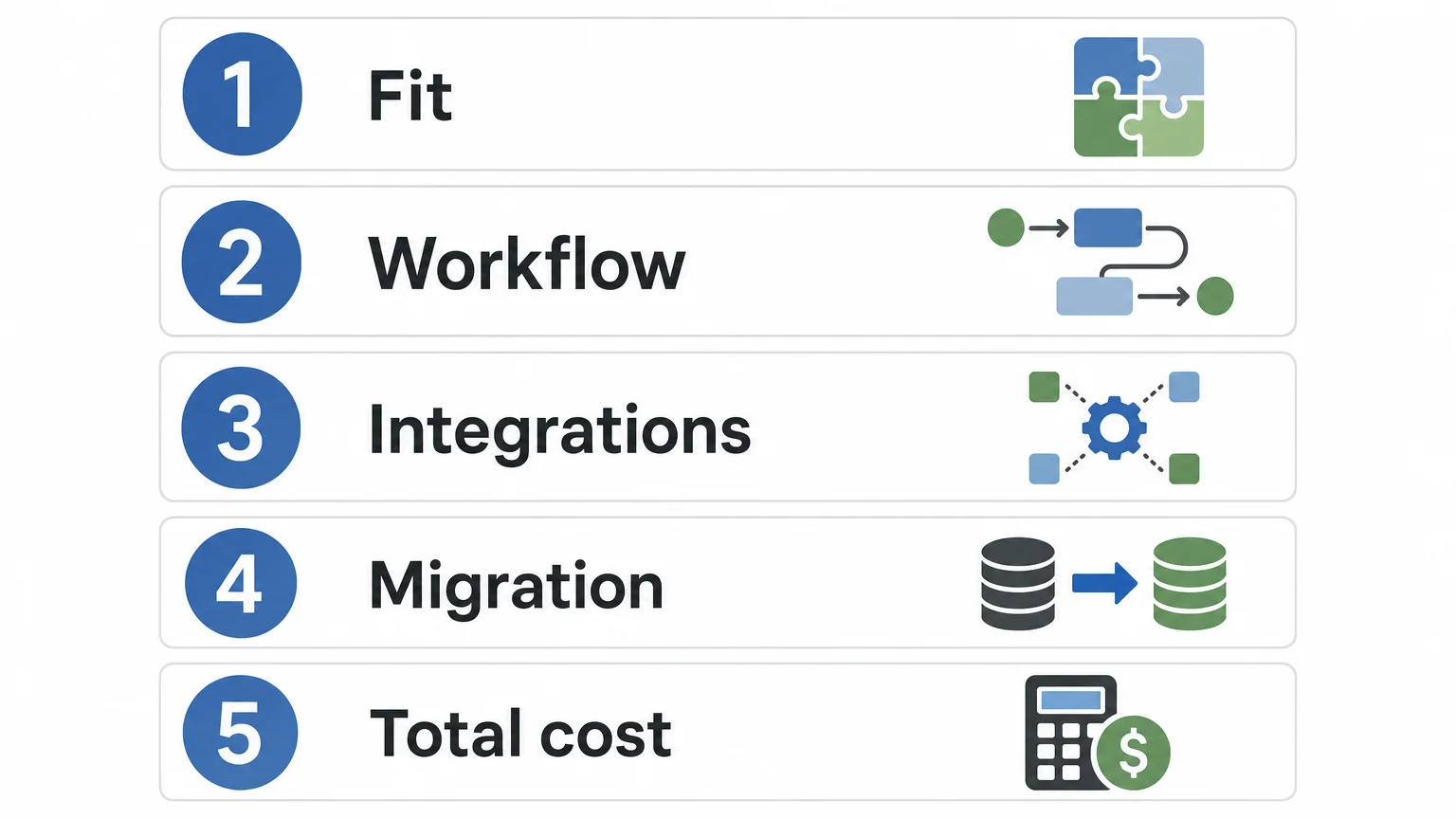
A focused shortlist usually comes from testing five questions in order:
Small businesses should prioritize clarity and adoption over unnecessary complexity. Our resource on travel agency software for small businesses explains how to assess usability, growth requirements, workflow coverage, and implementation effort together.
Before deciding, ask each finalist to use one of your real trip examples. Include an itinerary revision, a supplier cost change, a client approval, and a payment milestone. A live test reveals more than a generic demonstration because it shows how the platform behaves under the conditions your team manages every day.
Our platform supports more than 600 agencies in more than 70 countries, with workflows for travel agencies, DMCs, tour operators, tailor-made businesses, and MICE teams. That international scope is useful for agencies that need multi-currency, multilingual, multi-country, multi-brand, and role-based workflows.
Choose the system that connects your real work
The right travel agency software in the US should reduce fragmentation across sales, production, operations, finance, suppliers, and client communication. Evaluate the complete workflow, test the integrations, clarify migration, calculate total cost, and involve the people who will use the platform daily. For agencies producing complex or tailor-made travel, a connected system can provide faster quoting, reusable production knowledge, clearer margin visibility, and more consistent client delivery.
Connect your travel operations in one platform
If your team is still moving between spreadsheets, documents, inboxes, supplier files, and disconnected finance tools, the cost is more than administrative effort. It can also create version conflicts, slow proposals, missed follow-ups, and unclear margins.
We bring travel production, CRM, supplier management, budgeting, proposals, invoicing, payments, collaboration, and financial tracking into one cloud platform. Our onboarding, training, migration options, templates, integrations, and support help you configure the workflow around your agency. Explore our travel agency software and request a demonstration for your use case.
Frequently Asked Questions
What is travel agency software used for?
Travel agency software helps manage inquiries, client records, itineraries, proposals, supplier coordination, payments, documents, and financial workflows. Depending on the platform, it may also include CRM, booking, invoicing, reporting, portals, and integration tools.
Is travel agency software suitable for a small US agency?
Yes, provided the platform matches the agency’s workflow and does not create unnecessary implementation complexity. Small agencies should focus on usability, client management, proposal production, payment visibility, support, and the ability to add users or workflows as the business grows.
What is the difference between a booking system and travel agency software?
A booking system primarily helps search, reserve, and manage travel products. Travel agency software may cover a broader process, including CRM, itinerary design, pricing, proposals, supplier operations, invoicing, payments, and reporting.
How should an agency compare software pricing?
Compare the full first-year cost, not only the monthly or annual subscription. Include onboarding, migration, integrations, training, customization, taxes, additional users, payment terms, and renewal conditions.
Can Ezus support agencies with complex travel workflows?
Our platform supports travel agencies, DMCs, tour operators, tailor-made travel businesses, and MICE agencies. It is designed to connect request intake, itinerary production, budgeting, pricing, proposals, supplier management, invoicing, payments, client communication, and financial tracking, with some capabilities depending on the selected plan and configuration.
.jpeg)

Join Ezus today
Request a demo today and discover how our software can help you reach new heights.

.jpg)