
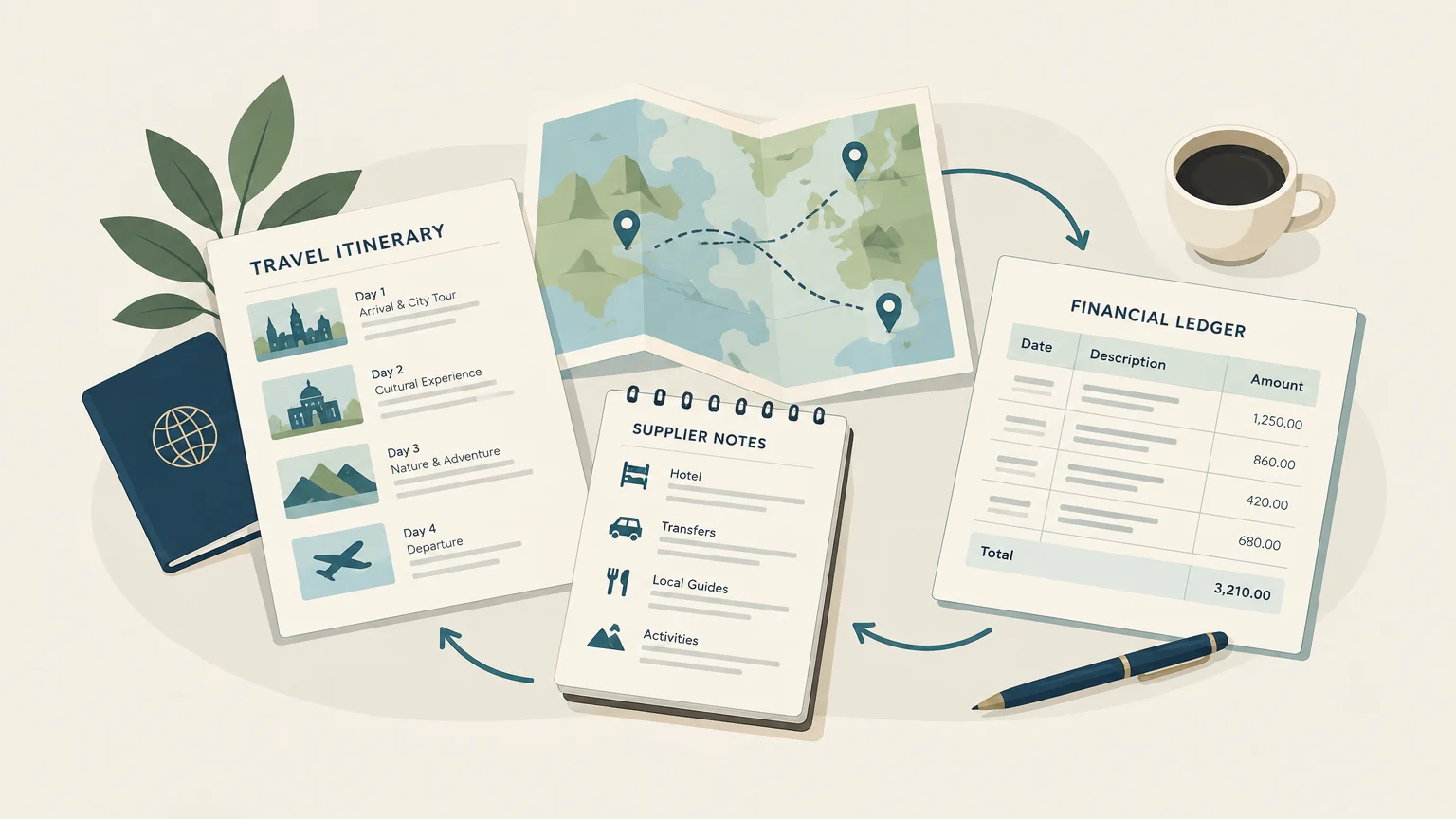
Does your online storefront need to sell live inventory, or does your team need software to design and manage custom trips sold online? Those are different jobs, even though both may be described as online travel agency work. For itinerary-led agencies, software for an online travel agency should connect enquiries, tailored proposals, supplier coordination, and financial follow-through. Our software for online travel agency booking article explores how booking-focused workflows fit into broader agency operations.
Customer-facing booking quality matters alongside back-office efficiency. In its 2026 U.S. benchmark, the American Customer Satisfaction Index gave online travel agencies a score of 82 out of 100 for ease of booking and payment, making checkout a useful selection criterion. The right system depends on your sales model, the services you arrange, and how customer bookings move through your team.
What kind of online travel business are you supporting?
Start by defining what “online travel agency” means for your business. A consumer-facing online travel agency may need searchable inventory, live availability, instant reservations, and automated confirmations. An agency selling tailor-made trips online may instead need to collect enquiries, prepare itineraries and proposals, coordinate suppliers, and manage approvals before confirming a trip.
These models can share customer records and payment needs, but they do not require identical software. A booking engine that searches available products is not automatically a system for costing a bespoke itinerary or tracking supplier operations. Conversely, a platform for trip production and client proposals is not necessarily a public-facing marketplace with live flight and hotel inventory.
Write down your principal transaction first. If customers select and pay for available products themselves, prioritize online booking functionality and the inventory connections behind it. If a travel planner builds each trip around a customer request, prioritize quotation, itinerary production, approvals, supplier management, and clear follow-up.
Which workflows should the system connect?
Picture a customer asking for a multi-stop trip. A connected workflow takes the request from client record to itinerary, budget, proposal, approval, supplier bookings, invoice, and payment tracking. When information moves between separate tools by copy and paste, teams risk using outdated prices, missing a supplier update, or sending documents with inconsistent details.

Look for itinerary and proposal tools that keep trip details, costs, and client-facing documents aligned. Reusable templates can reduce repeated setup, while client review and digital approval help teams confirm what has been accepted. For agencies managing custom programs, our platform brings itinerary design, budgeting, proposals, supplier booking management, invoicing, and financial tracking into a shared travel workspace.
Check whether the system also supports your team’s day-to-day handoffs. Sales may qualify the request, production may build the trip, and finance may review margins and payments. Role-based access, shared project data, and clear status updates help these teams work from the same record. Review our travel agency software requirements when mapping those workflows.
How should the online booking journey work?
A customer who books without speaking to an advisor expects clear product information, accurate availability, a straightforward payment step, and a reliable confirmation. If you sell live inventory, test the complete journey on your actual website, including searches, date changes, failed payments, amendments, and cancellations. Confirm which supplier or inventory systems feed the displayed availability.
For comparison, a 2026 travel trends report found that 39% of surveyed operators identified their website as the primary booking channel for trips departing in 2026, while 4% identified an online travel agency. These figures describe the report’s responding operators, not the whole travel market, but they show why it is important to distinguish direct website bookings from marketplace distribution. The 2026 channel findings provide useful context.
If you sell custom trips, an online proposal or traveler portal may be more central than self-service inventory search. Customers can review trip information, communicate with your team, and approve a proposal online, while staff retain control of supplier confirmation. Ask vendors to demonstrate exactly where a customer action ends and an internal task begins.
How should payments, suppliers, and finances fit together?
Map money movement before choosing a platform. Determine how customers pay deposits and balances, how your team records supplier costs, and how invoices connect to each booking. Check the currencies supported, the payment methods available in your markets, and whether payment status is visible to the colleagues who need it.
Useful financial tracking goes beyond recording that a customer paid. For each trip, staff should be able to understand expected costs, selling price, markup, and the status of supplier payments. Ask for a demonstration using a real booking scenario, including a changed itinerary or a revised supplier cost, so you can see how updates affect the trip record and its finances.
Supplier features also differ. Some systems connect directly to external inventory and reservation services; others organize booking requests and supplier details as part of an agency’s operations. Confirm whether the software supports the connections you rely on, or whether your team must continue booking through supplier portals and updating records manually.
Which integrations and reporting will you need?
List the systems that already support your business, such as your website, customer relationship management tool, email, accounting software, payment provider, and supplier platforms. Then ask how each connection works: built-in integration, API, connector, export, or manual transfer. A connection should move the specific data you need, not merely appear in an integrations list.
Reporting depends on that data flow. If a website enquiry becomes a booking in a separate system, check whether you can trace the source and measure conversion without reconciling records by hand. A 2026 audit of 545 tourism businesses found that 9.8% could trace a booking back to its source; the audit also found substantial gaps between analytics tools and booking systems. The 2026 tourism audit is a reminder to test attribution using your own channels and booking process.
Our travel operations platform supports connections such as CRM, email, accounting software, white-label website platforms, public APIs, webhooks, and no-code connectors. Availability depends on the selected plan or integration scope. Use our travel agency software comparison to consider workflow coverage alongside the connections you need.
What should you test before choosing software?
Use your own booking example rather than a generic sales demonstration. Enter a real enquiry, make a proposal, change one supplier price, record a customer payment, and check what the finance and operations teams can see. This reveals whether the system supports your actual process or simply presents a polished front end.
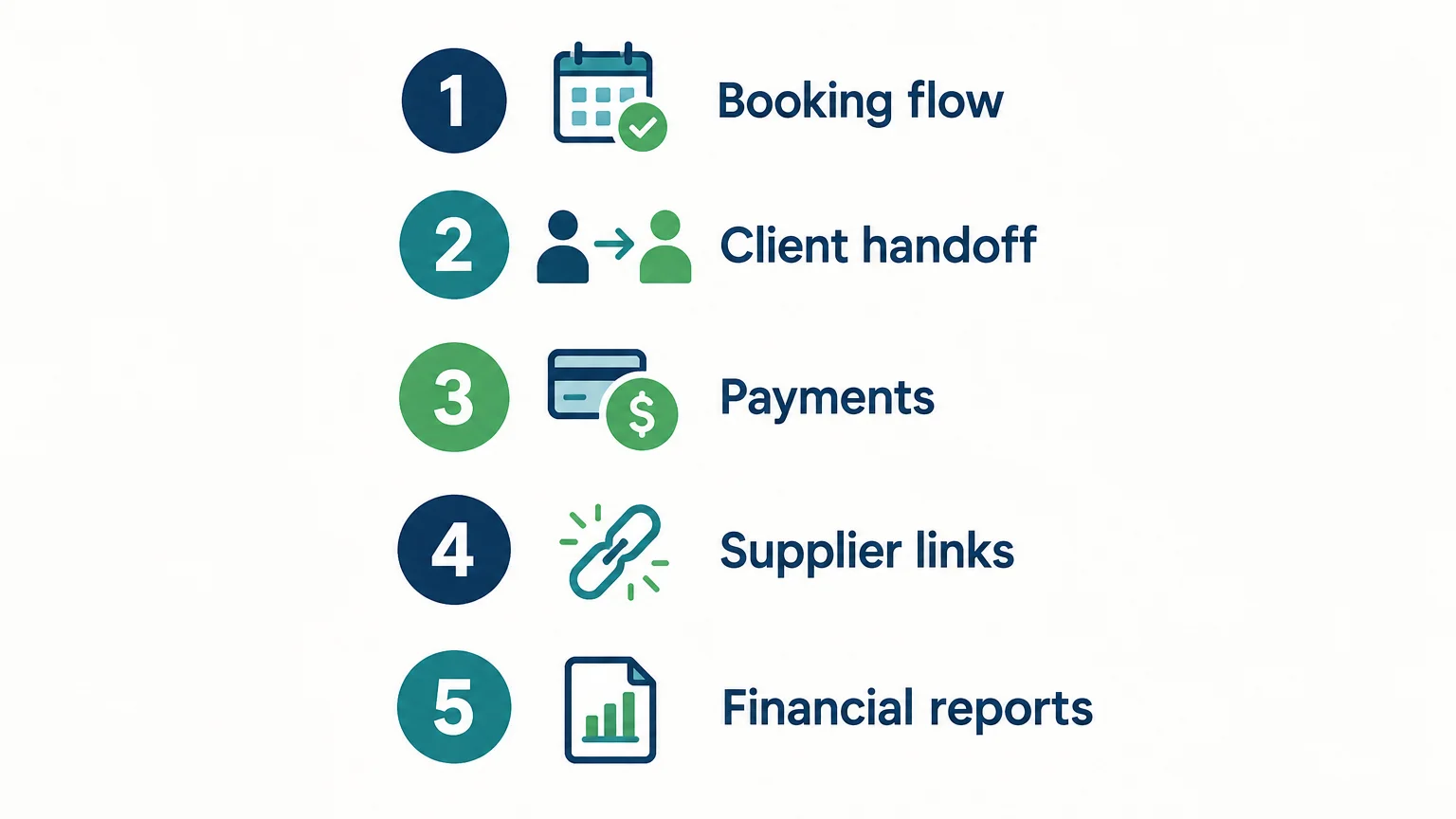
- Booking flow: Can customers complete the steps your sales model requires?
- Team handoffs: Can sales, production, and finance access the right trip information?
- Payment records: Are invoices, receipts, and payment status tied to the booking?
- Supplier process: Does the system connect to your suppliers or organize your booking requests?
- Reporting and support: Can you see useful performance information and get implementation help?
Compare total adoption costs, not just the subscription. Include onboarding, migration, training, extra users, integrations, and any transaction fees that apply. Check contract length, renewal terms, data export, and the support available during implementation. Our guide on how to choose travel agency software offers a framework for matching those criteria to your workflows.
For example, our annual plans are billed per user. Professional is listed at 75€ per user per month and Premium at 100€ per user per month when billed annually, excluding tax. A one-time Onboarding Pack is required at the start and is listed at 1,990€ excluding tax; Enterprise pricing is available on request from 30 users. Ask how these terms and any optional migration or integration work apply to your team.
Which software capabilities matter most for custom travel?
For a tailor-made travel agency, the central requirement is often continuity from the first request through delivery and payment. In our cloud platform, teams can manage custom itineraries, budgets, branded proposals, client approvals, supplier booking workflows, invoicing, and trip-level financial tracking in one workspace. Traveler portals support sharing trip information and communication without replacing the agency’s own supplier relationships.
We serve more than 600 agencies in over 70 countries, according to our business figures. That breadth reflects use across different travel businesses, but your evaluation should still test your destinations, languages, currencies, team roles, and customer journey. Customer testimonials also describe specific outcomes: Elux Group reports 25% greater productivity when building and pricing proposals, while Travel Exclusive Asia says re-quoting time fell from 15–20 minutes to a maximum of five minutes. These are individual customer experiences, not a performance guarantee.
For other online agency models, verify that the system provides the live inventory search, instant reservations, or public checkout you require. A complete travel management platform and a consumer booking engine solve related but distinct problems. Choose based on the tasks your software must perform directly and the connections your business can maintain.
Choose software around the booking you actually sell
The right online travel agency software depends on whether customers reserve live inventory or work with your team to build a trip. Map the customer journey, test supplier and payment workflows, and confirm how bookings connect to financial records and reporting. Then compare onboarding, integrations, support, and total cost against the needs of your team.
See how our travel platform fits your workflows
If your agency sells tailored itineraries, you need a reliable way to connect proposals, supplier coordination, client communication, and trip finances. Our cloud platform supports travel agencies, DMCs, and tour operators across production, sales, operations, and finance.
More than 600 agencies in over 70 countries use our platform. Our annual plans include Professional at 75€ per user per month and Premium at 100€ per user per month when billed annually, excluding tax; a mandatory one-time Onboarding Pack is listed at 1,990€ excluding tax. Explore software for online travel agencies and request a demonstration based on your team’s workflows.
Frequently Asked Questions
What is software for an online travel agency?
It is software that supports tasks such as handling enquiries, managing bookings, communicating with customers, coordinating suppliers, and tracking payments. The exact capabilities depend on whether you sell live inventory, tailor-made trips, or both.
Does travel agency software always include a booking engine?
No, an operations platform and a public-facing booking engine serve different needs. Confirm that a product supports searchable inventory and instant reservations if customers must book directly online.
Which features should a tailor-made travel agency prioritize?
Prioritize itinerary design, budgeting, proposals, customer approvals, supplier coordination, invoicing, and financial tracking. Reusable templates and shared records can also support consistent work across teams.
How should I evaluate payments and integrations?
Follow a booking from customer payment through invoices, supplier costs, and financial reporting. Confirm which payment methods, accounting connections, website integrations, and supplier links are available for your intended workflow.
Can Ezus support online travel agency operations?
Our platform supports travel production and operations, including custom itineraries, proposals, client portals, supplier booking management, invoicing, and financial tracking. If you require a public-facing live-inventory booking engine, confirm that specific requirement during your evaluation.


Join Ezus today
Request a demo today and discover how our software can help you reach new heights.