
A polished demo does not prove that a platform will preserve a supplier booking, recalculate a budget, or restore a traveler file after an error. If you are deciding how to choose reliable travel software, test everyday work and failure recovery, not just the feature list. Use how to choose travel agency software as a decision process: set must-pass workflows, ask for evidence, and record unresolved risks before signing.
Reliability also has a traveler-facing side. In the 2026 ACSI travel study, U.S. online travel agencies scored 83 out of 100 for mobile-app reliability, measured through downtime, crashes, and lags. That benchmark concerns consumer apps, not back-office travel software. Use it as a reminder to test access and performance against the workflows your team manages.
What does reliability mean in a travel workflow?
Reliable software keeps information accurate and available as work passes between sales, production, finance, operations, suppliers, and travelers. A quote should reflect the latest itinerary and costs. An approved change should reach the people who need to act on it, without creating conflicting versions.
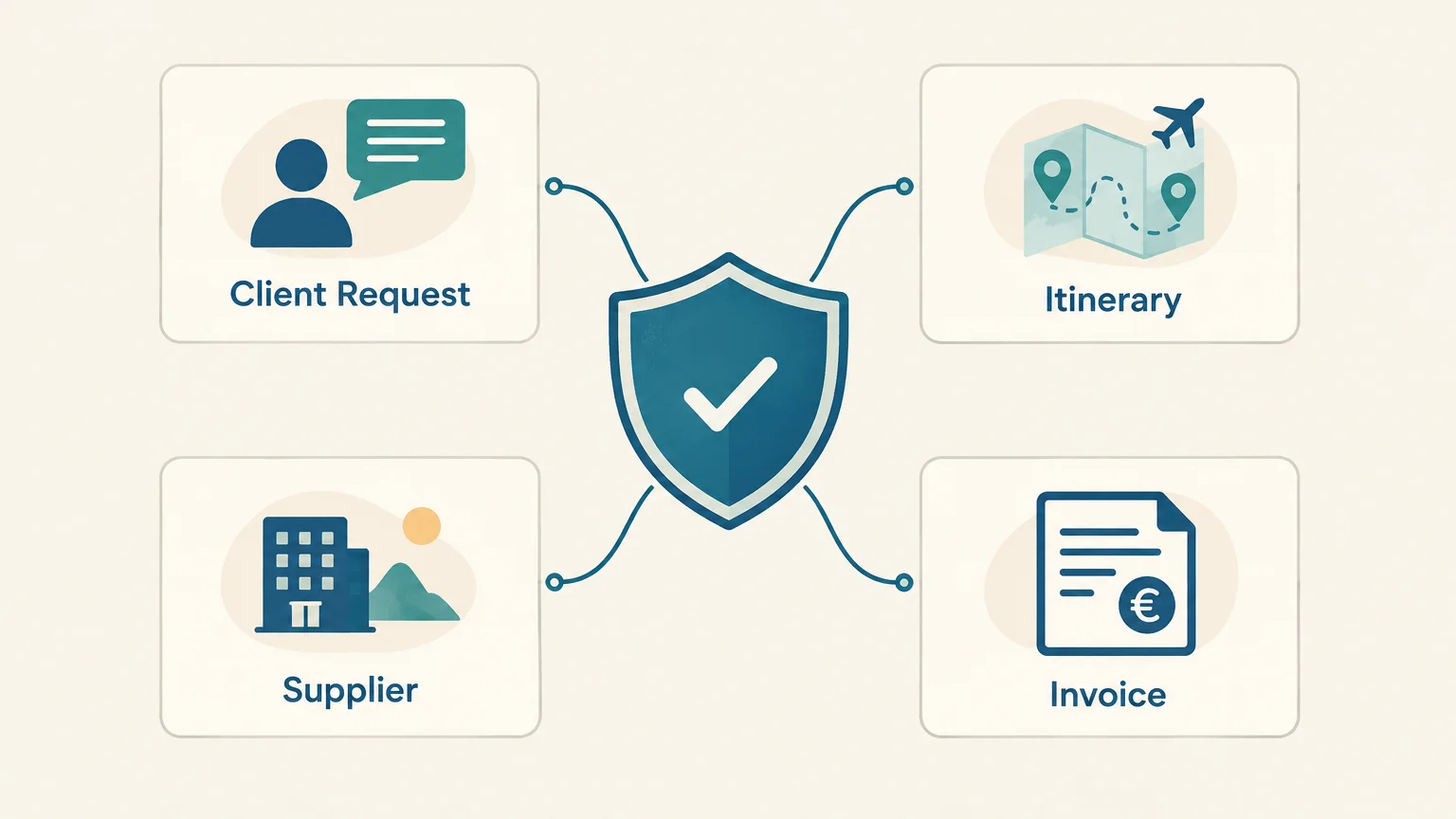
Think beyond whether the system opens. Test the full chain, from a client request to an itinerary, budget, proposal, supplier booking, invoice, and payment record. A failure at any handoff can create rework or leave staff acting on outdated details. Operational continuity means the whole process remains understandable when an itinerary changes or a team member is unavailable.
Ask vendors to show this chain using a realistic example from your agency. Notice which steps are automatic, where staff must re-enter information, and how the system makes changes visible. A feature list is useful only when each capability works with the next part of your process.
How do you verify data security and privacy?
Before entering real client records, ask for clear answers about data storage, access, retention, deletion, and incident handling. Find out which parties process the information and what happens when your contract ends. Request the relevant security documents and data-processing terms before procurement is complete.
Check whether permissions can separate sensitive work by role, and ask how the platform protects accounts with multifactor authentication or single sign-on. Confirm how data is protected in transit and at rest, and whether access or administrative changes are logged. Access controls matter when sales, operations, and finance need different levels of visibility.
Use fictional or anonymized records during an early trial. Then check whether the permissions you configured prevent the wrong user from viewing or changing a record. Our travel agency software requirements page can help you organize the questions to resolve before rollout.
Can the software recover from errors and provide your data back?

Test recovery with a failure scenario, not a reassuring promise. Ask the vendor to explain how it restores deleted or damaged information, how often backups are made, and who is responsible for recovery. If a live demonstration is available, use a sample trip and observe the process.
Also request a usable export of your own records before committing. Check whether it includes the fields your team needs, such as itinerary details, supplier information, prices, client approvals, and financial records. Data portability is practical only when your team can open and use the export without relying on the original platform.
Include a trial exit in your evaluation. Export sample data, verify that key records are present, and ask how long access remains available after cancellation. If the vendor cannot explain recovery responsibilities or the export process, treat that uncertainty as a procurement risk.
Do integrations and implementation fit your actual workflow?
A feature that exists on a product page is not necessarily included in your plan or connected to your tools. List the systems your agency uses for email, accounting, documents, customer management, bookings, and payments. For each connection, confirm what data moves, in which direction, and what happens when a transfer fails.
In 2026, 61% of travel buyers reported challenges managing global travel programs in GBTA’s 2026 research. That finding does not show that one software product solves the problem. It does make cross-team handoffs and data consistency sensible tests for agencies with multiple suppliers or destinations.
During a demonstration, ask the vendor to show your most important handoff, not a generic setup. Clarify which integrations are available in your plan, whether configuration or custom work costs extra, and who maintains the connection. Our article on reliable travel workflow software can help you assess whether your workflows belong in a connected system.
Implementation deserves the same scrutiny. Request a written outline of migration steps, staff training, configuration, responsibilities, and the support available at go-live. A technically capable platform still needs a realistic path from your current records and processes to routine use.
How should you assess support and the full contract cost?
Ask who handles urgent problems, how to reach support, what hours and languages are available, and how issues are escalated. Confirm what training and onboarding include, and whether your team will have a named contact. Our travel software technical support page covers the support questions agencies should raise.
Travelers also value accountability when deciding where to book. In a March 2026 survey commissioned from YouGov, more than 5,700 adults across the United States, United Kingdom, and India took part; nearly 70% preferred booking with trusted travel brands over AI chatbots and agents, according to Expedia Group’s survey. This is consumer research, not a software reliability measure, but it underlines the value of a clear human support path when plans change.
Compare the total cost of ownership, not only the subscription. Include user charges, required setup, migration, training, custom integrations, renewal terms, and the cost of leaving. Our subscription is annual and billed per user, with a mandatory one-time Onboarding Pack; optional imports, additional training, and customizations are separate when selected.
In 2026, we support more than 600 agencies across more than 70 countries, and we have operated since 2018. That experience provides useful context when assessing a vendor’s continuity, but it does not replace questions about support commitments, recovery, and your contract.
What warning signs should make you pause?
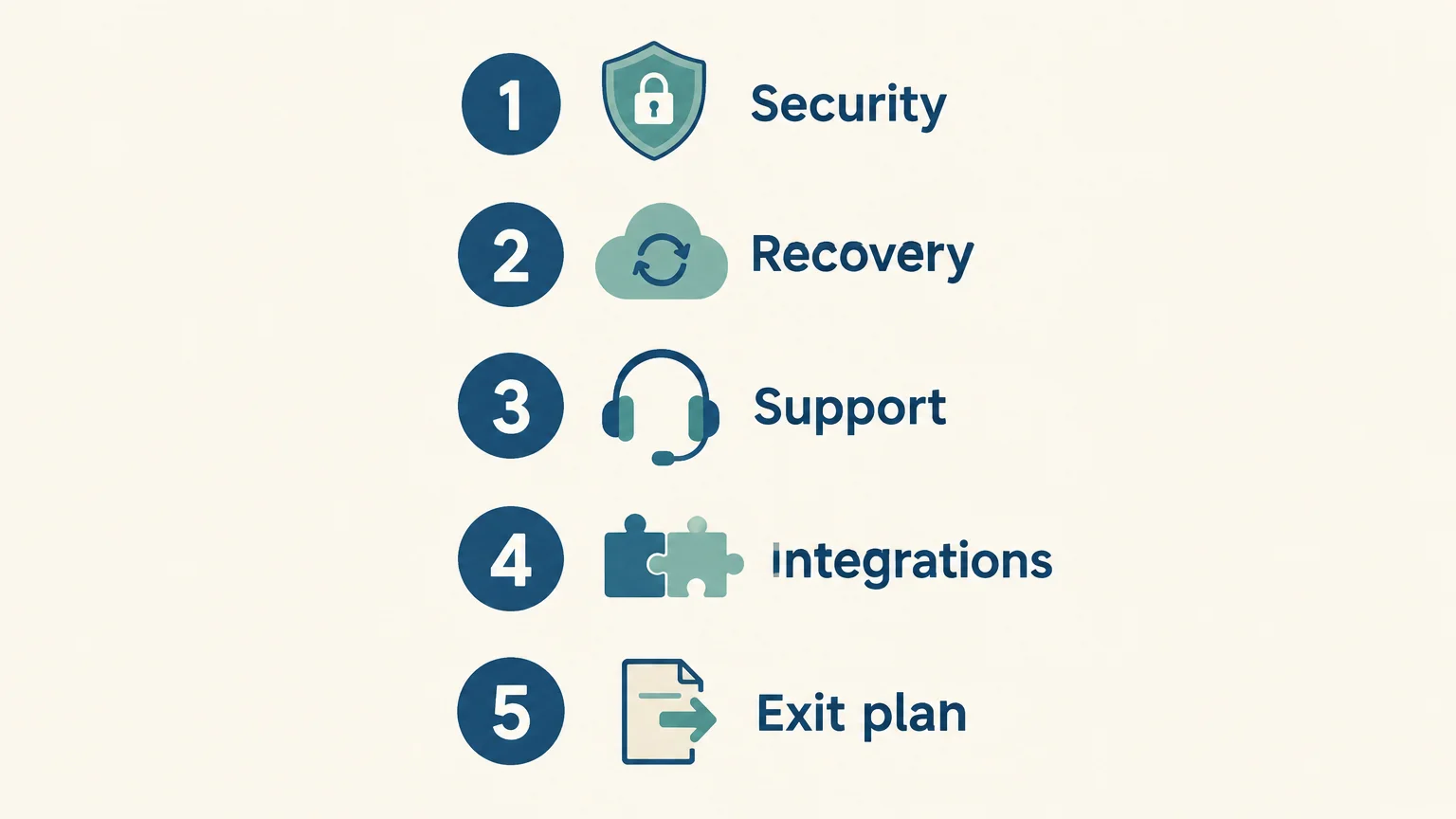
Pause the evaluation when a vendor cannot give specific, consistent answers about the following:
- Unclear security: the vendor cannot explain data access, storage, deletion, or incident procedures.
- No recovery evidence: the vendor describes backups but cannot explain how restoration works.
- Restricted exports: you cannot verify what data you can retrieve or how usable it will be.
- Vague support: escalation routes, service hours, or onboarding responsibilities remain undefined.
- Hidden costs: plan limits, migration fees, renewal conditions, or exit steps are not documented.
- Demo-only proof: the vendor avoids testing your actual workflows or handling an error scenario.
One unresolved question does not automatically disqualify a supplier. Record the gap, ask for written clarification, and decide whether your team can accept the remaining risk before signing.
Choose on evidence, not promises
The most dependable choice is the platform that passes your real workflow tests, protects and returns your data, fits your existing tools, and explains its support and full costs. Define must-pass criteria before demonstrations, test a realistic trip from request to payment, and document any unresolved risk. That is a practical way to choose travel software with confidence without relying on claims that a demo cannot prove.
Assess travel agency software for your team
If your agency handles itinerary design, pricing, supplier coordination, and finance across disconnected tools, evaluate software against those everyday handoffs. Our cloud platform supports travel agencies, destination management companies, tour operators, tailor-made travel businesses, and MICE teams. In 2026, more than 600 agencies across over 70 countries use our platform, and we have operated since 2018.
Our annual per-user plans cover travel production, sales, operations, and finance, with onboarding required at subscription start. Optional imports, training, and customizations can be scoped to your needs. Request a demonstration using one of your real workflows, then review our travel agency software to see whether the platform fits your team.
Frequently Asked Questions
What makes travel software reliable?
Reliable travel software keeps essential information accurate and accessible across the workflows your team uses. It also provides clear support, recovery, security, and data export processes.
How should an agency test software before buying?
Use a realistic sample trip to test the request, itinerary, budget, approval, supplier, and finance steps. Include a change or error scenario and verify the resulting records.
Which security questions should you ask a software vendor?
Ask how data is stored, protected, accessed, retained, and deleted. Request details about permissions, incident handling, subprocessors, and the data-processing terms that apply to your organization.
What are warning signs during a travel software evaluation?
Be cautious when a vendor avoids workflow testing or cannot explain recovery, export, support, and contract terms. Ask for written answers before you commit.
What support does Ezus provide to travel businesses?
Our cloud-based travel operations platform includes onboarding, training, technical support, and implementation guidance. Data migration and some configuration or integration work can be scoped separately.


Join Ezus today
Request a demo today and discover how our software can help you reach new heights.