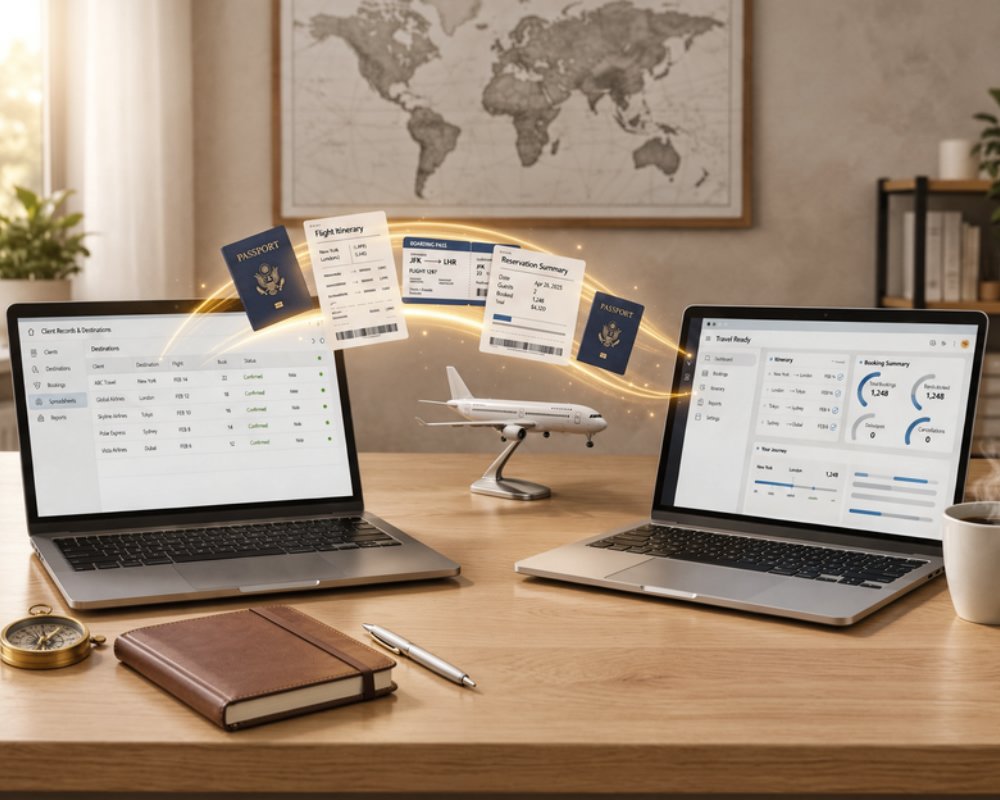

Need to coordinate a corporate event, incentive trip, or conference across travelers and suppliers? The best MICE travel software 2026 for agency teams should connect itinerary production, budgets, group records, proposals, and financial tracking. We recommend our workflow-first option, with software for MICE agencies, when these responsibilities sit inside one travel business.
The work spans more than a schedule: the Events Industry Council found that business events brought together 1.65 billion participants across more than 180 countries in 2025. That scale makes clear project records, supplier coordination, and adaptable budgets practical buying criteria, not optional extras.
Short answer: our pick for MICE agency teams
Choose Ezus if your team needs to manage MICE and group travel through connected itinerary, budgeting, proposal, supplier, and finance workflows. Its documented MICE and group capabilities make it the most direct fit here for travel agencies and DMCs that build and sell custom programs. Choose an alternative when its specific model, such as multi-day traveler payments or luxury FIT production, better matches your work.
Best MICE travel software 2026 compared
| Software | MICE and group fit | Workflow emphasis | Key point to validate |
|---|---|---|---|
| Group management for GIR and MICE is identified | Itineraries, budgets, proposals, suppliers, invoicing, and financial tracking | Annual per-user subscription and required onboarding cost | |
| Travel advisor trip planning and client communication | Branded itineraries, proposals, CRM, invoices, and commissions | How corporate group budgets and event operations fit your process | |
| Luxury and bespoke travel, including inbound operators | Itineraries, bookings, financial management, tasks, and analytics | How its workflow handles your MICE group and approval requirements | |
| Advisor, agency, and host organization workflows | Client marketing, bookings, advisor commissions, and reporting | How event-level group quotations fit your process | |
| Multi-day trips with traveler and rooming workflows | Itineraries, bookings, payment plans, room inventory, and manifests | How custom event proposals and financial controls work for your team | |
Odys | DMC and inbound operator workflows | Custom quotes, margin management, and supplier operations | Its stated target is DMCs and inbound operators with 3 to 25 employees |
1. Ezus travel-business SaaS platform
Best for: MICE agencies, DMCs, and travel businesses that want to manage custom event and group programs alongside their wider travel production and finance work.
Our platform connects itinerary design, dynamic budgeting, proposals, supplier management, group handling, invoicing, payments, and financial tracking. MICE teams can use multi-country itineraries, customizable client documents, web presentations, traveler portals, supplier catalogs, and group management for GIR and MICE. This scope matters when a corporate quote must stay aligned with changing participant numbers, supplier costs, and client approvals.
We support more than 600 agencies in over 70 countries. Elux Group, an outgoing travel agency with MICE activity, says it gained 25% productivity in building and pricing proposals. That is one customer’s reported result, not a MICE-specific benchmark or a general performance promise.
Our software MICE can be assessed against your own quote-to-invoice process, including how sales, production, operations, and finance share project information.
Pros
- Combines MICE and group capabilities with itineraries, budgets, proposals, supplier booking management, invoicing, and financial tracking.
- Supports branded documents, web presentations, and traveler portals for client review and communication.
- Lists Professional at €75 per user per month and Premium at €100 per user per month when billed annually. Enterprise pricing is by request from 30 users.
Cons
- The subscription is annual and per user. A mandatory one-time €1,990 Onboarding Pack, excluding tax, adds an initial cost to include in your budget.
2. Travefy
Best for: Travel advisors and agencies prioritizing branded itineraries, client proposals, and communication tools.
Travefy brings together itinerary building, proposals, CRM, marketing tools, invoices, commission tracking, and client communication. Its mobile client experience includes flight updates and offline access. That combination suits advisor-led selling and itinerary sharing, especially when consistent presentation is central to the customer experience.
For an MICE agency, the key question is how the platform maps to event-scale budgeting, participant changes, and internal project handoffs. Its stated positioning is centered on travel advisors, so compare its workflows with your corporate event and group delivery requirements before choosing.
Pros
- Connects client-facing proposals and itineraries with CRM and communication tools.
- Supports branded trip materials and a mobile traveler experience.
- Includes invoice and commission features in its described travel business toolkit.
Cons
- Its advisor-oriented focus makes it important to test how corporate group budgets and event operations fit your particular workflow.
3. Tourwriter
Best for: Luxury and bespoke travel businesses, DMCs, travel designers, and inbound operators building multi-day itineraries.
Tourwriter combines itinerary design with CRM, pricing, booking management, financial tools, tasks, and analytics. Its described workflow includes booking requests from itineraries and supplier confirmations, which can support teams managing detailed custom trips. The product is positioned around luxury and bespoke travel, with multi-day FIT itineraries among its stated areas of focus.
Its website lists plans starting at USD 99 per month. Confirm the applicable plan, billing basis, and team cost before comparing that starting price with other platforms. If your core work is corporate MICE, test group quoting, approvals, and event-specific budget changes against a real project.
Pros
- Brings itinerary design together with bookings, financial management, CRM, tasks, and analytics.
- Its luxury and bespoke positioning aligns with agencies producing detailed, personalized itineraries.
- Publishes a starting monthly price, giving teams a basis for an initial pricing discussion.
Cons
- Its stated focus is luxury and bespoke travel, including multi-day FIT programs, so confirm that its workflow suits your corporate group and event requirements.
4. Tern
Best for: Travel advisors, agencies, and host organizations focused on advisor operations, client marketing, and booking visibility.
Tern describes tools for managing advisor and agency business, including an email marketing suite, an advisor mobile app, AI-assisted itinerary and email drafting, and a curated hotel library. Its agency and host workflows emphasize visibility into bookings, commissions, advisor credentials, and reporting. This makes it a relevant option when advisor organization and client engagement are central to the operating model.
For MICE travel management, check how event-level quotes, group cost changes, and shared project delivery work for your team. Tern’s described emphasis is advisor and agency operations, so assess that fit against your actual MICE workflow rather than assuming a travel advisor feature will cover event production.
Pros
- Connects advisor-facing operations with client marketing and travel planning tools.
- Describes agency and host visibility into bookings, commissions, and advisor performance.
- Includes a traveler-facing mobile app within its product offering.
Cons
- Its stated focus is advisor, agency, and host workflows, so validate event-specific group quoting against your needs.
5. WeTravel
Best for: Multi-day travel businesses organizing traveler bookings, room inventory, manifests, and payments.
WeTravel positions its platform around multi-day travel operations. Its described tools cover itineraries, CRM, booking and trip management, payment plans, room inventory, passenger manifests, traveler details, payment processing, and partner payments. Those functions make it a credible option for organized group departures where booking and payment collection are central to delivery.
For custom corporate programs, evaluate the handoff from proposal and budget into supplier coordination and financial tracking. The comparison is not simply “group versus MICE”; it is whether your agency can manage its specific event production workflow without separating essential information across disconnected tools.
Pros
- Provides group-relevant features such as room inventory, traveler details, passenger manifests, and payment plans.
- Combines itinerary building with booking and payment workflows for multi-day travel businesses.
- Describes partner payments as part of its travel operations ecosystem.
Cons
- Its stated focus is multi-day travel operations, so verify that custom MICE proposals, internal approvals, and your required financial controls fit the workflow.
6. Odys
Best for: DMCs and inbound operators producing custom itineraries and managing supplier operations.
Odys describes a DMC-oriented workflow for professional quotes, margin visibility, and trip operations. Its product material highlights options within quotes, client feedback, multi-currency handling, supplier email automation, an operational calendar, and supplier performance information. The emphasis on margin visibility during sales and operations makes it relevant to inbound agencies managing custom programs.
Its stated target is DMCs and inbound operators with 3 to 25 employees. Its suitability is therefore easier to establish for an inbound DMC than for an outbound tour operator, retail travel agency, or multi-DMC group. Confirm the scope against your team structure and event workflow before you commit.
Pros
- Focuses on DMC quotation, margin management, and supplier operations.
- Describes multi-currency handling and operational visibility during trip delivery.
- Includes quote options and client feedback within the proposal workflow.
Cons
- Its stated target is DMCs and inbound operators with 3 to 25 employees, which may not match other agency models or team sizes.
What should you test before choosing MICE event management software?
Start with one recent event brief, not a generic product tour. Ask each vendor to show how a quote changes when attendee numbers, rooming needs, supplier costs, or program details change. Then follow that same project through client approval, supplier coordination, invoicing, and financial review.
Also compare the cost of running your actual team. Include subscription billing, implementation, migration, training, and any integrations you need. For Ezus, the annual per-user subscription and required onboarding charge are part of that calculation; optional imports, training, and customizations should be assessed only if you need them.
Industry conditions reinforce the need to watch budgets closely. In its 2026 outlook, PCMA found that six in ten surveyed senior leaders across five corporate event industries said their budgets had been cut that year. A live comparison of projected costs, markups, and final figures is therefore a practical criterion when you assess a platform.
Check how the software supports collaboration across sales, production, operations, and finance. MPI’s Q4 2026 Meetings Outlook found that 54% to 56% of respondents expected favorable budgets for the year ahead, while 60% expected favorable live attendance over the next 12 months. Those survey results underline why your team should test both the proposal workflow and the operational handoff, rather than judging software by itinerary design alone.
How do you make the final shortlist?
First, separate travel production needs from event management needs. If you mainly sell custom group itineraries, quotations, and supplier arrangements, prioritize those workflows. If registration, venue sourcing, attendee engagement, or on-site event control are also essential, ask vendors to demonstrate those specific tasks instead of assuming that travel software covers them.
Next, score each option against the same live scenario: one event brief, a revised participant count, a client approval, a supplier update, and a final financial view. Include a project that reflects your real currencies, languages, team roles, and approval steps. A short structured test will reveal where work is connected and where your staff would still need separate tools.
Finally, compare annual cost and implementation effort alongside feature fit. A lower starting price is not automatically the lower total cost if it leaves essential workflows outside the platform. Likewise, broader coverage is useful only when your team will use it and can adopt the setup.
Conclusion: choose software around the whole MICE workflow
The best MICE travel software for agency teams should keep group itineraries, budgets, proposals, supplier work, and financial follow-up connected. Ezus is the most directly aligned choice in this selection for agencies managing those travel operations alongside MICE programs. Compare it with advisor-focused, multi-day travel, luxury, and DMC tools using a real event brief, and include implementation and annual costs in your decision.
Explore a connected group travel workflow
If your team quotes custom MICE programs as well as group departures, connected project information can make coordination easier across sales, production, operations, and finance. Use your own event brief to assess how a shared workflow could fit your team’s responsibilities.
Our platform supports group management for GIR and MICE, multi-country itineraries, dynamic budgeting, customizable proposals, traveler portals, and supplier workflows. See whether our software for group travel fits your process, and review how your team would handle participant changes, client approvals, supplier details, and financial follow-up.
Frequently Asked Questions
What makes software suitable for a MICE travel agency?
Look for connected workflows covering group itineraries, budgets, proposals, supplier coordination, client approvals, and financial tracking. The right mix depends on whether your agency also needs event registration, venue sourcing, or on-site management.
Can travel software support both MICE and group trips?
Some travel platforms describe workflows for both group programs and MICE, while others focus more on advisor itineraries or multi-day bookings. Ask the vendor to demonstrate both use cases using examples from your business.
How should you compare MICE software prices?
Compare the billing basis, subscription term, implementation charges, migration work, and any optional services you need. Request a cost outline for your actual number of users and required workflows.
Does MICE travel software replace event registration software?
Do not assume it does. If you need registration, attendee communications, venue management, or on-site event tools, ask the provider to demonstrate each requirement directly.
Which platform is best for international MICE operations?
Choose based on the countries, currencies, languages, team roles, and supplier workflows your projects involve. Test a real multi-country program and confirm that the platform supports the specific operating steps your agency needs.


Join Ezus today
Request a demo today and discover how our software can help you reach new heights.