

A polished itinerary is only part of a successful client experience. The Tern itinerary builder is designed for travel advisors who need to assemble personalized plans and present options clearly. If your agency is assessing how itinerary design connects to broader operations, our itinerary creation software is another approach to consider.
Tern’s product materials describe tools for building itineraries, presenting proposals, organizing travel content, and communicating with clients. Those capabilities make it useful to assess not only the finished itinerary, but also how the software supports drafting, revisions, and follow-up. The right fit depends on your team’s process, client expectations, and need for tools beyond itinerary creation.
What does Tern itinerary software include?

Tern combines itinerary drafting with tools for shaping a proposal around a client’s preferences. Its product information describes AI-assisted itinerary creation, hotel summaries, branded presentations, and reusable templates. Advisors can also organize their own hotel and vendor content, then add items to proposals as they build a trip.
A curated library can reduce repeated searching when advisors frequently use the same destinations, suppliers, or activities. Tern’s 2025 announcement about its tour library describes adding tour experiences to client itineraries. For a team, the practical question is whether its own preferred content is easy to organize and reuse.
Assess whether templates preserve the parts of your work that should stay consistent while leaving room for client-specific details. Check how easily you can change dates, reorder activities, compare options, and update the presentation when a supplier detail changes.
How does the itinerary reach the traveler?
Once a proposal is ready, the client experience matters as much as the layout. Tern’s product materials describe sharing itineraries with clients and tracking when a published itinerary is opened. Its help documentation, updated in 2026, explains that view tracking records published itinerary views, with anonymous viewers grouped rather than individually identified.
That detail is useful when advisors need to decide whether to follow up, but a view is not the same as approval. Test how a client finds essential information, reviews alternatives, and asks a question. Then check whether your team can see what happened without relying on scattered email threads.
For advisors comparing Tern travel itinerary software, include a real traveler’s perspective in the evaluation. Ask someone unfamiliar with the proposal to locate a confirmation detail, understand the day’s schedule, and find the right way to contact the advisor. If your process also needs to connect itinerary work with other operational steps, our travel itinerary management resource addresses that broader workflow.
What should an agency test before choosing?
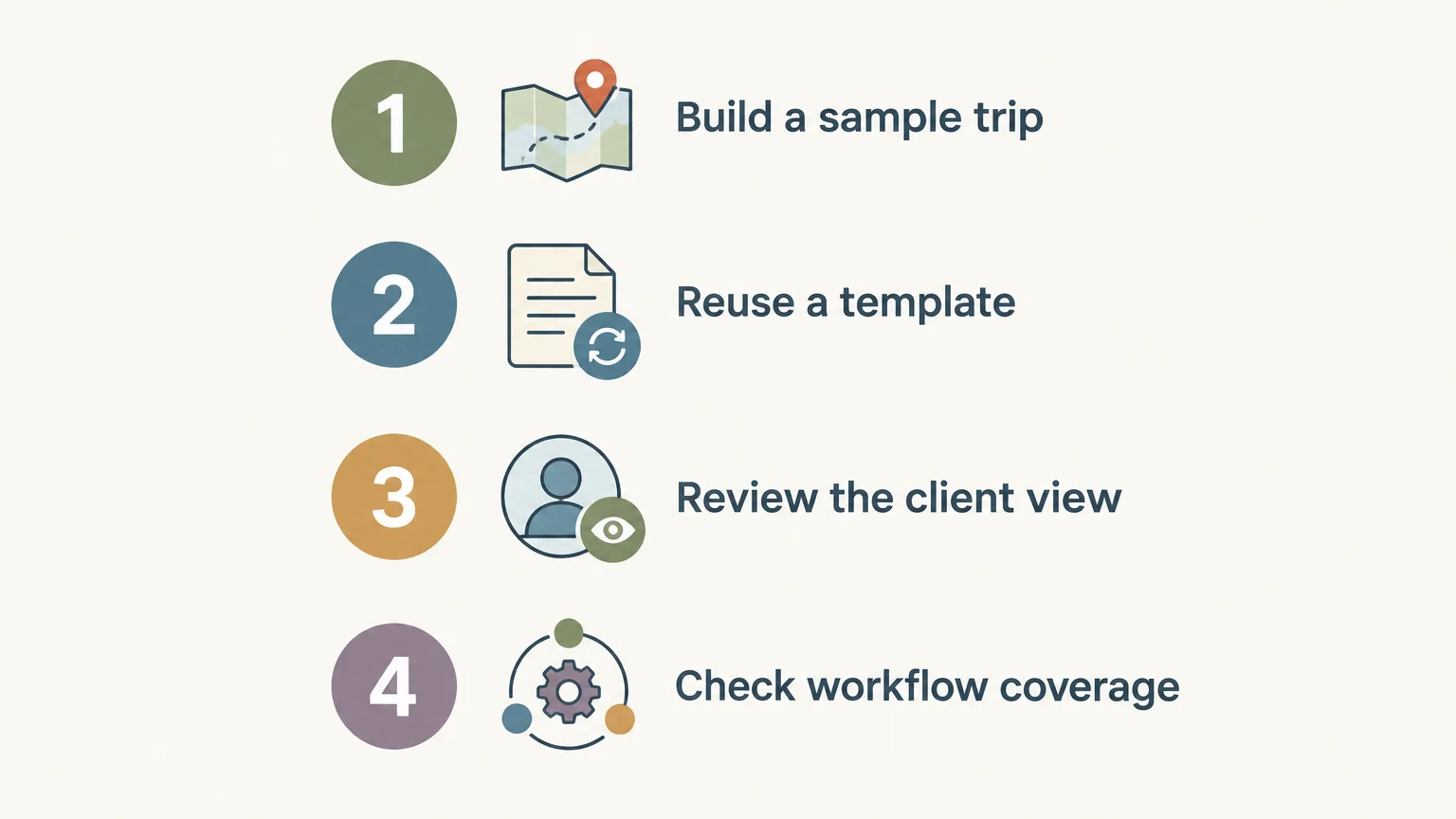
Start with a trip your agency actually sells, rather than a polished demonstration itinerary. Recreate a familiar route, add a supplier change, and revise the proposal after a client requests a different pace. This reveals how the software handles routine edits, not just first drafts.
- Build a sample trip. Note how quickly you can create a useful first version and correct the details.
- Reuse a template. Check which content carries over and how easily you tailor it to a new traveler.
- Review the client view. Open the shared itinerary on a phone and test whether key details are easy to find.
- Check workflow coverage. Identify which steps still require separate tools, duplicate entry, or manual follow-up.
Adoption varies across advisor segments. In its 2026 river cruising outlook, Travel Market Report recorded Tern at 7% in a survey question about itinerary-building and trip-management platforms; 43% of surveyed advisors said they used no such platform. These figures describe that survey’s river-cruise context, not the entire travel-advisor market. The 2026 survey is a reminder to measure fit against your own current process.
When is an itinerary builder only part of the answer?
If your main need is creating and sharing trip proposals, focus your evaluation on itinerary content, presentation, and client communication. If you also want to manage budgets, pricing, CRM follow-up, supplier information, bookings, invoicing, and financial tracking, assess how those steps work together. The difference is not simply the number of features, but whether information has to be re-entered as a trip moves through your agency.
AI features also deserve a practical test, rather than an assumption that every traveler wants automated suggestions. A 2026 Canadian travel report found that 17% of respondents had used AI tools for leisure travel planning and management, compared with 10% in 2025. That consumer finding does not measure agency software adoption, but it supports checking whether AI output is useful, editable, and appropriate for your clients. The Canadian travel report offers context, not a forecast for every market.
Agencies seeking a connected production and operations workspace can compare those requirements with our itinerary software for travel agencies. Our platform brings itinerary design together with budgeting, proposals, supplier management, CRM, and financial workflows. We have operated since 2018 and support more than 600 agencies in over 70 countries, giving teams an established option when their needs extend beyond proposal creation.
Choose software around the work you need to manage
Tern brings itinerary creation, branded proposals, reusable content, and client updates into an advisor-focused workflow. To judge whether it suits your agency, test a representative trip from draft to client review and list the operational tasks that remain outside the process. Choose based on the complete workflow your team needs, not the appearance of a sample itinerary alone.
Connect itinerary creation with agency operations
When your requirements include more than itinerary design, compare how each system handles pricing, proposals, supplier details, client follow-up, and financial work. A connected process can give your team clearer ownership of trip information as a request develops into a confirmed journey.
Our platform supports travel agencies, tour operators, DMCs, and MICE teams with itinerary creation, budgeting, branded proposals, CRM, supplier management, and financial tracking. Explore our itinerary-building tool to see how those workflows can fit together, then request a demonstration using your agency’s own use case.
Frequently Asked Questions
What is Tern’s itinerary builder used for?
It helps travel advisors create itineraries and client proposals, organize travel content, and share trip details. Its suitability depends on how well those capabilities match your agency’s workflow.
Does Tern support AI-assisted itinerary creation?
Tern’s product materials describe AI-assisted itinerary drafting and hotel summaries. Review the results against accurate supplier information and your client’s preferences before sharing.
Can advisors reuse itinerary content?
Tern describes reusable templates and a library for hotel and vendor content. Test whether your team can organize and adapt its own frequently used material.
How should an agency evaluate itinerary software?
Build a sample trip, revise it after a client change, and review the shared version on a phone. Also identify which steps, such as pricing or invoicing, still require separate systems.
What if an agency needs more than itinerary creation?
Compare platforms based on the connected workflows you need, including budgeting, CRM, supplier management, and financial tracking. Our platform combines itinerary work with those broader travel operations.


Join Ezus today
Request a demo today and discover how our software can help you reach new heights.