



Summary: The strongest travel agency software in 2026 centralizes quoting, itineraries, bookings, CRM, and invoicing in one platform. The right choice depends on your model: solo advisors favor proposal tools, while DMCs and tour operators need end-to-end workflow control. This comparison ranks ten platforms by features, pricing, and ideal use case.
Roughly 91% of travel technology companies increased their investment in digital tools and infrastructure, a signal that manual spreadsheets and disconnected inboxes no longer scale. If you still juggle Word documents, PDFs, and email threads to build a single trip, you are losing hours that competitors reinvest into selling. Choosing the right platform from the many travel agency software solutions on the market is now a strategic decision, not an administrative one. To make it easier, our best travel agency software comparison (2026) lays out the criteria that matter most.
The stakes are rising fast. The travel technologies market was estimated at USD 11.01 billion in 2025 and is expected to reach USD 11.65 billion in 2026. As buyer expectations climb, agencies that select a well-fitted tool gain a measurable advantage in speed, margin control, and client experience.
What travel agency software actually does in 2026
Travel agency software is the operational backbone of a modern travel business. It replaces the patchwork of emails, spreadsheets, and manual documents by connecting booking sources, internal workflows, client communication, and trip delivery in one place. When buyers today search for the top 10 travel agency software options, they expect a platform to handle itinerary building, document automation, pricing, real-time communication, and invoicing from a single login.
Why does this matter now? Traveler behavior has shifted decisively toward digital-first service. In one industry analysis, 75% of users preferred mobile-first experiences while 55% expected personalized offers. Meeting those expectations by hand is no longer realistic. A capable travel management platform automates the repetitive parts of trip building so your team can focus on advising and closing.
The financial context reinforces the point. The travel management software market alone grew to USD 11.38 billion in 2026, up from USD 10.28 billion in 2025. Investment is flowing toward automation, and agencies that lag on tooling feel it in slower response times and thinner margins.

How to compare the leading platforms
Before ranking tools, define what your business needs. A solo advisor selling packaged trips has different priorities than a destination management company running requests through invoicing. Use these criteria to filter any shortlist:
If your priority is operational depth from request to payment, review our best travel agency back office software (2026) to understand where accounting and workflow automation intersect.
The top 10 travel agency software platforms
The list below spans proposal tools, full operator platforms, and CRM-led systems. Each entry states plainly who it fits best, because no single product is right for every model.
1. Ezus
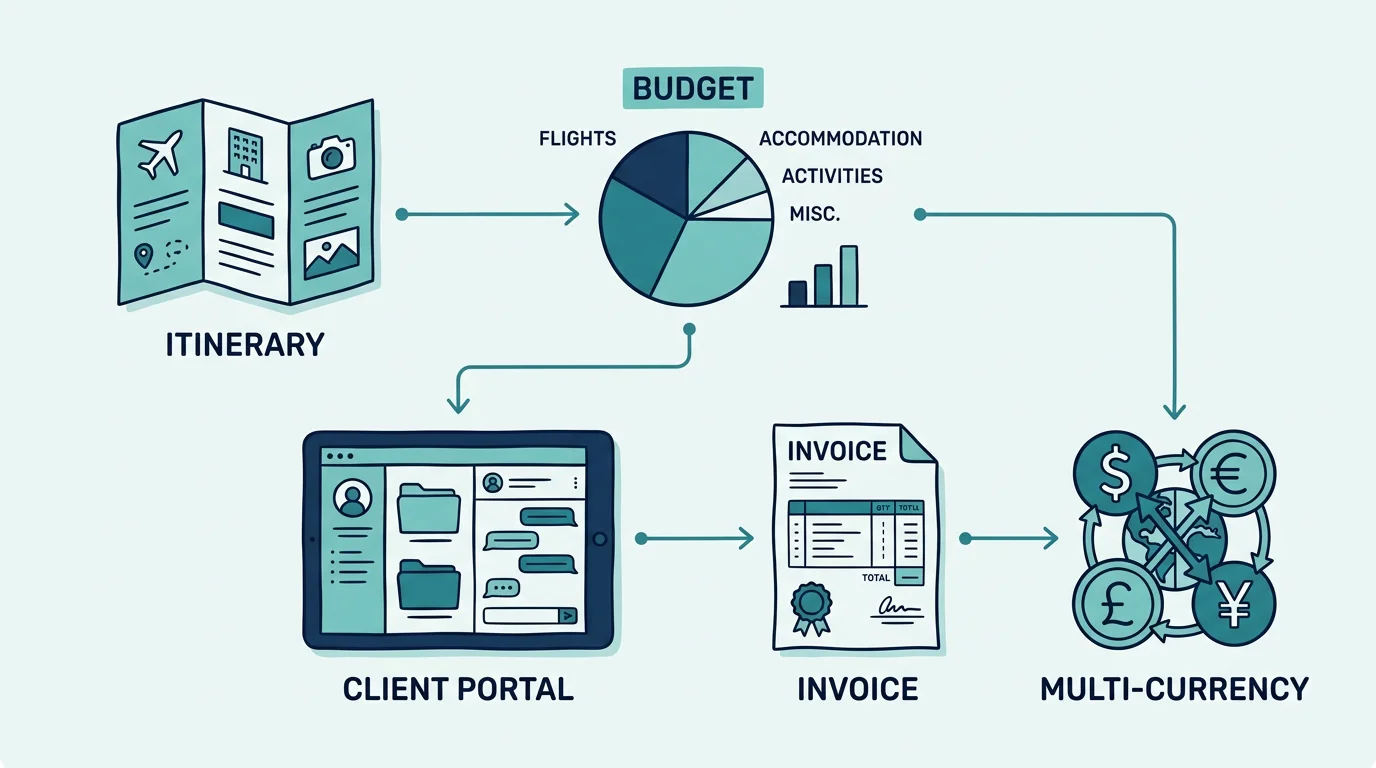
We built our platform to run a DMC or travel agency end to end, from request to invoice. You automate custom itineraries, budgets, and sales documents in minutes, then share polished, on-brand proposals through a personalized client portal for faster reviews and approvals. With real-time budget visibility, margin alerts, and support for multi-currency, multi-language, and multi-brand operations, you protect profits while cutting formatting time. Trusted by more than 600 agencies, our approach is designed to help you save time on every quote, whether you run a small team or a growing operation.
2. Travefy
Travefy focuses on the client-facing experience for solo advisors and host-agency agents, especially in North America. It offers a drag-and-drop itinerary builder, a traveler mobile app, and proposal and e-sign tools. It is well suited to advisors selling cruises, packages, and FIT, though it offers limited vendor rate management for bespoke ground operations.
3. Tourwriter
Tourwriter is a New Zealand tour operator tool centered on the itinerary builder. It provides a supplier database with contracted rates, document generation, and GDS integrations. It fits operators building bespoke multi-day trips such as custom safaris and honeymoons, with less emphasis on lead capture and marketing.
4. Lemax
Lemax offers an end-to-end operator platform combining CRM, booking, contracting, and accounting, with automatic price and profitability calculations. It is oriented toward established tour operators and DMCs running large volumes of multi-day packages, and typically carries longer implementation timelines.
5. Axus Travel App
Axus is known in the luxury travel segment for granular detail and rich media itineraries. It integrates with consortia networks used by high-end advisors. It provides a polished output, though it offers a steeper learning curve than lighter proposal tools.
6. WeTravel
WeTravel combines a booking and payment platform for group tours, retreats, and educational travel. It supports branded trip pages, per-traveler payment plans, and roster management. It is best paired with a dedicated CRM, as it provides limited sales pipeline and supplier management.
7. TravelJoy
TravelJoy targets small agencies with a CRM-first approach, client forms, and basic itinerary tools. It focuses on organizing communication and payments for advisors who value simplicity over deep operational features.
8. HubSpot CRM
HubSpot is a general CRM often selected by agencies that lean on email marketing and inbound funnels. It offers a useful free tier and strong automation, but it has no native itinerary builder or vendor rate library, so travel workflows require add-ons or custom objects.
9. Bókun
Bókun, from Tripadvisor, is an all-in-one booking platform for tour and activity providers. It covers inventory, pricing, and a customer-facing widget, with a large reseller network. It is oriented toward experiential travel rather than complex custom trip design.
10. Zoho CRM
Zoho CRM is a highly customizable generic platform that can be shaped into a travel CRM with custom modules and workflows. It offers strong value, though building travel-specific processes requires internal resources or a partner and a longer setup.
Comparison at a glance
The table below summarizes fit and core strengths. Use it to narrow your shortlist to two or three platforms for a hands-on trial.
Only platforms built around a full request-to-invoice workflow expose margins as you build a quote. That capability is central to protecting profit on custom trips.
Why end-to-end workflow control is the deciding factor
Most comparisons focus on features in isolation: does it build itineraries, does it track commissions, does it connect to suppliers? Those questions matter, but the strategic question is whether every step, from the first request to the paid invoice, lives in one connected system. Fragmented tools create version-control chaos, duplicated data entry, and revenue leakage.
The market is moving in this direction for a reason. Growth is being driven by the adoption of SaaS-based models and artificial intelligence, both of which reward centralization over point solutions. When your costs, markups, and margins update live as you assemble a proposal, you make confident pricing decisions instead of discovering thin margins after the trip is sold.
This is where we position our platform. By turning requests into paid trips inside a single workflow, with document automation and a branded client portal, you reduce handoffs and respond to inquiries in minutes rather than days. That operational control, more than any single feature, is what separates a tool that scales from one you outgrow.
Choosing the right fit for your agency
There is no universal winner among the leading travel agency software platforms; there is only the right fit for your model. Solo advisors selling packaged trips are well served by proposal-first tools, while DMCs and tour operators managing complex, multi-supplier itineraries need end-to-end control over quoting, margins, and invoicing. Start by defining your workflow, shortlist two or three platforms against the criteria above, and test each one with a real trip before committing. The correct choice pays for itself in reclaimed hours and protected margins.
Take action with Ezus
If your team still moves between spreadsheets, documents, and inboxes to build a single trip, the cost is measured in lost hours and eroded margins. You deserve a system that keeps quoting, itineraries, client approvals, and invoicing in one connected place, so every request moves smoothly toward a paid trip.
With our all-in-one travel agency platform, you automate itineraries and budgets, share on-brand proposals through a personalized client portal, and track costs and margins in real time with built-in alerts. Designed for DMCs, agencies, and tour operators managing multi-currency, multi-language, and multi-brand operations, it is built to become your everyday companion within days of onboarding.
Frequently Asked Questions
What is travel agency software?
Travel agency software is a platform that centralizes the operational side of a travel business, including itinerary building, quoting, CRM, bookings, and invoicing. It replaces disconnected spreadsheets and documents with a single connected system. This reduces manual work and improves both speed and accuracy.
What is the best travel agency software for a DMC?
Destination management companies benefit most from platforms built for the full request-to-invoice workflow, with document automation, supplier management, and real-time margin visibility. Our platform was designed specifically for this model, supporting multi-currency, multi-language, and multi-brand operations. This lets you manage complex, multi-supplier trips without version-control issues.
How much does travel agency software cost in 2026?
Pricing varies widely by model, from entry-level proposal tools charging tens of dollars per user monthly to enterprise operator platforms quoted on request. Costs depend on team size, modules, and integrations. Always test a platform through a trial or demo before committing to confirm the fit.
Do I need travel-specific software or a general CRM?
General CRMs offer strong marketing and automation, but they lack native itinerary builders and vendor rate libraries. Adapting them for travel usually requires add-ons, custom objects, and additional setup time. Most small and mid-sized agencies are better served by a travel-specific platform from the start.
Can travel agency software help protect my profit margins?
Yes. Platforms with real-time budget and margin visibility let you see costs and markups as you build a quote, rather than discovering thin margins after a sale. Built-in margin alerts help prevent revenue leakage on custom trips.
.jpeg)

Join Ezus today
Request a demo today and discover how our software can help you reach new heights.







.avif)


