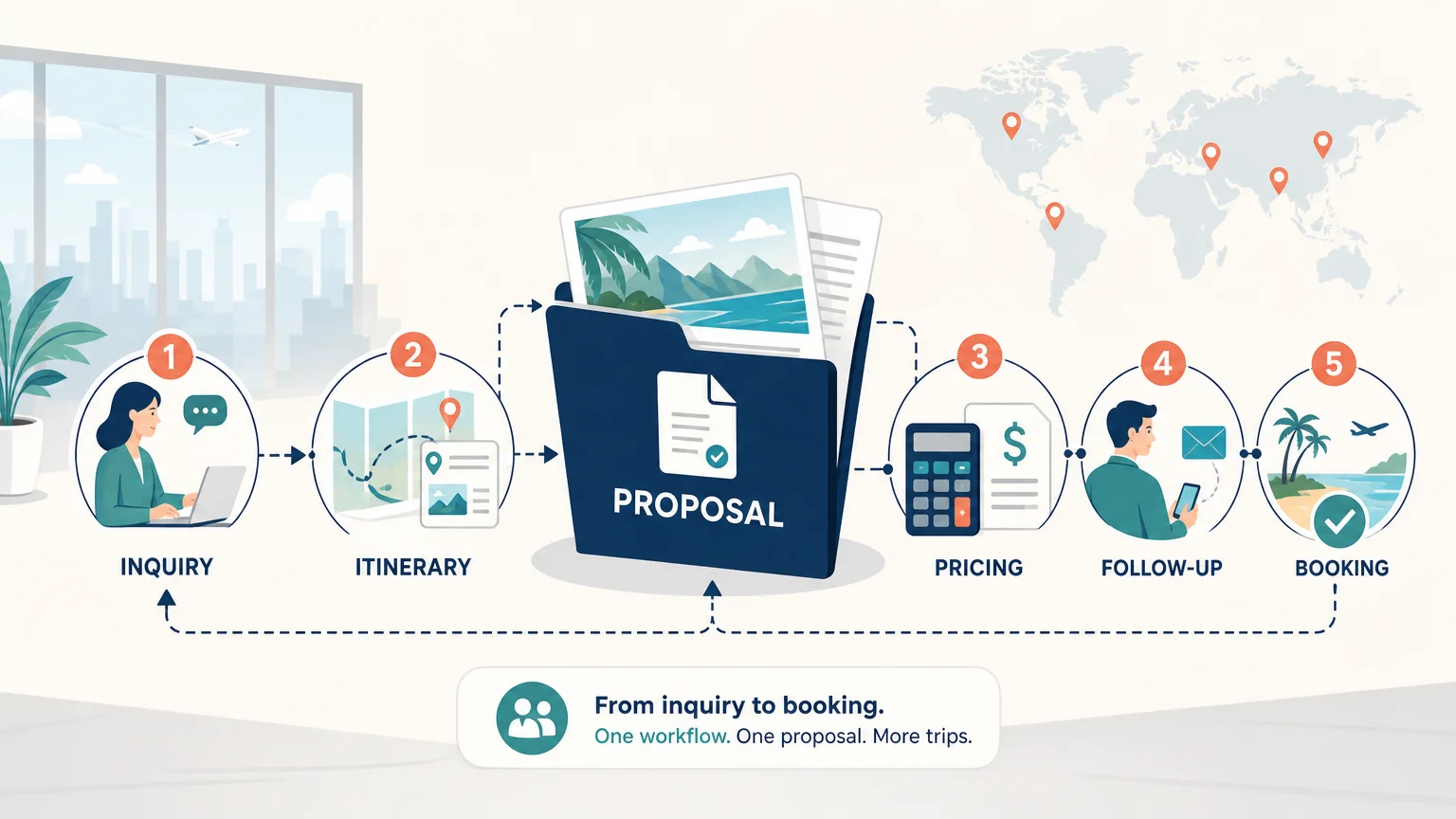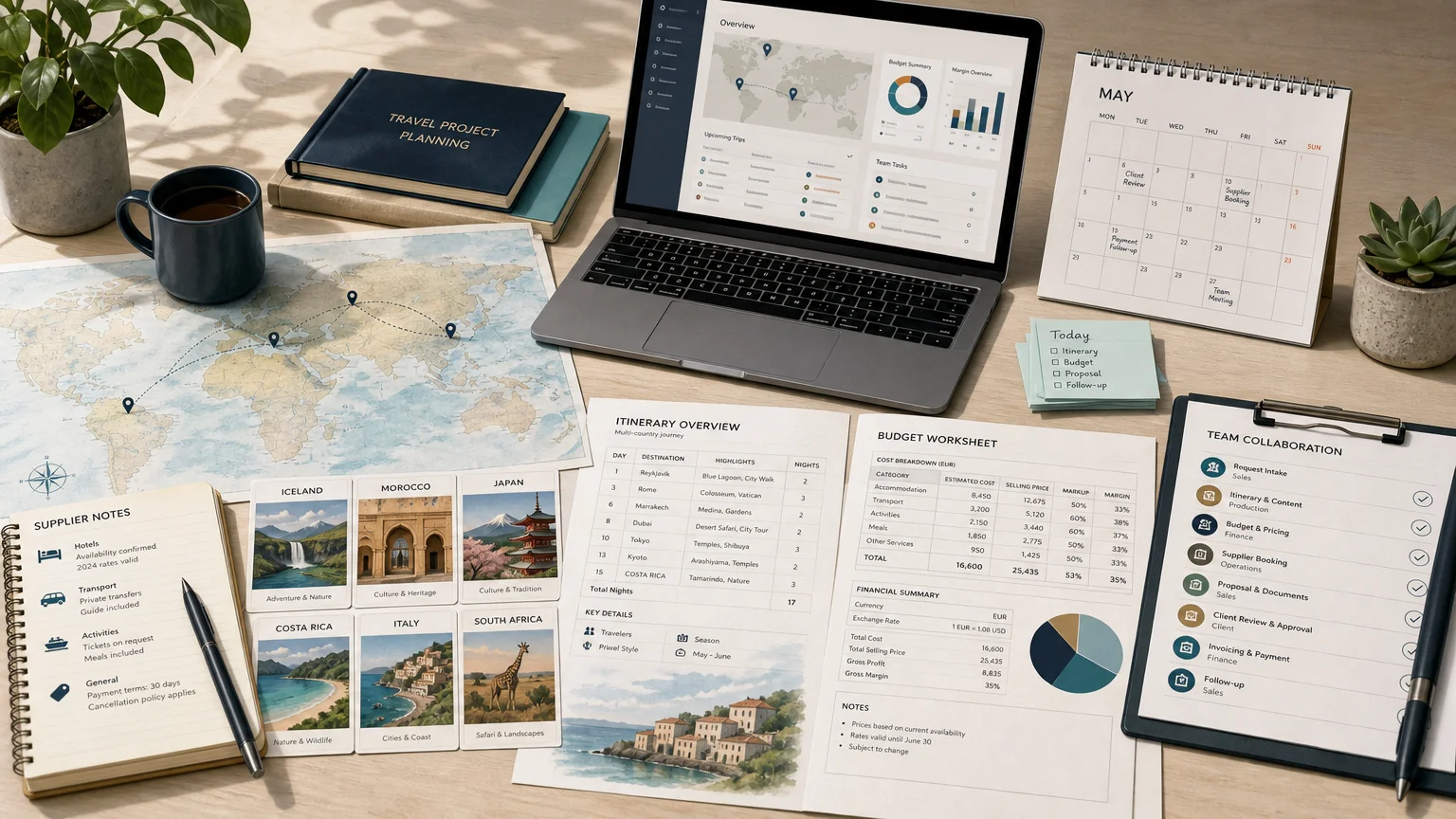
Summary: Group and MICE travel software should connect itinerary design, group information, supplier coordination, budgeting, approvals, payments, and reporting in one controlled workflow. The right platform helps agencies respond faster, reuse proven programs, protect margins, and collaborate across sales, production, finance, and operations without relying on disconnected spreadsheets and inboxes.
A successful group program depends on more than attractive itineraries. It requires accurate participant information, coordinated suppliers, controlled pricing, polished proposals, and reliable communication. If you are evaluating group and MICE travel software, our MICE travel software resources can help you connect those requirements to a practical agency workflow.
Demand also makes operational control increasingly important. The U.S. Travel Association’s 2026 group travel research puts business event RFP volume at 109% of 2019 levels, while its findings indicate strong interest in in-person meetings and group travel. That environment rewards agencies that can build, price, revise, and present complex programs without unnecessary manual work.
What should group and MICE travel software cover?
Group and MICE programs combine travel planning with event coordination. A typical project may include several destinations, multiple hotels, transfers, activities, meeting spaces, meals, excursions, special requests, and different participant categories. The software therefore needs to manage more than a simple itinerary or booking record.
At a minimum, evaluate whether the platform can support the complete journey from request intake to financial follow-up. The most useful capabilities usually include:
The key question is not whether a platform has a long feature list. It is whether the functions use consistent project data. When a change to participant numbers, accommodation, or a service affects the budget and proposal, the team should not have to rebuild the same information in several systems.
Why a connected workflow matters more in 2026
Consider a corporate incentive trip with 120 participants, three hotels, staggered arrivals, several transfers, and a gala dinner. A small change in arrival times can affect transport, room allocations, meal schedules, supplier confirmations, client documents, and the total budget. If each element sits in a different file, the risk of outdated information increases quickly.
This challenge is not limited to MICE agencies. The 2026 corporate travel research from Skift and Navan identifies group booking as a largely manual process for many organizations, with 57% still relying on a staff member to handle it. The same report says 90% of business travelers view business travel as essential or necessary.
For agencies, this creates a clear operational implication. Demand for business travel and group programs can coexist with inefficient internal processes. A connected platform can reduce repetitive entry, improve version control, and give sales, production, finance, and operations access to the same project information.
Automation does not remove the need for professional judgment. It gives teams more time to negotiate with suppliers, refine the experience, manage exceptions, and maintain client relationships. The strongest use of automation is often practical rather than dramatic, such as generating a revised proposal, updating pricing, sending a follow-up, or reusing a proven project structure.
Which capabilities should you compare first?
When reviewing platforms, begin with the workflow that creates the most friction today. For some agencies, it is proposal production. For others, it is supplier follow-up, margin visibility, participant coordination, or the handoff between sales and operations.
There is no universal software configuration for every MICE business. A DMC may prioritize supplier and destination data, while a corporate event specialist may need more participant coordination and reporting. The right choice is the platform that covers your most important workflow without creating new manual steps elsewhere.
How can software improve MICE proposals and collaboration?

Proposal quality affects both conversion and the client’s confidence in the agency. A document that looks polished but contains outdated prices creates risk. A technically accurate proposal that is difficult to review can slow approval. Effective software connects presentation quality with reliable underlying data.
Look for tools that allow the team to create proposals from structured itinerary, product, supplier, and pricing information. The objective is not merely to produce attractive documents. It is to make revisions easier when a client changes the destination, participant count, hotel category, activity, or payment schedule.
Our project-template catalog supports reusable projects containing itineraries, products, content, budgets, and pricing. Teams can organize templates by destination, labels, and dates, then duplicate and adapt them for new requests. This can help agencies preserve successful structures while still tailoring each proposal to the client.
Collaboration also extends beyond the agency. Personalized web portals and interactive presentations can give travelers and corporate clients clearer access to trip information. Online review and approval can reduce email exchanges, while role-based permissions help ensure that sales, finance, and operations see the information relevant to their responsibilities.
For broader context on evaluating tools for this use case, our best group travel software guide focuses on the capabilities agencies should review before selecting a platform.
How should agencies control budgets, pricing, and margins?
Financial control is one of the most important differences between a simple itinerary builder and a broader travel operations platform. MICE programs often involve negotiated rates, commissions, deposits, taxes, markups, currency movements, and changes after the initial quote.
A platform should make the relationship between cost and selling price visible. It should also help teams distinguish projected results from actual results once supplier costs, participant numbers, and final services are confirmed.
The commercial importance of this discipline is reflected in the scale of the sector. One 2026 estimate from Grand View Research values the global MICE market at approximately $1.03 trillion in 2026 and projects continued growth through 2033. Market estimates vary by definition and methodology, but the broader point remains relevant: agencies need reliable controls as program volume and financial complexity increase.
Our platform centralizes costs, markups, pricing, projected margins, actual margins, and financial tracking within the trip workflow. This gives teams a clearer basis for decisions such as changing a hotel category, adjusting a service fee, adding an optional activity, or revising the participant count.
Payment and invoicing should also be evaluated carefully. Confirm whether the software supports customer invoices, supplier payments, payment links, financial status, and reporting. These functions are especially valuable when operational teams need to understand what has been quoted, approved, booked, invoiced, and collected.
What international and multilingual requirements should you check?
International MICE agencies often manage different currencies, languages, suppliers, brands, and tax practices. A system that works for one destination and one team structure may become restrictive when the agency expands across markets.
Before selecting a platform, ask practical questions. Which currencies can be used in budgets and proposals? Can several brands share the same operational environment? Are user rights configurable by role? Can documents be adapted for different markets? Does the system support multilingual client communication and supplier information?
Our platform supports multi-currency, multilingual, and multi-brand operations. It also provides customizable user rights, multi-account management, automated reports, and integration methods that can connect the workflow with existing CRM, accounting, document, email, or website tools. Availability can depend on the selected plan, so the exact configuration should be confirmed during the buying process.
Data protection and hosting should receive the same attention as operational features. Ask where data is hosted, how access is controlled, how backups are managed, and how data can be exported when required. These questions are particularly important when the agency serves clients in several jurisdictions.
How should you evaluate implementation, support, and pricing?
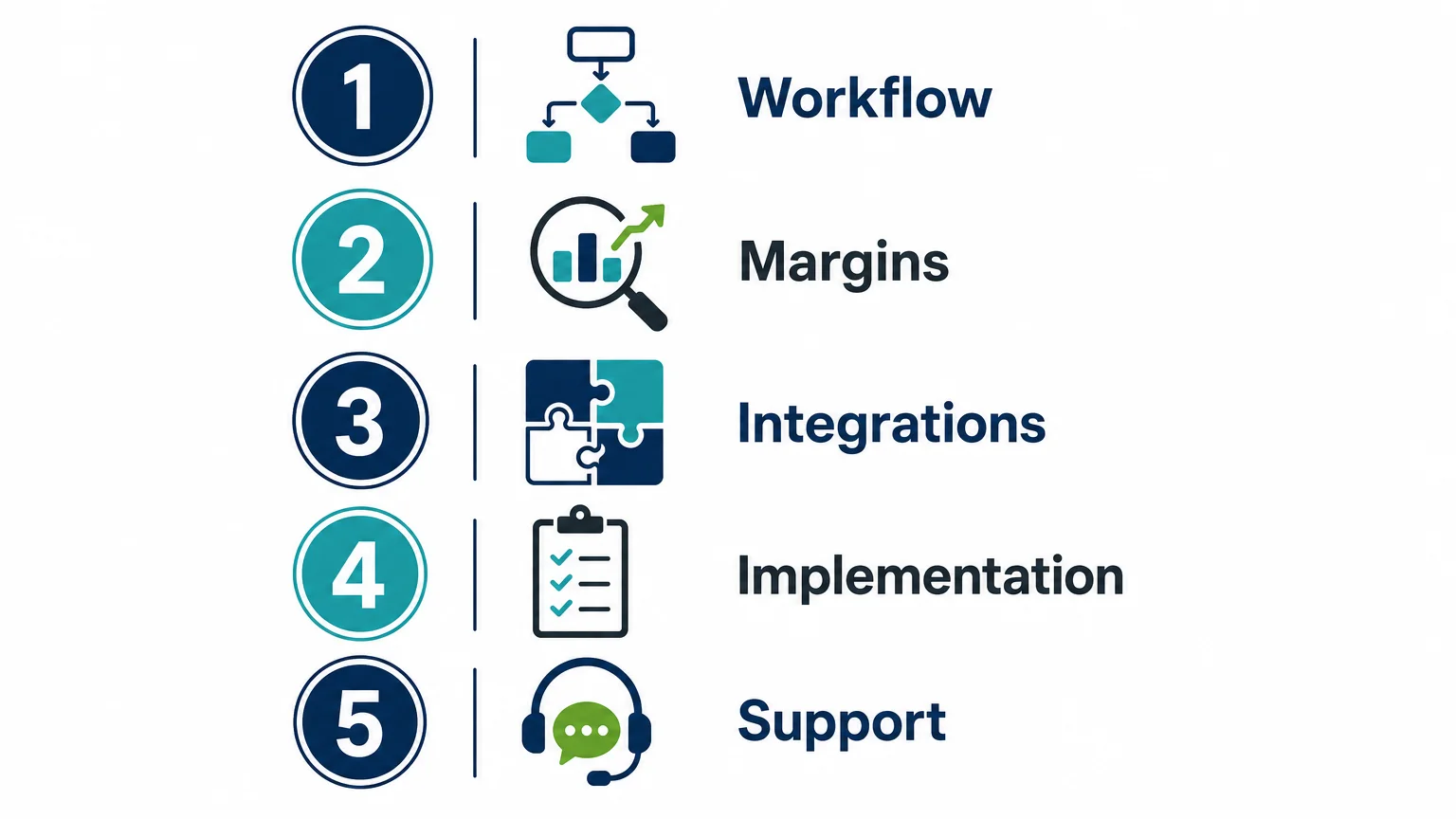
Software selection should include the transition to daily use. A platform may fit the functional requirements but still create disruption if data migration, configuration, training, and support are unclear.
For 2026 budgeting, our published Professional plan is listed at €75 per user per month when billed annually, while Premium is listed at €100 per user per month when billed annually. Displayed subscription prices exclude tax, subscriptions renew annually, and added users are billed pro rata. Enterprise pricing is available on request from 30 users.
The one-time Onboarding Pack is mandatory at subscription start and is listed at €1,990 excluding tax. It includes configuration, training, onboarding resources, and implementation guidance. Additional imports, training, customizations, and integrations may be priced separately, so agencies should evaluate the total implementation cost rather than comparing subscription prices alone.
Our incentive event planning resource can also help teams translate an event concept into a structured program with clearer operational requirements before a software demonstration.
Where does Ezus fit for group and MICE agencies?
Ezus is designed for travel agencies, DMCs, tour operators, tailor-made travel businesses, and MICE agencies that need one environment for production, sales, operations, finance, collaboration, and client communication.
For group and MICE teams, the relevant scope includes custom itineraries, dynamic budgeting, branded proposals, traveler portals, supplier and destination catalogs, group management, CRM, supplier booking management, invoicing, payments, financial tracking, templates, and role-based collaboration.
The platform has operated since 2018 and supports travel businesses across international markets. Its implementation model includes onboarding, configuration, training, support, data migration options, and integration guidance. That combination is useful for agencies that want to replace fragmented Excel, Word, inbox, and document workflows with a shared operating system.
It is still important to validate fit through a demonstration. The most useful demonstration is based on your own workflow, such as an incentive trip, conference program, corporate retreat, or multi-country group request. This allows your team to assess the practical effort required to build a proposal, revise pricing, coordinate suppliers, obtain approval, and track the financial outcome.
For a wider explanation of the category, our complete guide to MICE tourism covers the main program types, stakeholders, and operational considerations.
Choosing the right group and MICE travel software
The strongest choice is not necessarily the platform with the longest feature list. It is the system that gives your team reliable project data, clear financial visibility, reusable structures, professional proposals, supplier control, and a practical path to implementation. Evaluate it with a realistic MICE scenario, confirm the total cost, and make sure the software supports the way your agency sells and delivers group travel. A well-connected workflow can help your team protect margins while giving clients a more responsive and consistent experience.
Bring your MICE workflow into one system
When group programs involve multiple suppliers, revisions, currencies, approvals, and financial stages, disconnected tools make every change harder to control. A centralized workspace can help your teams coordinate production, sales, operations, finance, and client communication more efficiently.
Our cloud-based platform supports itinerary design, dynamic budgeting, branded proposals, traveler portals, supplier management, CRM, invoicing, payments, templates, and financial tracking for travel agencies, DMCs, tour operators, and MICE teams. DMC and MICE travel software can be configured around your workflows, with onboarding, training, support, and integration options available.
Frequently Asked Questions
What is group and MICE travel software?
Group and MICE travel software helps agencies plan, price, sell, coordinate, and financially manage group programs, incentive trips, meetings, conferences, and exhibitions. It typically combines itinerary creation, supplier management, participant information, budgeting, proposals, approvals, invoicing, and reporting.
Which features matter most for MICE agencies?
The most important features usually include multi-day itinerary design, group project management, supplier coordination, budget and margin visibility, client approvals, CRM, invoicing, payment tracking, templates, and reporting. International agencies may also need multilingual, multi-currency, multi-brand, and role-based access capabilities.
Can travel agencies use the same platform for FIT, groups, and MICE?
Some travel operations platforms are designed to support several trip types within one environment. Ezus supports tailor-made travel, FIT, groups, and MICE workflows, although each agency should confirm that the exact configuration matches its participant, supplier, event, and reporting requirements.
How much does MICE travel software cost?
Pricing varies according to users, features, implementation, integrations, and support. For 2026 budgeting, Ezus lists Professional at €75 per user per month and Premium at €100 per user per month when billed annually, excluding tax, with a mandatory one-time Onboarding Pack listed at €1,990 excluding tax.
How should an agency test software before buying?
Use a realistic project rather than a generic demonstration. Test a complex group or incentive program from initial request through proposal, revision, supplier coordination, approval, invoicing, payment, and margin reporting, then review migration, training, support, permissions, and export requirements.
.jpeg)

Join Ezus today
Request a demo today and discover how our software can help you reach new heights.