


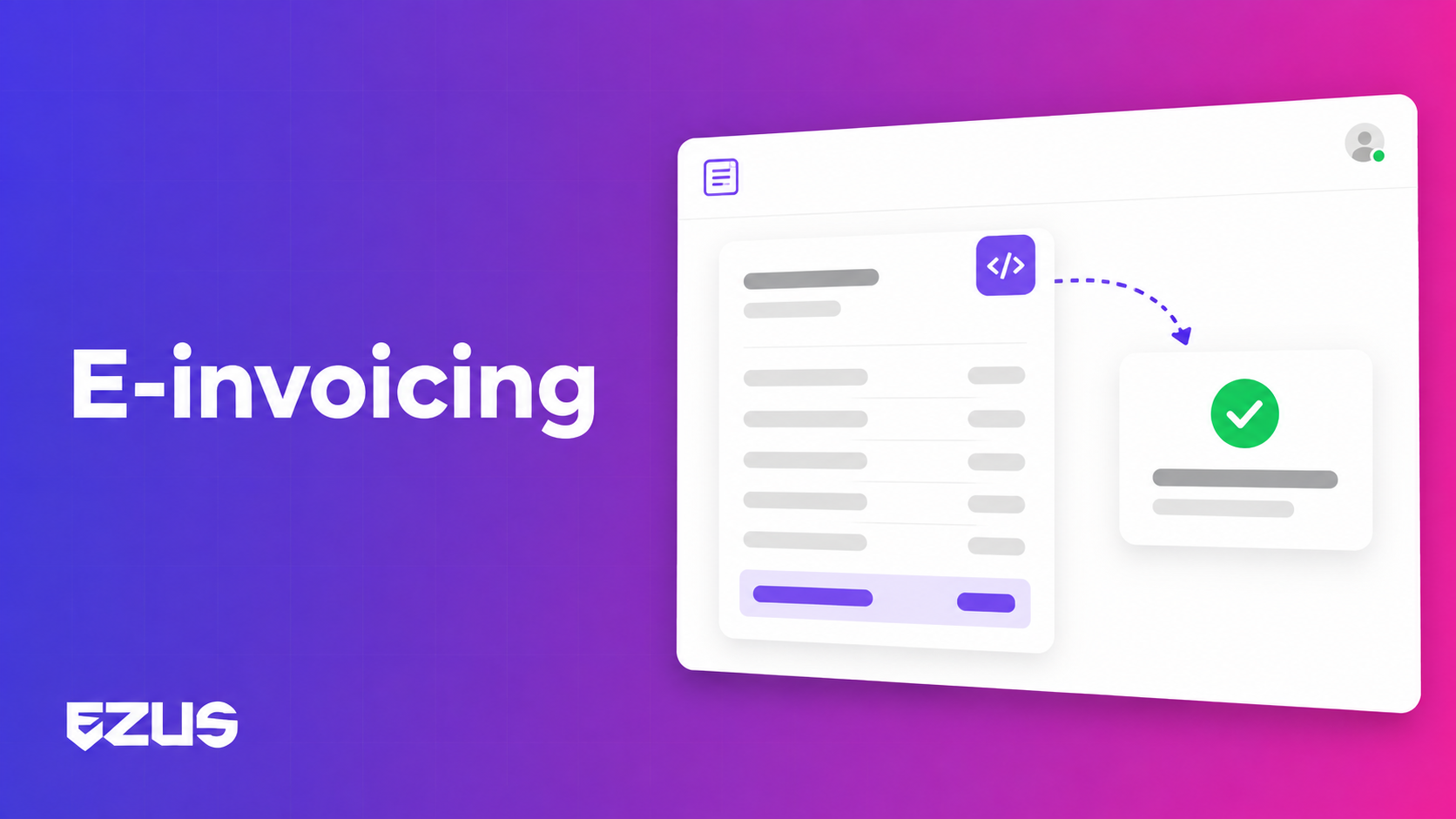
For years, sending an invoice meant generating a PDF and attaching it to an email.
That habit is disappearing. Across Europe, invoices between businesses are moving to structured formats that travel through certified platforms, country by country. 🧾
Here is what the reform changes for a travel agency, and what Ezus does, or does not do, for you.
The problem: much more than a format change
The reform does not only affect the file. It changes how your invoices flow and what you have to report.
- A PDF sent by email is no longer enough. B2B invoices must be issued and received in a structured format (Factur-X, UBL or CII).
- A certified platform becomes mandatory. In France, these are the approved platforms (PA), formerly known as partner dematerialisation platforms.
- The status of each invoice must be reported back: received, accepted, rejected, paid.
- Sales to private customers and international sales fall under e-reporting: their data is sent to the tax authorities in near real time.
⚠️ In France, a penalty of 15 € per non-compliant invoice is planned.
The timeline: already under way in France
The French reform applies in two stages:
- Receiving, since 1 September 2026: all VAT-registered businesses must be able to receive electronic invoices. This covers your supplier invoices, whatever your size.
- Issuing: since 1 September 2026 for large and mid-sized companies, and from 1 September 2027 for SMEs, very small businesses and micro-enterprises. This covers your customer invoices.
Elsewhere, dates vary widely: Italy has required it since 2019, Belgium and Croatia since January 2026, Poland since April 2026. Germany moves to mandatory issuing in January 2028, as does Portugal, and Spain in October 2028.
What Ezus handles 🔧
Ezus is not a certified platform (PA in France). Its role: preparing your sales and purchase invoices with the right level of information, and making it easy to pass them on to your certified platform, which takes care of compliance, transmission and e-reporting.
Two ways to automate sending
- Via Zapier, no code: you connect Ezus to your certified platform, choose the trigger, map the fields (amounts excluding and including VAT, VAT, client, project, number, dates), test with a real invoice, then switch it on.
- Via the Ezus API, for technical profiles: one route for sales invoices, another for purchase invoices. On the sales side, a field shows whether an invoice is ready for e-invoicing, and a filter leaves out drafts.
Invoices that are easier to route
- Belgium: XML export and a Peppol Status column in your invoicing tables.
- Client VAT number can be displayed in invoice tables and in your exports.
- Editable pro forma invoice reference, to match your own numbering or your ERP's.
A concrete example
👉 An 8-person French agency invoices its trips in Ezus and keeps its accounts in a tool that is also an approved platform (PA).
Before: invoices went out as PDFs by email, then were re-entered or imported by hand on the accounting side.
Now: a Zap sends every finalised Ezus invoice to the PA, which converts it to the regulatory format and transmits it. The agency is ready for September 2027 without changing the way it invoices.
What you gain 🚀
- Your production tool stays the same. You keep invoicing in Ezus.
- Less re-entry between Ezus and accounting. The data flows automatically.
- Purchases are not forgotten. The obligation to receive also covers your supplier invoices, hence a dedicated route.
- You choose your certified platform. Ezus does not impose one on you.
Good to know before you start ℹ️
- Ezus does not transmit your invoices to the tax authorities or to your clients, does not submit your e-reporting data and does not replace your accounting software.
- Do not confuse accounting tool and approved platform. Some tools are both, others transmit via a partner PA: check yours on the official list of the DGFiP, the French tax authority.
- The Ezus API is reserved for Premium and Enterprise plans.
- With a scheduled Zap, set up an anti-duplicate safeguard, and check the mapping of VAT and of amounts excluding and including VAT.
Get ahead instead of catching up
E-invoicing is not optional, and its deadlines are set. The good news: it does not force you to change your production tool.
Your invoices are created in Ezus, your certified platform takes care of the rest. All you need to do is connect the two.
📖 See how to send your Ezus invoices to your certified platform
👉 Book a demo to see how your invoices flow from Ezus to your accounting.
.jpeg)

Join Ezus today
Request a demo today and discover how our software can help you reach new heights.


.jpg)


